


Relationship between the Asthma Control Test (ACT) and other outcomes: a targeted literature review
- PMID: 32245451
- PMCID: PMC7118934
- DOI: 10.1186/s12890-020-1090-5
Relationship between the Asthma Control Test (ACT) and other outcomes: a targeted literature review
Abstract
Background: The Asthma Control Test (ACT) has been used to assess asthma control in both clinical trials and clinical practice. However, the relationships between ACT score and other measures of asthma impact are not fully understood. Here, we evaluate how ACT scores relate to other clinical, patient-reported, or economic asthma outcomes.
Methods: A targeted literature search of online databases and conference abstracts was performed. Data were extracted from articles reporting ACT score alongside one or more of: Asthma Control Questionnaire (ACQ) score; rescue medication use; exacerbations; lung function; health-/asthma-related quality of life (QoL); sleep quality; work and productivity; and healthcare resource use (HRU) and costs.
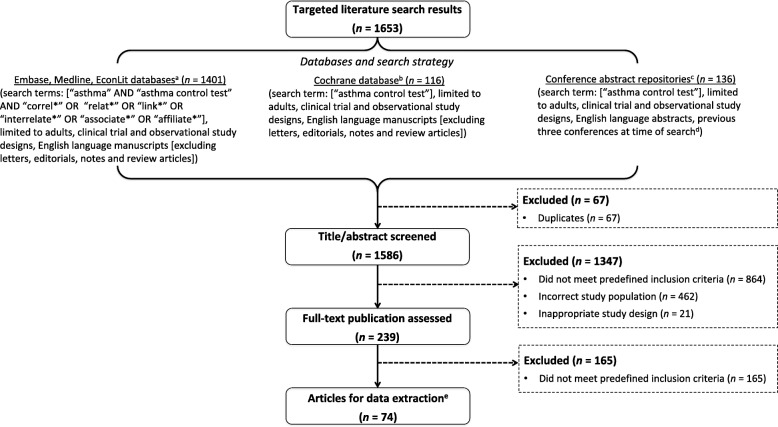
Results: A total of 1653 publications were identified, 74 of which were included in the final analysis. Of these, 69 studies found that improvement in ACT score was related to improvement in outcome(s), either as correlation or by association. The level of evidence for each relationship differed widely between outcomes: substantial evidence was identified for relationships between ACT score and ACQ score, lung function, and asthma-related QoL; moderate evidence was obtained for relationships between ACT score and rescue medication use, exacerbations, sleep quality, and work and productivity; limited evidence was identified for relationships between ACT score and general health-related QoL, HRU, and healthcare costs.
Conclusions: Findings of this review suggest that the ACT is an appropriate measure for overall asthma impact and support its use in clinical trial settings. GlaxoSmithKline plc. study number HO-17-18170.
Keywords: ACT; Asthma Control Test; Exacerbations; Lung function; Quality of life; Rescue medication.
Conflict of interest statement
HS, LN, and AH are employees of/hold stocks in GlaxoSmithKline plc. CA is a paid employee of Pharmerit International, the vendor who conducted the research on behalf of the sponsor. BvD and JB were employees of Pharmerit International at the time of the research. Trademarks are the property of their respective owners.
Figures
References
-
- Global Initiative for Asthma. 2018 GINA report: global strategy for asthma management and prevention 2018. https://ginasthma.org/wp-content/uploads/2019/01/2018-GINA.pdf. Accessed 26 June 2018.
-
- National Heart, Lung, and Blood Institute. Expert panel report 3: guidelines for the diagnosis and management of asthma. 2007. https://www.nhlbi.nih.gov/files/docs/guidelines/asthgdln.pdf. Accessed 26 June 2018.
-
- Adachi M, Goldfrad C, Jacques L, Nishimura Y. Efficacy and safety comparison: fluticasone furoate and fluticasone propionate, after step down from fluticasone furoate/vilanterol in Japanese patients with well-controlled asthma, a randomized trial. Respir Med. 2016;120:78–86. doi: 10.1016/j.rmed.2016.09.018. - DOI - PubMed
Publication types
MeSH terms
LinkOut - more resources
Full Text Sources
Medical
