Review
. 2020 Jul 1;88(1):63-69.
doi: 10.1016/j.biopsych.2020.01.027. Epub 2020 Feb 11.

Modeling Individual Differences in Brain Development

Affiliations
Review

Modeling Individual Differences in Brain Development

Andrik I Becht et al. Biol Psychiatry. .

Abstract

Within the field of developmental cognitive neuroscience, there is an increasing interest in studying individual differences in human brain development in order to predict mental health outcomes. So far, however, most longitudinal neuroimaging studies focus on group-level estimates. In this review, we highlight longitudinal neuroimaging studies that have moved beyond group-level estimates to illustrate the heterogeneity in patterns of brain development. We provide practical methodological recommendations on how longitudinal neuroimaging datasets can be used to understand heterogeneity in human brain development. Finally, we address how taking an individual-differences approach in developmental neuroimaging studies could advance our understanding of why some individuals develop mental health disorders.

Keywords: Adolescence; Heterogeneity; Longitudinal; MRI; Mental health; Neuroimaging.


Figures

Figure 1.
Figure 1.
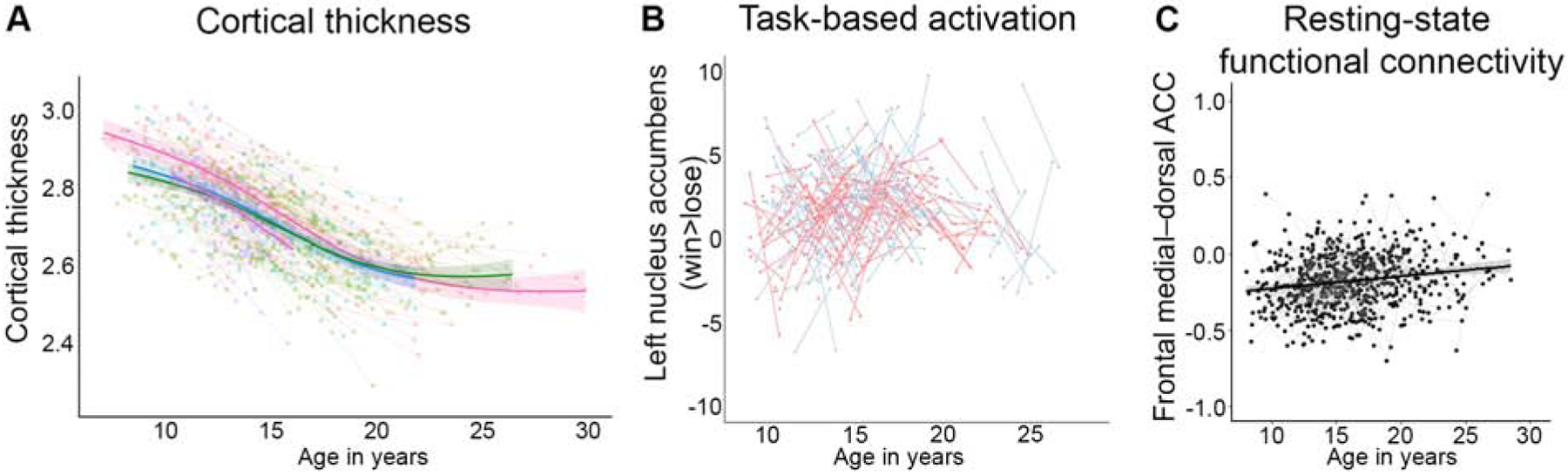
Developmental trajectories and individual differences in brain measures for: (A) Average cortical thickness (adapted from Tamnes et al., 2017); (B) Task-based activation of the left nucleus accumbens (NAcc) during win versus lose conditions (adapted from Braams et al., 2015); and (C) Resting-state functional connectivity between the frontal medial cortex and dorsal anterior cingulate cortex (ACC) (adapted from van Duijvenvoorde et al. 2019). Individual scans are represented by dots in each graph, and each individual is connected by a line. Group level trajectories are visible in bolded lines with shaded 95% confidence intervals for A and C.
Figure 2.
Figure 2.
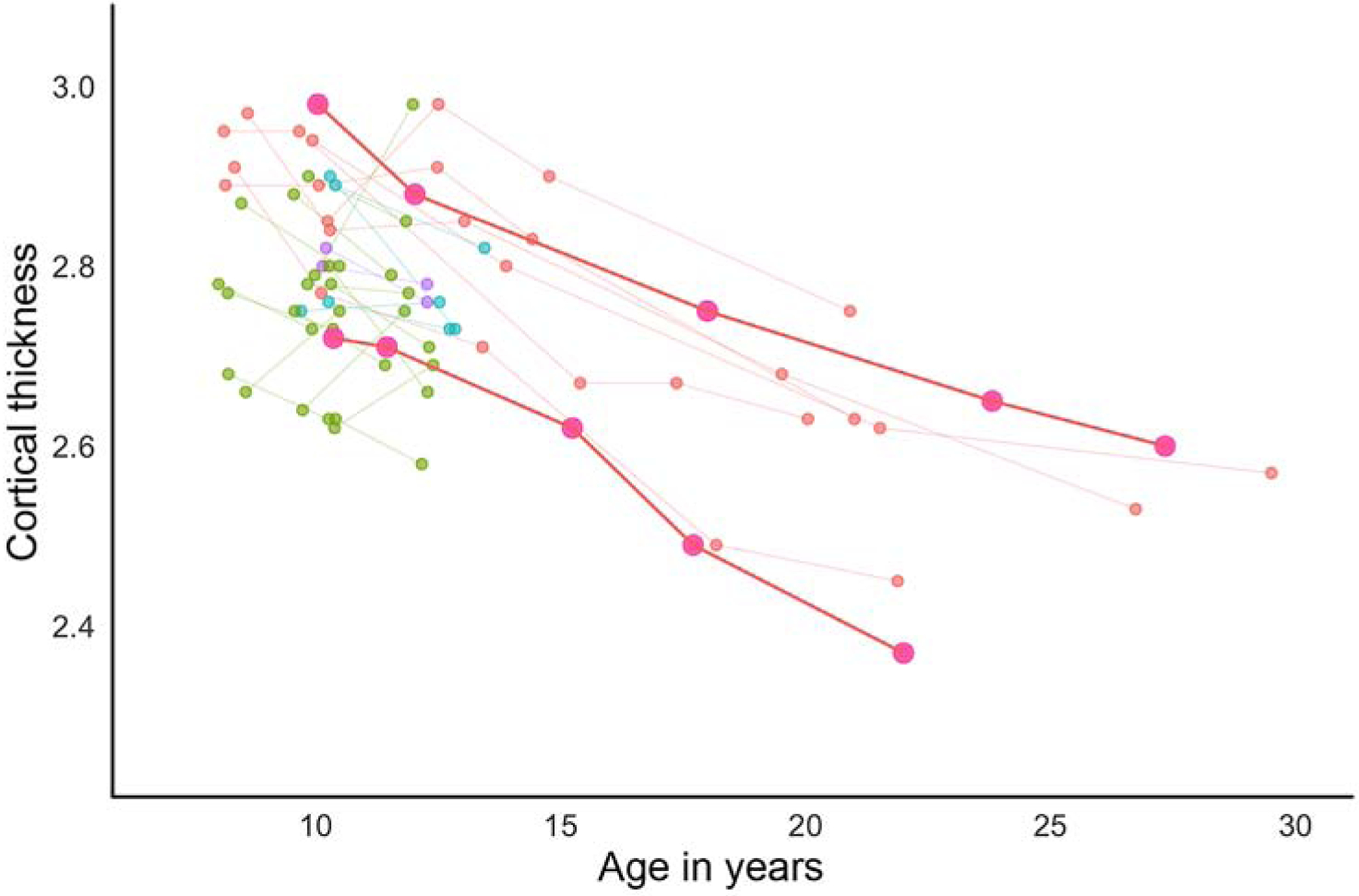
Individual developmental changes for a sample of participants involved in longitudinal MRI studies at age 10 years. In this figure, each scan is represented by one dot and each individual connected by lines. Two individuals are bolded (in pink), demonstrating different average cortical thickness sizes at age 10 years, but continued change in thickness across adolescence and into young adulthood. Figure adapted from data in Tamnes et al., 2017 and presented by (10).
Figure 3.
Figure 3.
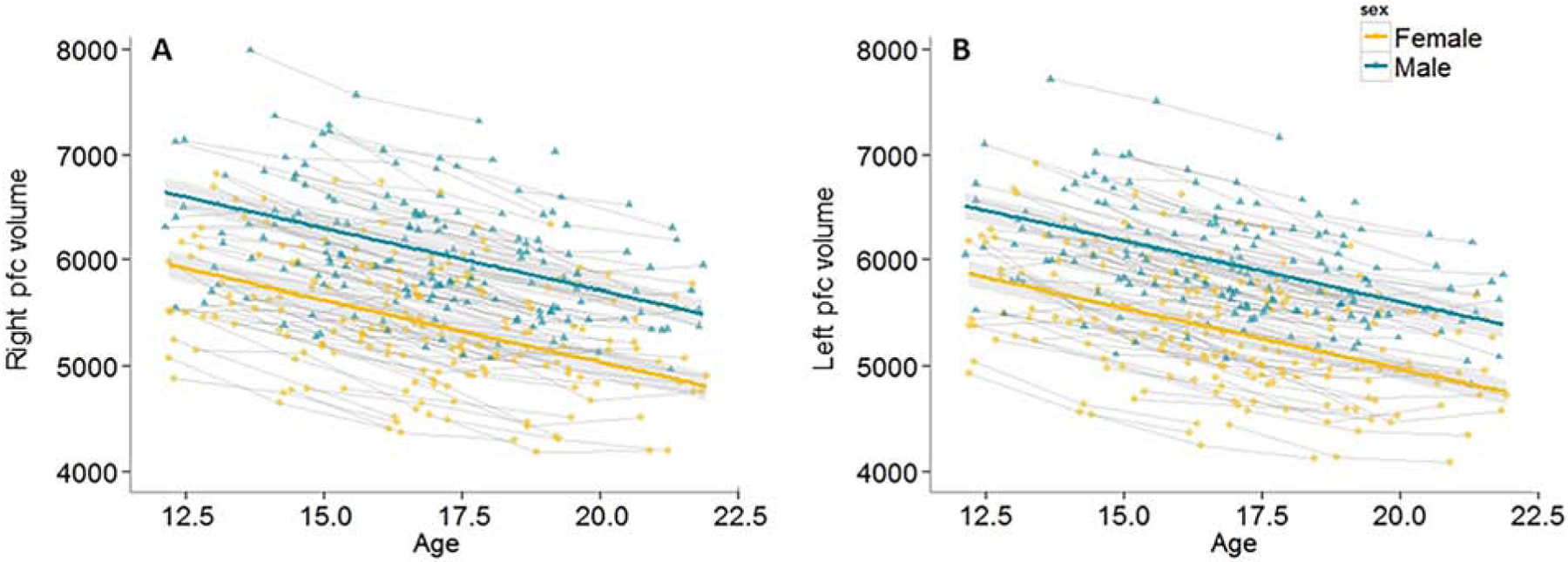
Observed individual volume (in mm3) trajectories and average trajectories for (A) right prefrontal cortical and (B) left prefrontal cortical volume. Shaded areas represent 95% CI. Raw mean scores for prefrontal cortical volume are displayed. Reproduced with permission from Becht et al. (2018).

References

    1. Kessler RC, Amminger GP, Aguilar-Gaxiola S, Alonso J, Lee S, Ustun TB (2007): Age of onset of mental disorders: A review of recent literature. Curr Opin Psychiatry 20: 359–364. - PMC - PubMed
    1. Kessler RC, Berglund P, Demler O, Jin R, Merikangas KR, Walters EE (2005): Lifetime prevalence and age-of-onset distributions of DSM-IV disorders in the National Comorbidity Survey Replication. Arch Gen Psychiatry 62: 593–602. - PubMed
    1. Rosenberg MD, Casey BJ, Holmes AJ (2018): Prediction complements explanation in understanding the developing brain. Nat Commun 9: 589. - PMC - PubMed
    1. Lewis DA, Levitt P (2002): Schizophrenia as a Disorder of Neurodevelopment. Annu Rev Neurosci 25: 409–432. - PubMed
    1. Shaw P, Gogtay N, Rapoport J (2010): Childhood psychiatric disorders as anomalies in neurodevelopmental trajectories. Hum Brain Mapp 31: 917–925. - PMC - PubMed

Publication types