. 2020 Apr 3;10(1):5938.
doi: 10.1038/s41598-020-62751-z.

Genomic characterization and outcome of prosthetic joint infections caused by Staphylococcus aureus

Affiliations

Genomic characterization and outcome of prosthetic joint infections caused by Staphylococcus aureus

Peter Wildeman et al. Sci Rep. .

Abstract

Staphylococcus aureus is a commensal colonizing the skin and mucous membranes. It can also act as a pathogen, and is the most common microorganism isolated from prosthetic joint infections (PJIs). The aim of this study was to explore the genomic relatedness between commensal and PJI S. aureus strains as well as microbial traits and host-related risk factors for treatment failure. Whole-genome sequencing (WGS) was performed on S. aureus isolates obtained from PJIs (n = 100) and control isolates from nares (n = 101). Corresponding clinical data for the PJI patients were extracted from medical records. No PJI-specific clusters were found in the WGS phylogeny, and the distribution of the various clonal complexes and prevalence of virulence genes among isolates from PJIs and nares was almost equal. Isolates from patients with treatment success and failure were genetically very similar, while the presence of an antibiotic-resistant phenotype and the use of non-biofilm-active antimicrobial treatment were both associated with failure.In conclusion, commensal and PJI isolates of S. aureus in arthroplasty patients were genetically indistinguishable, suggesting that commensal S. aureus clones are capable of causing PJIs. Furthermore, no association between genetic traits and outcome could be demonstrated, stressing the importance of patient-related factors in the treatment of S. aureus PJIs.


Conflict of interest statement

The authors declare no competing interests.

Figures

Figure 1
Figure 1
Neighbor-joining tree of core genome multilocus sequence typing (cgMLST) loci (n = 1,861) in Staphylococcus aureus isolates (n = 201). The innermost track represents site of collection (prosthetic joint infections in orange and nares in grey) and the outermost track shows clonal complexes (CCs). Five cgMLST complex types (isolates with <25 loci differences) have been marked in red. The scale represents the fraction of core loci differing between the isolates.
Figure 2
Figure 2
Neighbor-joining tree of core genome multilocus sequence typing (cgMLST) loci (n = 1,861) in Staphylococcus aureus isolates from prosthetic joint infections (n = 100). Classification: early postoperative, late acute, and chronic prosthetic joint infection. Eradicated: microbiological eradication of S. aureus infection. Mortality: death within 12 months, dark grey. CC: clonal complex. DAIR: debridement, antibiotics, and retention of the prosthesis. The scale represents the fraction of core loci differing between the isolates.
Figure 3
Figure 3
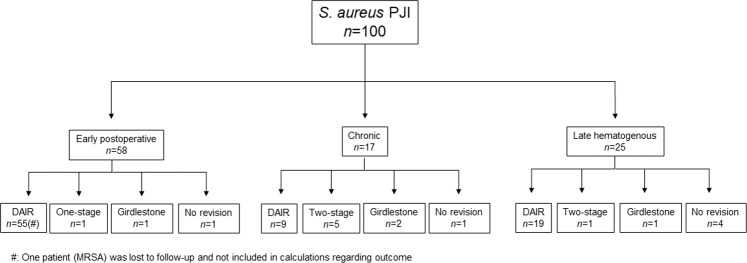
Flowchart of PJI patients regarding classification and primary surgical intervention. (#): One patient (MRSA) was lost to follow-up and not included in the calculations regarding treatment outcome, microbial eradication, and death.

References

    1. Organization for Economic Co-operation and Development Vol. 2018 (2017).
    1. Goldmann O, Medina E. Staphylococcus aureus strategies to evade the host acquired immune response. Int. J. Med. Microbiol. 2018;308:625–630. doi: 10.1016/j.ijmm.2017.09.013. - DOI - PubMed
    1. Ricciardi BF, et al. Staphylococcus aureus Evasion of Host Immunity in the Setting of Prosthetic Joint Infection: Biofilm and Beyond. Curr. Rev. Musculoskelet. Med. 2018;11:389–400. doi: 10.1007/s12178-018-9501-4. - DOI - PMC - PubMed
    1. Kunutsor SK, Whitehouse MR, Blom AW, Beswick AD. Patient-Related Risk Factors for Periprosthetic Joint Infection after Total Joint Arthroplasty: A Systematic Review and Meta-Analysis. PLoS One. 2016;11:e0150866. doi: 10.1371/journal.pone.0150866. - DOI - PMC - PubMed
    1. Tande AJ, Patel R. Prosthetic joint infection. Clin. Microbiol. Rev. 2014;27:302–345. doi: 10.1128/cmr.00111-13. - DOI - PMC - PubMed

Publication types