


Geriatric Screening, Triage Urgency, and 30-Day Mortality in Older Emergency Department Patients
- PMID: 32246476
- PMCID: PMC7497167
- DOI: 10.1111/jgs.16427
Geriatric Screening, Triage Urgency, and 30-Day Mortality in Older Emergency Department Patients
Abstract
Background: Urgency triage in the emergency department (ED) is important for early identification of potentially lethal conditions and extensive resource utilization. However, in older patients, urgency triage systems could be improved by taking geriatric vulnerability into account. We investigated the association of geriatric vulnerability screening in addition to triage urgency levels with 30-day mortality in older ED patients.
Design: Secondary analysis of the observational multicenter Acutely Presenting Older Patient (APOP) study.
Setting: EDs within four Dutch hospitals.
Participants: Consecutive patients, aged 70 years or older, who were prospectively included.
Measurements: Patients were triaged using the Manchester Triage System (MTS). In addition, the APOP screener was used as a geriatric screening tool. The primary outcome was 30-day mortality. Comparison was made between mortality within the geriatric high- and low-risk screened patients in every urgency triage category. We calculated the difference in explained variance of mortality by adding the geriatric screener (APOP) to triage urgency (MTS) by calculating Nagelkerke R2 .
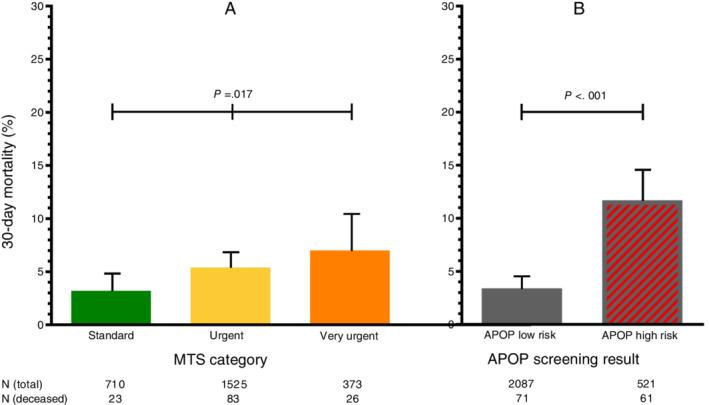
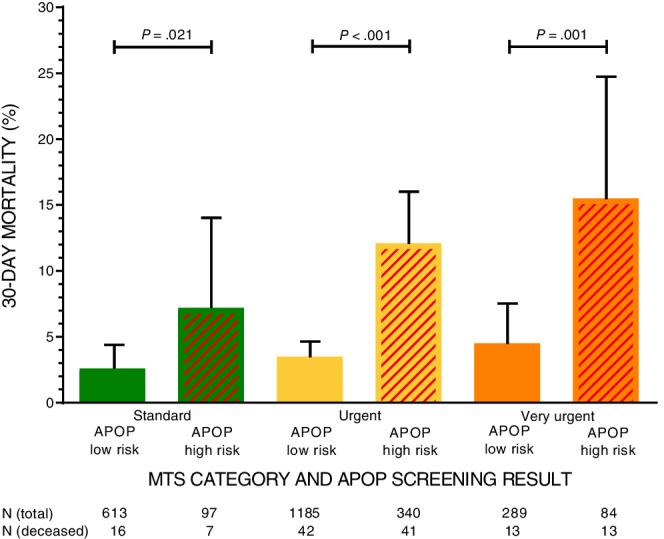
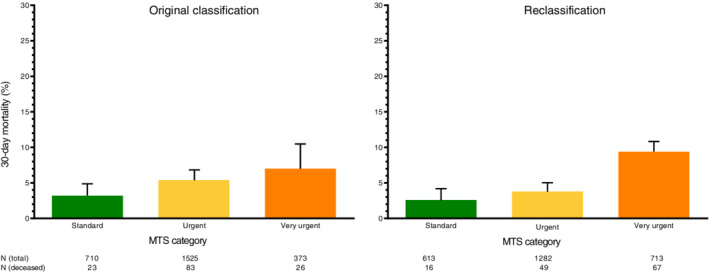
Results: We included 2,608 patients with a median age of 79 (interquartile range = 74-84) years, of whom 521 (20.0%) patients were categorized as high risk according to geriatric screening. Patients were triaged on urgency as standard (27.2%), urgent (58.5%), and very urgent (14.3%). In total, 132 (5.1%) patients were deceased within a period of 30 days. Within every urgency triage category, 30-day mortality was threefold higher in geriatric high-risk compared to low-risk patients (overall = 11.7% vs 3.4%; P < .001). The explained variance of 30-day mortality with triage urgency was 1.0% and increased to 6.3% by adding the geriatric screener.
Conclusion: Combining triage urgency with geriatric screening has the potential to improve triage, which may help clinicians to deliver early appropriate care to older ED patients. J Am Geriatr Soc 68:1755-1762, 2020.
Keywords: emergency department; geriatric assessment; geriatric emergency medicine; risk stratification; triage.
© 2020 The Authors. Journal of the American Geriatrics Society published by Wiley Periodicals, Inc. on behalf of The American Geriatrics Society.
Conflict of interest statement
The authors declare no conflict of interest.
Figures
References
-
- FitzGerald G, Jelinek GA, Scott D, Gerdtz MF. Emergency department triage revisited. Emerg Med J. 2010;27:86‐92. - PubMed
-
- Australasian College for Emergency Medicine . Guidelines on the Implementation of the Australasian Triage Scale in Emergency Departments. https://acem.org.au/getmedia/51dc74f7-9ff0-42ce-872a-0437f3db640a/G24_04.... January 27, 2020.
-
- Bullard MJ, Musgrave E, Warren D, et al. Revisions to the Canadian Emergency Department Triage and Acuity Scale (CTAS) guidelines 2016. CJEM. 2017;19:S18‐S27. - PubMed
-
- Mackway‐Jones K, Marsden J, Windle J. Emergency Triage: Manchester Triage Group. Vol 18 3rd ed. London, England: BMJ; 2014. http://healthindisasters.com/images/Books/Emergency-Triage–Manchester-Tr...
-
- Gilboy N, Tanabe T, Travers D, Rosenau AM. Emergency Severity Index (ESI): A Triage Tool for Emergency Department Care, Version 4. Implementation Handbook 2012 Edition AHRQ Publication No.12‐0014 Rockville, MD: Agency for Healthcare Research and Quality, 2011.
Publication types
MeSH terms
LinkOut - more resources
Full Text Sources
