


Soluble pattern recognition molecules: Guardians and regulators of homeostasis at airway mucosal surfaces
- PMID: 32246830
- PMCID: PMC7216992
- DOI: 10.1002/eji.201847811
Soluble pattern recognition molecules: Guardians and regulators of homeostasis at airway mucosal surfaces
Abstract
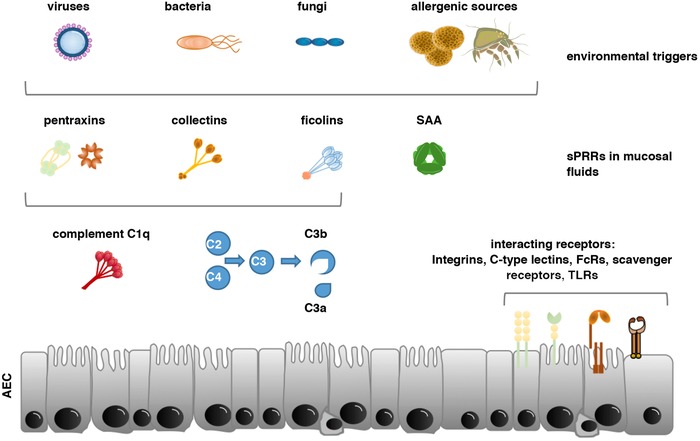
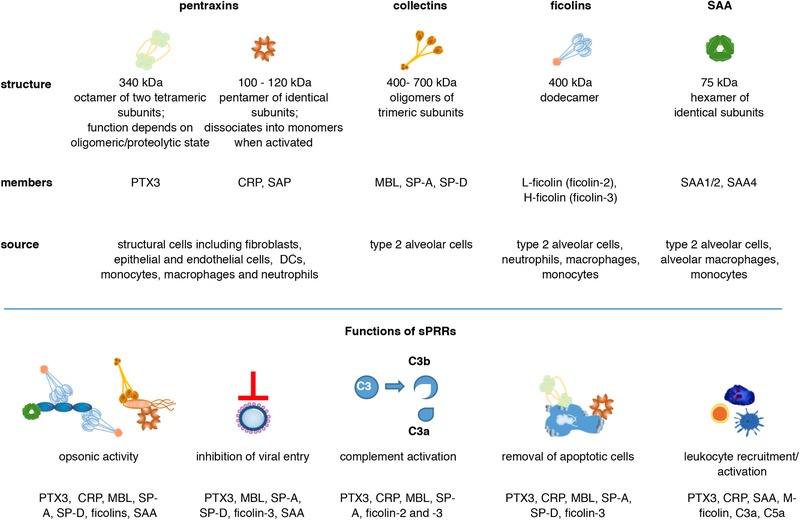
Maintenance of homeostasis at body barriers that are constantly challenged by microbes, toxins and potentially bioactive (macro)molecules requires complex, highly orchestrated mechanisms of protection. Recent discoveries in respiratory research have shed light on the unprecedented role of airway epithelial cells (AEC), which, besides immune cells homing to the lung, also significantly contribute to host defence by expressing membrane-bound and soluble pattern recognition receptors (sPRR). Recent evidence suggests that distinct, evolutionary ancient, sPRR secreted by AEC might become activated by usually innocuous proteins, commonly referred to as allergens. We here provide a systematic overview on sPRR detectable in the mucus lining of AEC. Some of them become actively produced and secreted by AECs (like the pentraxins C-reactive protein and pentraxin 3; the collectins mannose binding protein and surfactant proteins A and D; H-ficolin; serum amyloid A; and the complement components C3 and C5). Others are elaborated by innate and adaptive immune cells such as monocytes/macrophages and T cells (like the pentraxins C-reactive protein and pentraxin 3; L-ficolin; serum amyloid A; and the complement components C3 and C5). Herein we discuss how sPRRs may contribute to homeostasis but sometimes also to overt disease (e.g. airway hyperreactivity and asthma) at the alveolar-air interface.
Keywords: Airway epithelial cells; Barrier tissues; Complement system; Innate defence; Soluble pattern recognition receptors.
© 2020 WILEY-VCH Verlag GmbH & Co. KGaA, Weinheim.
Conflict of interest statement
Winfried F. Pickl holds stocks of Biomay AG and receives honoraria from Novartis and Roche. All other authors have no additional commercial or financial conflict of interest.
Figures
References
-
- Kay, A. B. , Allergy and hypersensitivity: history and concepts In Kay A. B., Kaplan A. P., Bousquet J. and Holt P. G. (Eds), Allergy and Allergic Diseases. Blackwell Publishing, Oxford, UK: 2008, pp 1–22.
-
- Mantovani, A. , Valentino, S. , Gentile, S. , Inforzato, A. , Bottazzi, B. and Garlanda, C. , The long pentraxin PTX3: a paradigm for humoral pattern recognition molecules. Ann. N. Y. Acad. Sci. 2013. 1285: 1–14. - PubMed
-
- Bottazzi, B. , Doni, A. , Garlanda, C. and Mantovani, A. , An integrated view of humoral innate immunity: pentraxins as a paradigm. Annu. Rev. Immunol. 2010. 28: 157–183. - PubMed
-
- Tucci, A. , Goldberger, G. , Whitehead, A. S. , Kay, R. M. , Woods, D. E. and Colten, H. R. , Biosynthesis and postsynthetic processing of human C‐reactive protein. J. Immunol. 1983. 131: 2416–2419. - PubMed
-
- Litvack, M. L. and Palaniyar, N. , Soluble innate immune pattern‐recognition proteins for clearing dying cells and cellular components: implications on exacerbating or resolving inflammation. Innate Immun. 2010. 16: 191–200. - PubMed
Publication types
MeSH terms
Substances
Grants and funding
LinkOut - more resources
Full Text Sources
Medical
Research Materials
Miscellaneous
