


Longitudinal Understanding of Child Maltreatment Report Risks
- PMID: 32247069
- PMCID: PMC8323119
- DOI: 10.1016/j.chiabu.2020.104467
Longitudinal Understanding of Child Maltreatment Report Risks
Abstract
Background: Child maltreatment reports (CMR) are both common and strongly associated with various negative outcomes.
Objective: To examine CMR risks by child age, early childhood context, current/cumulative economic status (welfare receipt), race, and other risk factors with a longitudinal dataset.
Participants and setting: The CAN sample included 2,111 children having a CMR ≤ age 3, suggestive of a harmful early childhood context. The AFDC sample included 1,923 children having AFDC but no CMR ≤ age 3, suggestive of early childhood protective factors despite poverty.
Methods: We estimated the CMR likelihood at each age from 1-17 years based on various risk factors while following up children from 1995-2009.
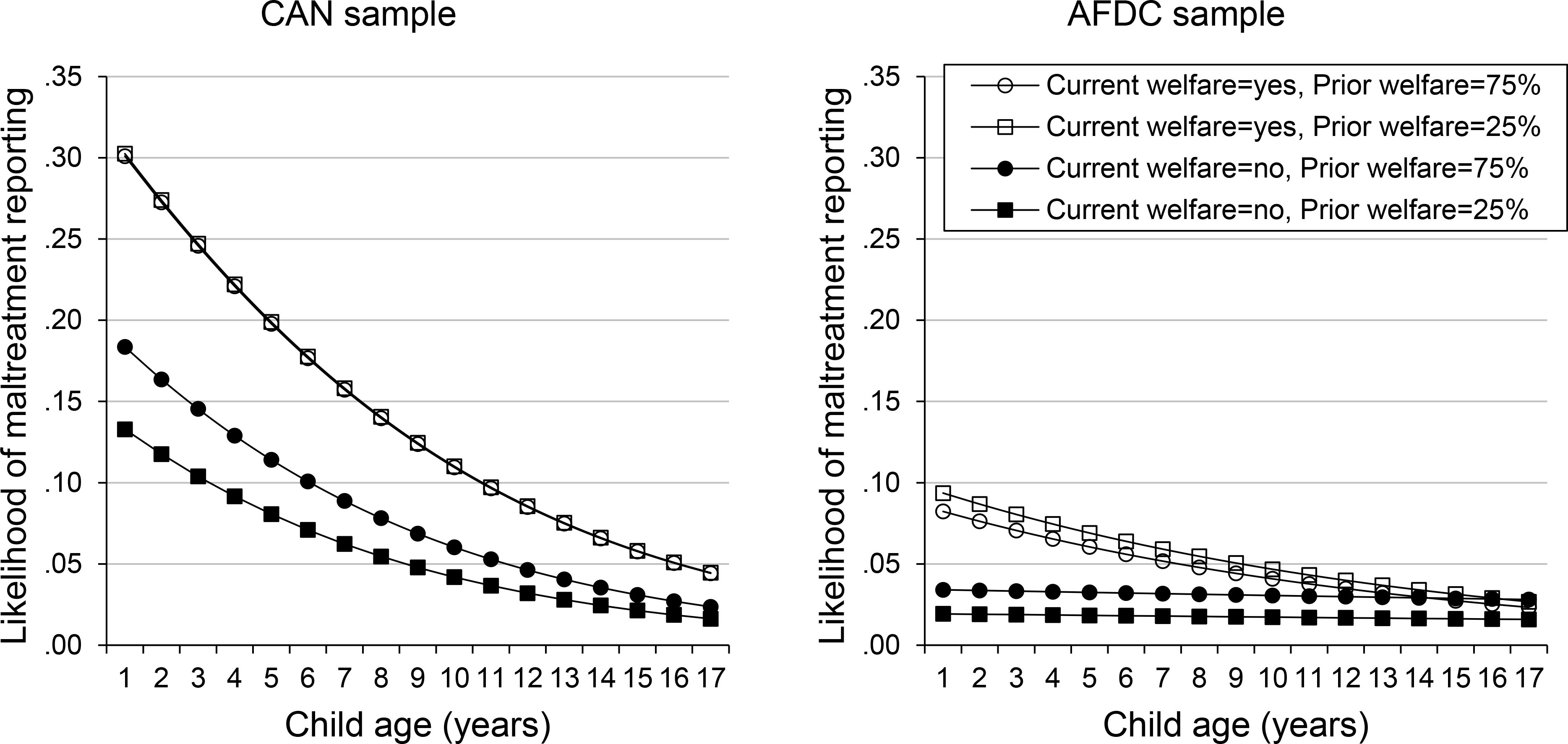
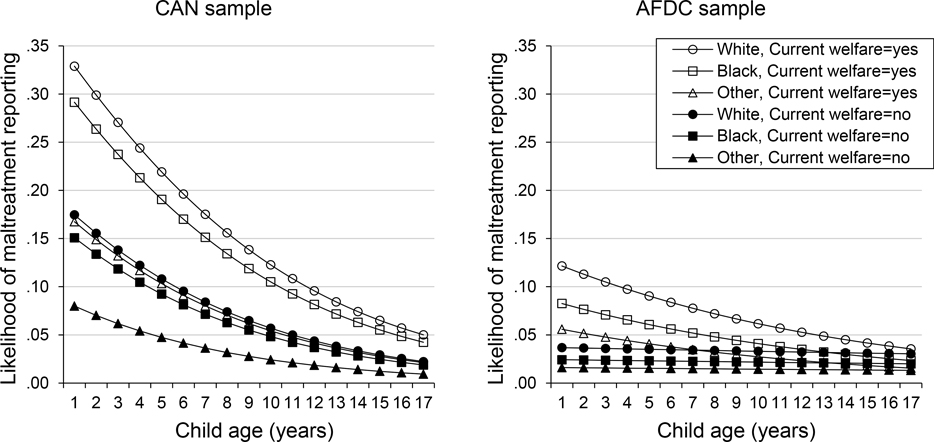
Results: During follow-up, CMR likelihoods were substantially higher for the CAN sample than for the AFDC sample. The age-CMR relationship was strongly negative for the CAN sample (OR = 0.87, 95% CI = 0.86-0.88). This relationship was weaker for the AFDC sample (OR = 0.92, 0.89-0.95) and became non-significant for children who exited welfare. Current welfare receipt remained a strong predictor of CMR likelihoods for both CAN (OR = 2.32, 1.98-2.71) and AFDC (OR = 2.08, 1.61-2.68) samples. Prior welfare receipt moderately increased CMR likelihoods among those not currently on welfare. Controlling for other risk factors, White children had the highest likelihood of CMR. Other child and parent level vulnerabilities also increased CMR risk over time.
Conclusions: This study highlights the importance of longitudinal analytic approaches and the utility of cross-sector administrative data in improving our ability to understand and predict CMRs over time.
Keywords: Administrative data analysis; Child abuse; Child maltreatment; Child protective services; Multilevel growth curve model.
Copyright © 2020 Elsevier Ltd. All rights reserved.
Conflict of interest statement
Declaration of Competing Interest None.
Figures
References
-
- Acs G, & Loprest P (2001). Final synthesis report of findings from ASPE’s “leavers” grants. Washington, DC.
-
- Anda RF, Felitti VJ, Bremner JD, Walker JD, Whitfield C, Perry BD, … Giles WH (2006). The enduring effects of abuse and related adverse experiences in childhood: A convergence of evidence from neurobiology and epidemiology. European Archives of Psychiatry and Clinical Neuroscience, 256(3), 174–186. 10.1007/s00406-005-0624-4 - DOI - PMC - PubMed
-
- Beimers DL, & Coulton CJ (2011). Do employment and type of exit influence child maltreatment among families leaving Temporary Assistance for Needy Families? Children and Youth Services Review, 33(7), 1112–1119. 10.1016/j.childyouth.2011.02.002 - DOI
