An official website of the United States government
The .gov means it’s official.
Federal government websites often end in .gov or .mil. Before
sharing sensitive information, make sure you’re on a federal
government site.
The site is secure.
The https:// ensures that you are connecting to the
official website and that any information you provide is encrypted
and transmitted securely.
The objective of this commentary was to analyze the causes and outcomes of gut microbiome dysbiosis in preterm infants who are born at very low birth weight (VLBW). The intrauterine development of VLBW infants is interrupted abruptly with preterm birth and followed by extrauterine, health-threatening conditions and sequelae. These infants develop intestinal microbial dysbiosis characterized by low diversity, an overall reduction in beneficial and/or commensal bacteria, and enrichment of opportunistic pathogens of the Gammaproteobacteria class. The origin of VLBW infant dysbiosis is not well understood and is likely the result of a combination of immaturity and medical care. We propose that these factors interact to produce inflammation in the gut, which further perpetuates dysbiosis. Understanding the sources of dysbiosis could result in interventions to reduce gut inflammation, decrease enteric pathology, and improve health outcomes for these vulnerable infants.
Keywords:
dysbiosis; gut microbiome; health; prematurity.
The authors report no conflicts of interest or relevant financial relationships.
Figures
Figure 1:
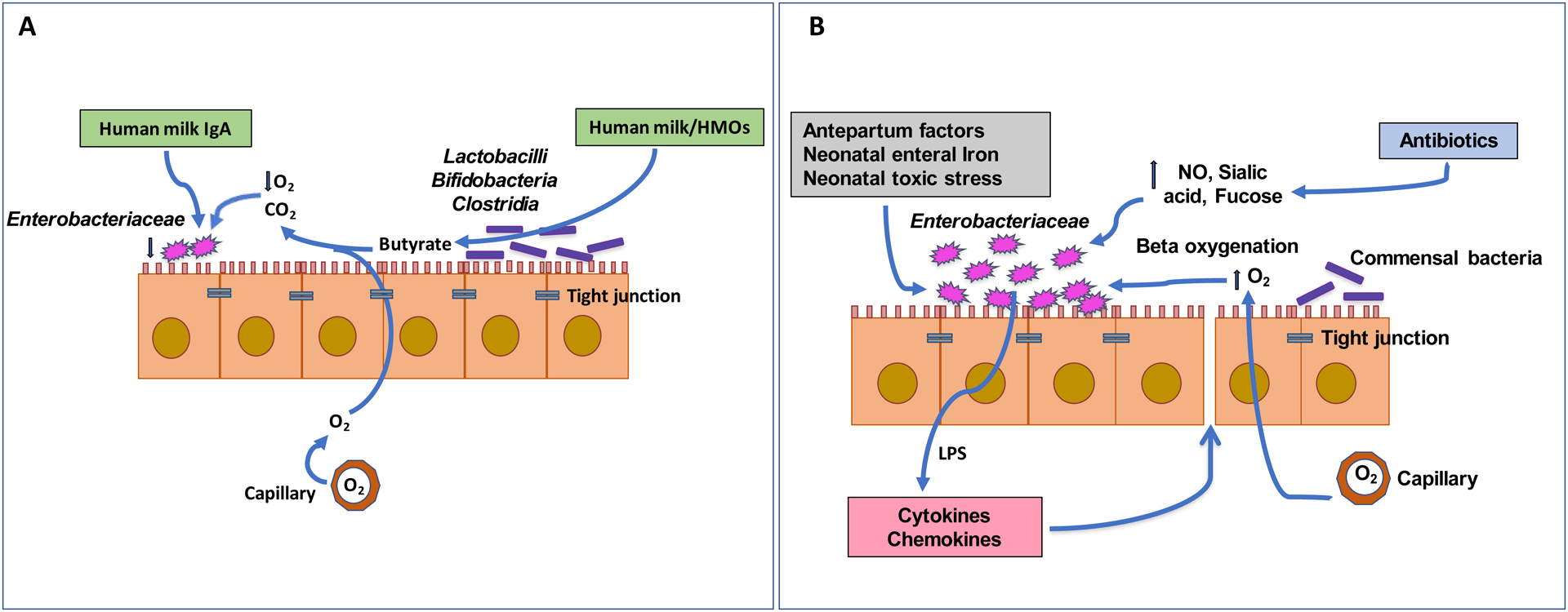
A non-inflamed ( A )…
Figure 1:
A non-inflamed ( A ) and inflamed ( B ) infant guts. A …
Figure 1:
A non-inflamed (A) and inflamed (B) infant guts. A. In the non-inflamed infant gut, butyrate produced by commensal bacteria decreases oxygen levels in the gut lumen, lowering abundance of Enterobacteriaceae. Human milk promotes the growth of commensal bacteria via HMOs, while IgA in milk reduces Enterobacteriaceae growth. B. In the inflamed infant gut, oxygen in the gut lumen facilitates the growth of Enterobacteriaceae, which produces LPS and promotes inflammation. Antepartum factors, antibiotics, neonatal toxic stress, and neonatal enteral iron can also exacerbate the inflammatory milieu.
Aagaard K, Ma J, Antony KM, Ganu R, Petrosino J, & Versalovic J (2014). The placenta harbors a unique microbiome. Science Translational Medicine, 6(237), 237ra265. doi: 10.1126/scitranslmed.3008599
-
DOI
-
PMC
-
PubMed
Ahluwalia B, Magnusson MK, & Ohman L (2017). Mucosal immune system of the gastrointestinal tract: Maintaining balance between the good and the bad. Scandinavian Journal of Gastroenterology, 52(11), 1185–1193. doi: 10.1080/00365521.2017.1349173
-
DOI
-
PubMed
Arroyo R, Martin V, Maldonado A, Jimenez E, Fernandez L, & Rodriguez JM (2010). Treatment of infectious mastitis during lactation: Antibiotics versus oral administration of Lactobacilli isolated from breast milk. Clinical Infectious Diseases, 50(12), 1551–1558. doi: 10.1086/652763
-
DOI
-
PubMed
Backhed F, Roswall J, Peng Y, Feng Q, Jia H, Kovatcheva-Datchary P, … Wang J (2015). Dynamics and stabilization of the human gut microbiome during the first year of life. Cell Host & Microbe, 17(5), 690–703. doi: 10.1016/j.chom.2015.04.004
-
DOI
-
PubMed
Blaser MJ, & Dominguez-Bello MG (2016). The human microbiome before birth. Cell Host & Microbe, 20(5), 558–560. doi: 10.1016/j.chom.2016.10.014
-
DOI
-
PubMed