


Childhood maltreatment and monocyte gene expression among women with breast cancer
- PMID: 32247915
- PMCID: PMC8667713
- DOI: 10.1016/j.bbi.2020.04.001
Childhood maltreatment and monocyte gene expression among women with breast cancer
Abstract
Background: Childhood adversity is reliably associated with immune alterations in adulthood, including increases in inflammatory processes. However, relatively few studies have investigated these associations in clinical populations such as cancer patients who are at risk for negative immune-related health outcomes. The current study tested the hypothesis that childhood maltreatment would be associated with alterations in immune-related gene expression in monocytes from women with breast cancer.
Methods: Women (n = 86) were recruited after diagnosis with early-stage breast cancer but before onset of adjuvant therapy with radiation, chemotherapy, and/or endocrine therapy. Participants completed questionnaires to assess childhood maltreatment (Childhood Trauma Questionnaire; CTQ) and depressive symptoms (Center for Epidemiologic Studies Depression Scale; CES-D) and provided blood samples for immune assessment. CD14+ monocytes were isolated for RNA extraction and gene expression analyses.
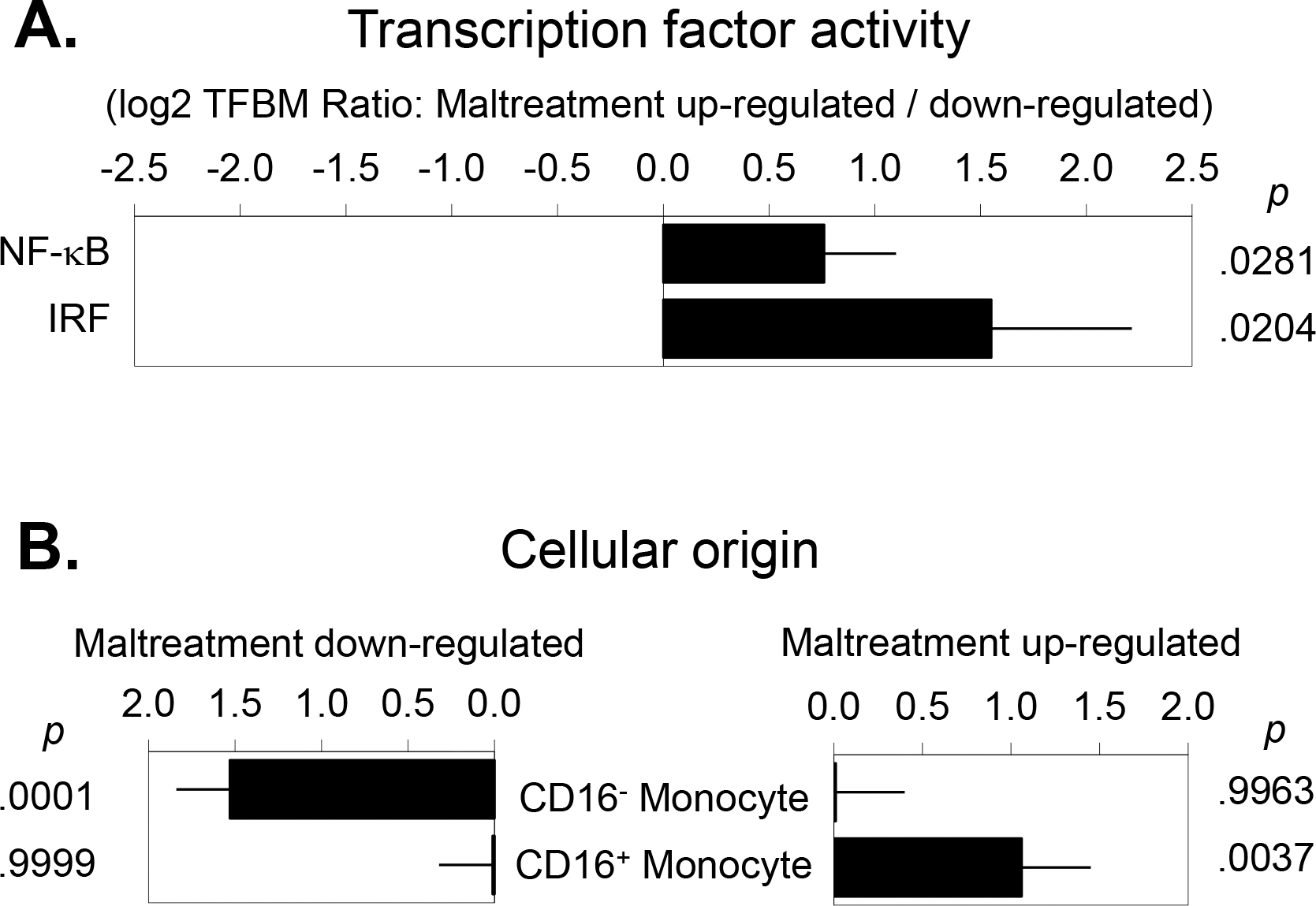
Results: Based on responses to the CTQ, 28% of participants were classified as experiencing physical and/or emotional abuse or neglect and 7% as experiencing sexual abuse. Genome-wide transcriptional profiling of isolated monocytes identified 202 gene transcripts that differed in average expression level by > 25% over the range of maltreatment exposure. Bioinformatics analyses of those gene transcripts identified a significantly greater prevalence of NF-κB-binding motifs within the promoters of up-regulated vs. down-regulated genes (p = .028) in women exposed to childhood maltreatment, indicating greater inflammatory signaling. Parallel analyses of Type I interferon signaling also indicated greater prevalence of Interferon Response Factor (IRF)-related binding sites in women with a childhood maltreatment history (p = .020). Results remained significant in analyses controlling for current depression; however, NF-κB and IRF-related gene expression was higher in women with both maltreatment exposure and current depression.
Conclusions: In women recently diagnosed with early-stage breast cancer, childhood maltreatment was associated with increases in the classical NF-kB-related pro-inflammatory signaling pathway and with increases in the Type I interferon system. These results suggest a broad pattern of chronic immunologic activation in breast cancer patients with a history of childhood maltreatment, particularly those who are currently experiencing clinically significant depressive symptoms. These findings have implications for the long-term health and well-being of maltreatment exposed breast cancer patients.
Keywords: Breast cancer; Childhood adversity; Depression; Immune; Inflammation; Monocyte.
Copyright © 2020. Published by Elsevier Inc.
Figures
References
-
- Bernstein DPF, A. L . (1998). Childhood Trauma Questionnaire Manual. San Antonio: The Psychological Corporation.
-
- Chapman DP, Whitfield CL, Felitti VJ, Dube SR, Edwards VJ, & Anda RF (2004). Adverse childhood experiences and the risk of depressive disorders in adulthood. J Affect.Disord, 82(2), 217–225. - PubMed
Publication types
MeSH terms
Grants and funding
LinkOut - more resources
Full Text Sources
Medical
Research Materials
