. 2020 Sep;34(6):680-689.
doi: 10.1037/adb0000576. Epub 2020 Apr 6.

Menstrual cycle phase, alcohol consumption, alcohol cravings, and mood among women in outpatient treatment for alcohol use disorder

Affiliations

Menstrual cycle phase, alcohol consumption, alcohol cravings, and mood among women in outpatient treatment for alcohol use disorder

Jumi Hayaki et al. Psychol Addict Behav. 2020 Sep.

Abstract

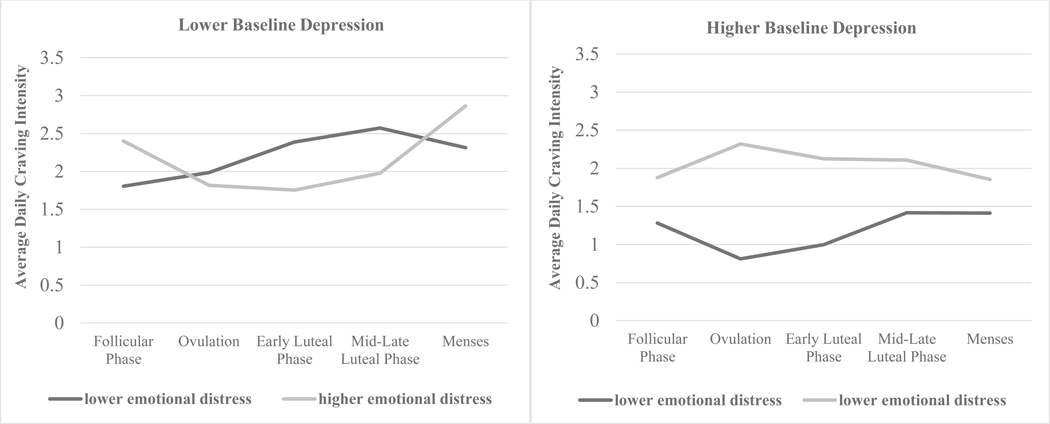
Research shows fluctuations in drinking across the menstrual cycle among women with alcohol use disorder (AUD), but little work has investigated moderators of these fluctuations. This study examined drinking and craving intensity across the menstrual cycle, and the moderating effect of baseline depression and emotional distress during the midlate luteal phase and/or menses, among women receiving AUD treatment. Fifty-nine regularly cycling women reported menstrual history and baseline depression. Over 3 months of treatment, they kept daily logs of drinks, alcohol cravings, and menstruation (yes/no). Emotional distress during the midlate luteal phase and/or menses of their most recent menstrual cycle was also assessed during treatment. Menstrual cycle phase was estimated for each within-treatment day. Mixed model analyses tested main and interactive effects of menstrual cycle phase, baseline depression, and emotional distress during the midlate luteal phase and/or menses on daily drinks and craving intensity. Women drank most during the midlate luteal phase and menses compared with other phases. Among women with lower baseline depression, those with lower distress during the midlate luteal phase and/or menses reported more intense cravings during the midlate luteal phase (ΔM = .77, p = .000) and menses (ΔM = .51, p = .012); those with higher distress reported more intense cravings during menses, compared with all other phases (p < .01). Among women with higher baseline depression, craving intensity remained consistently high. Results document more drinking during the midlate luteal phase and menses and suggest that cycle-related distress and depression moderate the alcohol-menstrual association among women in AUD treatment. (PsycInfo Database Record (c) 2020 APA, all rights reserved).


Figures
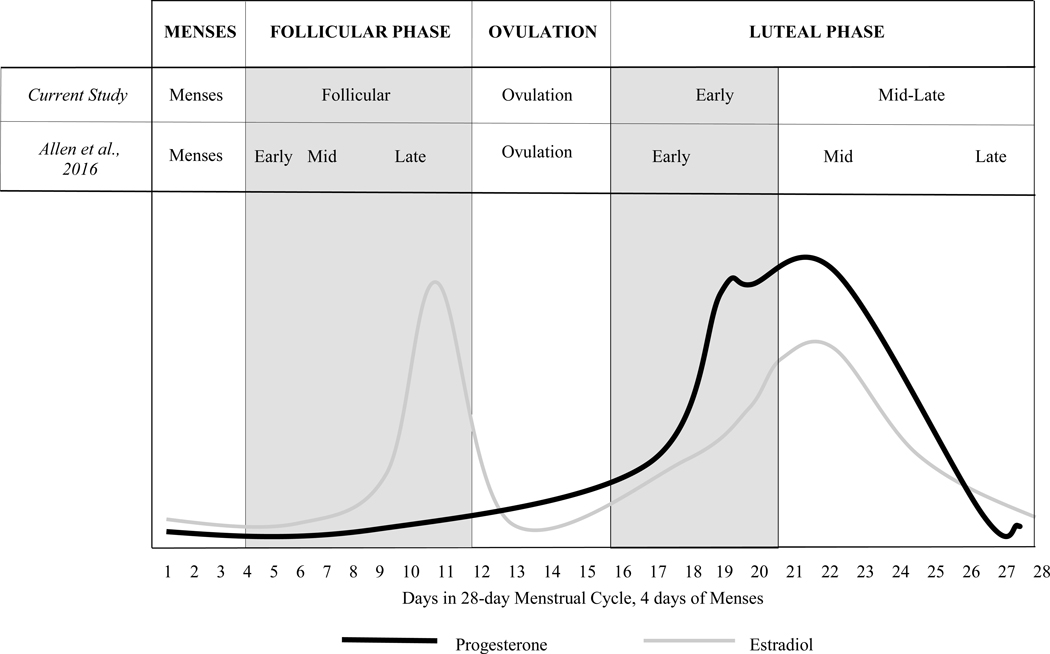
Figure 1.
Figure 1.
Fluctuation of Progesterone and Estradiol Levels during the Phases of a 28-Day Menstrual Cycle, as Defined in the Current Study and by Allen et al. (2016)
Figure 2.
Figure 2.
Interaction of Menstrual Cycle Phase and Lower/Higher Self-reported Emotional Distress in the Mid-Late Luteal Phase and/or Menses among Women with Lower or Higher Baseline Depression Note: To graph this three-way interaction effect, estimates are based on one standard deviation (BDI-II SD=10.40) below the mean for “lower baseline depression” and one standard deviation above the mean for “higher baseline depression”. Scores for baseline depression and self-reported emotional distress in the mid-late luteal phase and/or menses were entered as continuous variables in the mixed model analyses. Significant differences across menstrual cycle phases were found only among women with lower baseline depression. See results for details.

References

    1. Aganoff JA, & Boyle GJ (1994). Aerobic exercise, mood states and menstrual cycle symptoms. Journal of Psychosomatic Research, 38, 183–192. doi: 10.1016/0022-3999(94)90114-7 - DOI - PubMed
    1. Allen D. (1996). Are alcoholic women more likely to drink premenstrually? Alcohol & Alcoholism, 31, 145–147. doi: 10.1093/oxfordjournals.alcalc.a008125 - DOI - PubMed
    1. Allen AM, McRae-Clark AL, Carlson S, Saladin ME, Gray KM, Wetherington CL, … & Allen SS (2016). Determining menstrual phase in human biobehavioral research: A review with recommendations. Experimental and Clinical Psychopharmacology, 24, 1–11. doi: 10.1037/pha0000057 - DOI - PMC - PubMed
    1. Allen SS, Allen AM, Kotlyar M, Lunos S, Absi M, & Hatsukami D. (2013). Menstrual phase and depressive symptoms differences in physiological response to nicotine following acute smoking abstinence. Nicotine & Tobacco Research, 15, 1091–1098. doi: 10.1093/ntr/nts236 - DOI - PMC - PubMed
    1. Allen SS, Allen AM, Lunos S, & Hatsukami DK (2009). Patterns of self-selected smoking cessation attempts and relapse by menstrual phase. Addictive Behaviors, 34, 928–931. doi: 10.1016/j.addbeh.2009.05.013 - DOI - PMC - PubMed