Association Between Use of Warfarin for Atrial Fibrillation and Outcomes Among Patients With End-Stage Renal Disease: A Systematic Review and Meta-analysis
- PMID: 32250434
- PMCID: PMC7136833
- DOI: 10.1001/jamanetworkopen.2020.2175
Association Between Use of Warfarin for Atrial Fibrillation and Outcomes Among Patients With End-Stage Renal Disease: A Systematic Review and Meta-analysis
Abstract
Importance: Several studies have examined the role of warfarin in preventing strokes in patients with atrial fibrillation and end-stage renal disease; however, the results remain inconclusive.
Objective: To assess recently published studies to examine the outcomes of the use of warfarin among patients with atrial fibrillation and end-stage renal disease.
Data sources: A literature search was performed using the terms warfarin and atrial fibrillation and end-stage renal disease and warfarin and atrial fibrillation and dialysis in the MEDLINE, Embase, and Google Scholar databases from January 1, 2008, to February 28, 2019.
Study selection: The studies included were those with patients with end-stage renal disease and atrial fibrillation who were receiving warfarin and with hazard ratios (HRs) of at least 1 primary outcome. The studies excluded were those with a lack of information on outcomes and unreliable 95% CIs of the results.
Data extraction and synthesis: The Meta-analysis of Observational Studies in Epidemiology (MOOSE) guidelines were followed in selecting studies. Collected data were also scrutinized for reliable 95% CIs. Finally, studies were examined for perceived biases, their limitations, and the definitions of the outcomes.
Main outcomes and measures: The HRs and 95% CIs were calculated for the incidence of ischemic stroke, hemorrhagic stroke, major bleeding, and mortality among patients receiving anticoagulants and those not receiving anticoagulants.
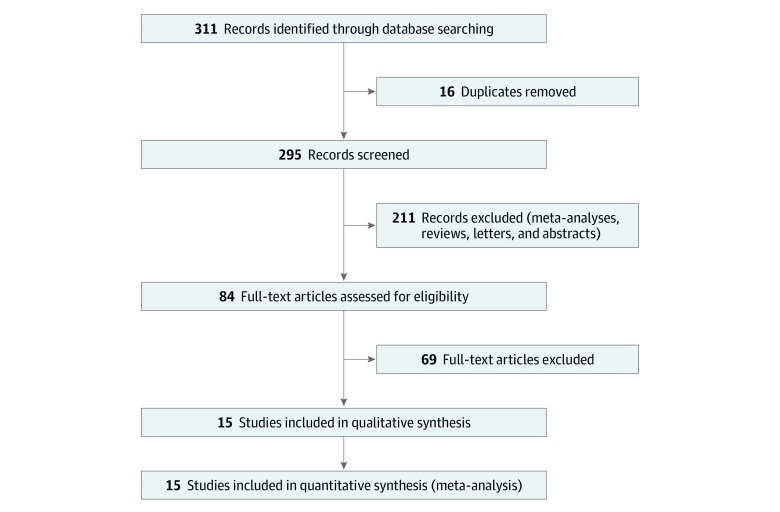
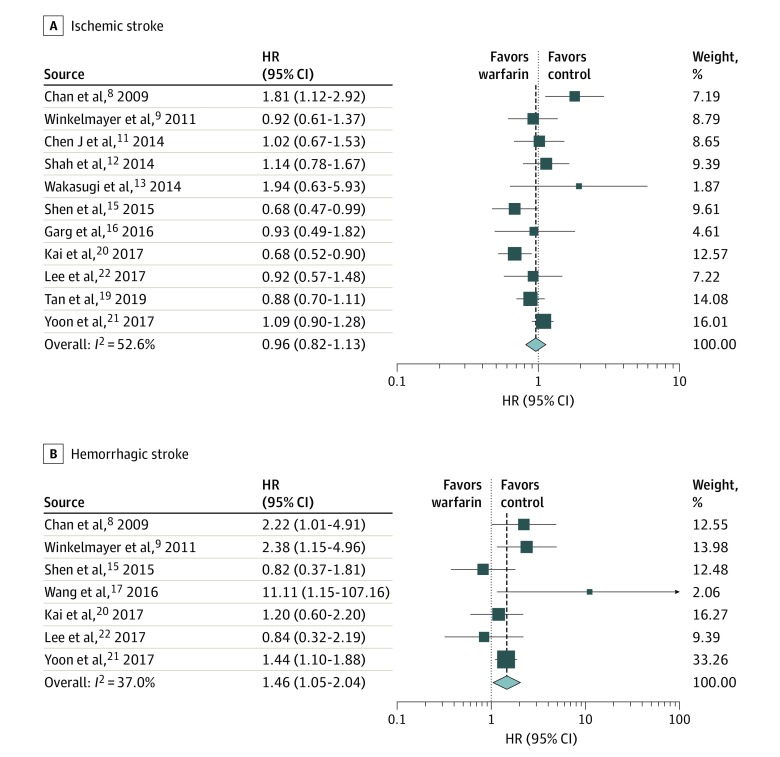
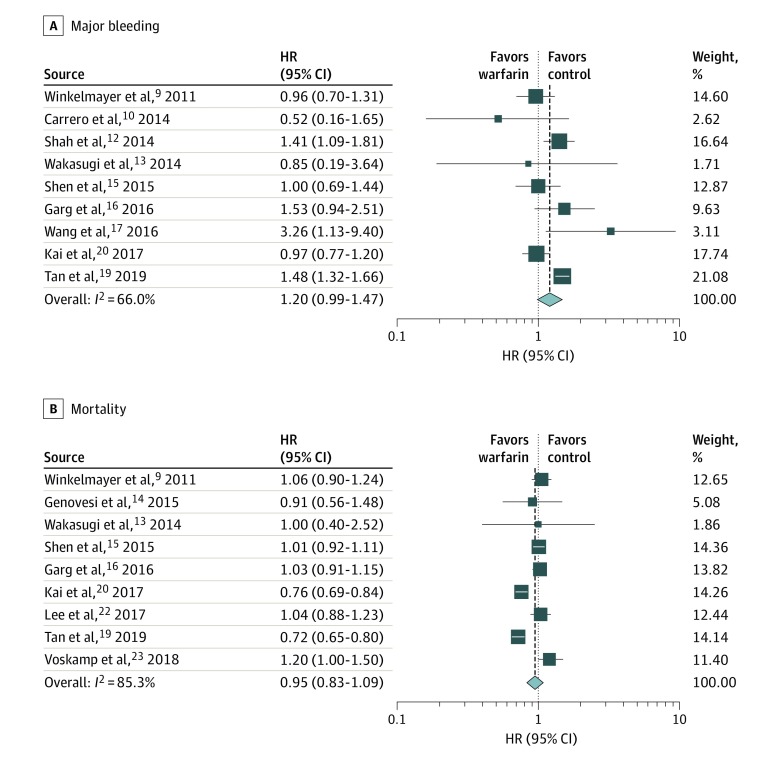
Results: Study selection yielded 15 studies with a total of 47 480 patients with atrial fibrillation and end-stage renal disease. Of these patients, 10 445 (22.0%) were taking warfarin. With a mean (SD) follow-up period of 2.6 (1.4) years, warfarin use was associated with no significant change for the risk of ischemic stroke (HR, 0.96; 95% CI, 0.82-1.13), with a significantly higher risk of hemorrhagic stroke (HR, 1.49; 95% CI, 1.03-1.94), with no significant difference in the risk of major bleeding (HR, 1.20; 95% CI, 0.99-1.47), and with no change in overall mortality (HR, 0.95; 95% CI, 0.83-1.09).
Conclusions and relevance: In the studies reviewed, warfarin use appears to have been associated with no change in the incidence of ischemic stroke in patients with atrial fibrillation and end-stage renal disease. However, from the studies reviewed, it does appear to be associated with a significantly higher risk of hemorrhagic stroke, with no significant difference in the risk of major bleeding, and with no change in mortality.
Conflict of interest statement
Figures
Comment in
-
Anticoagulation for Stroke Prevention in Patients With Atrial Fibrillation and End-Stage Renal Disease-First, Do No Harm.JAMA Netw Open. 2020 Apr 1;3(4):e202237. doi: 10.1001/jamanetworkopen.2020.2237. JAMA Netw Open. 2020. PMID: 32250429 No abstract available.
References
-
- January CT, Wann LS, Alpert JS, et al. ; American College of Cardiology/American Heart Association Task Force on Practice Guidelines . 2014 AHA/ACC/HRS guideline for the management of patients with atrial fibrillation: a report of the American College of Cardiology/American Heart Association Task Force on Practice Guidelines and the Heart Rhythm Society. J Am Coll Cardiol. 2014;64(21):-. doi: 10.1016/j.jacc.2014.03.022 - DOI - PubMed
-
- Fuster V, Rydén LE, Cannom DS, et al. 2011 ACCF/AHA/HRS focused updates incorporated into the ACC/AHA/ESC 2006 guidelines for the management of patients with atrial fibrillation: a report of the American College of Cardiology Foundation/American Heart Association Task Force on Practice Guidelines developed in partnership with the European Society of Cardiology and in collaboration with the European Heart Rhythm Association and the Heart Rhythm Society. J Am Coll Cardiol. 2011;57(11):e101-e198. doi: 10.1016/j.jacc.2010.09.013 - DOI - PubMed
Publication types
MeSH terms
Substances
LinkOut - more resources
Full Text Sources
Medical