Components of human breast milk: from macronutrient to microbiome and microRNA
- PMID: 32252145
- PMCID: PMC7402982
- DOI: 10.3345/cep.2020.00059
Components of human breast milk: from macronutrient to microbiome and microRNA
Abstract
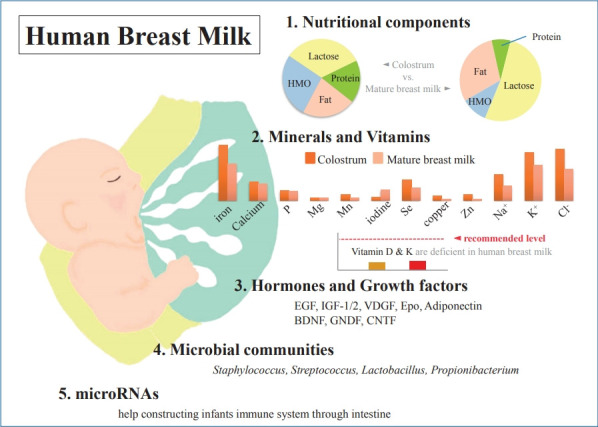
Human breast milk (HBM) is essential for the infant's growth and development right after birth and is an irreplaceable source of nutrition for early human survival. Various infant formulas have many similarities to HBM in many components, but there is no perfect substitute for HBM. Recently, various breast milk components and their roles have been studied according to the development of various analysis techniques. As is already well known, HBM contains about 87%-88% water, and 124- g/L solid components as macronutrients, including about 7% (60-70 g/L) carbohydrates, 1% (8-10 g/L) protein, and 3.8% (35-40 g/L) fat. The composition may vary depending on the environmental factors, including maternal diet. Colostrum is low in fat but high in protein and relatively rich in immuneprotective components. Although HBM contains enough vitamins to ensure normal growth of the infant, vitamins D and K may be insufficient, and the infant may require their supplementation. Growth factors in HBM also serve as various bioactive proteins and peptides on the intestinal tract, vasculature, nervous system, and endocrine system. In the past, HBM of a healthy mother was thought to be sterile. However, several subsequent studies have confirmed the presence of rich and diverse microbial communities in HBM. Some studies suggested that the genera Staphylococcus and Streptococcus may be universally predominant in HBM, but the origin of microbiota still remains controversial. Lastly, milk is the one of most abundant body fluid of microRNAs, which are known to play a role in various functions, such as immunoprotection and developmental programming, through delivering from HBM and absorption by intestinal epithelial cells. In conclusion, HBM is the most important source of nutrition for infants and includes microbiomes and miRNAs for growth, development, and immunity.
Keywords: Human milk; Infant; MicroRNA; Microbiota; Nutrient.
Conflict of interest statement
No potential conflict of interest relevant to this article was reported.
References
-
- Van Rossum CT, Buchner FL, Hoekstra J. Quantification of health effects of breastfeeding: review of the literature and model simulation. Bilthoven: RIVM; 2006.
-
- ESPGHAN Committee on Nutrition. Agostoni C, Braegger C, Decsi T, Kolacek S, Koletzko B, et al. Breast-feeding: a commentary by the ESPGHAN Committee on Nutrition. J Pediatr Gastroenterol Nutr. 2009;49:112–25. - PubMed
-
- World Health Organization. United Nations Children’s Fund . Global strategy for infant and young child feeding. Geneva: World Health organization; 2003.
-
- Johnston M, Landers S, Noble L, Szucs K, Viehmann L. Breastfeeding and the use of human milk. Pediatrics. 2012;129:e827–41. - PubMed
Grants and funding
LinkOut - more resources
Full Text Sources
Other Literature Sources
Research Materials
Miscellaneous