. 2020 Mar;17(1):114-120.
doi: 10.14245/ns.1938454.227. Epub 2020 Mar 31.

Telerobotic Spinal Surgery Based on 5G Network: The First 12 Cases

Affiliations

Telerobotic Spinal Surgery Based on 5G Network: The First 12 Cases

Wei Tian et al. Neurospine. 2020 Mar.

Abstract

Objective: The purpose of this study was to determine the efficacy and feasibility of 5th generation wireless systems (5G) telerobotic spinal surgery in our first 12 cases.

Methods: A total of 12 patients (5 males, 7 females; age, 23-71 years) with spinal disorders (4 thoracolumbar fractures, 6 lumbar spondylolisthesis, 2 lumbar stenosis) were treated with 5G telerobotic spinal surgery. Sixty-two pedicle screws were implanted.

Results: All patients had substantial relief from their symptoms. Screw placements were classified using Gertzbein-Robbins criteria. There were 59 grade A, 3 grade B. Mean operation time was 142.5 ± 46.7 minutes. Mean guiding wire insertion time was 41.3 ± 9.8 minutes. The deviation between the planned and actual positions was 0.76 ± 0.49 mm. No intraoperative adverse event was found.

Conclusion: 5G remote robot-assisted spinal surgery is accurate and reliable. We conclude that 5G telerobotic spinal surgery is both efficacious and feasible for the management of spinal diseases with safety.

Keywords: 5G; Orthopaedics; Remote surgery; Robotic surgery; Telemedicine; Telesurgery.


Figures
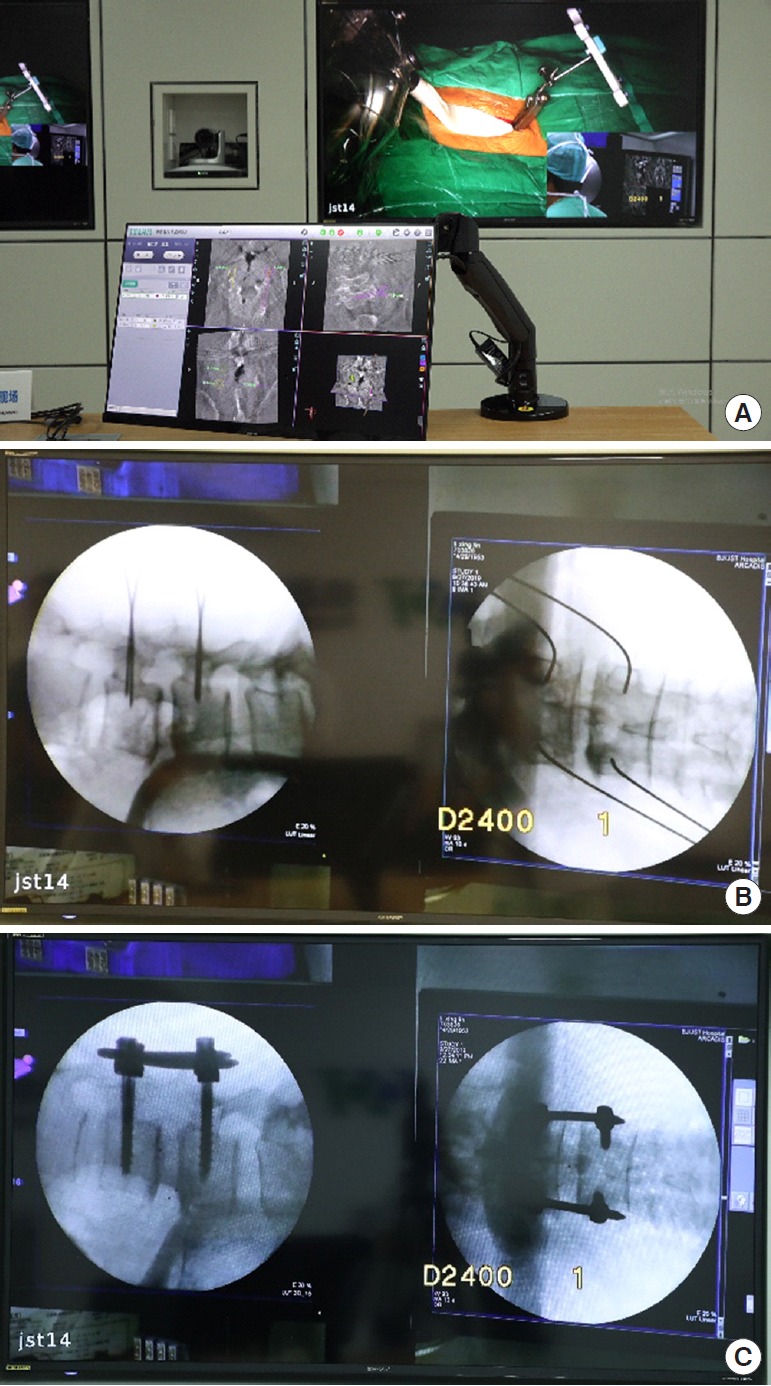
Fig. 1.
Fig. 1.
(A) Screw planning at master control room. (B) K-wire placement. (C) Screw placement.
Fig. 2.
Fig. 2.
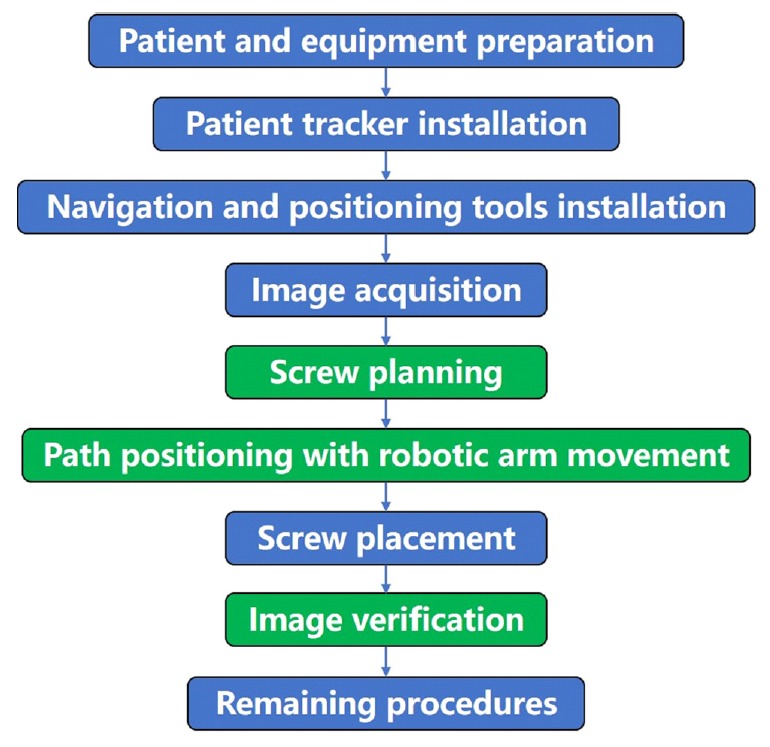
The workflow of 5G (5th generation wireless systems) telerobotic spinal surgery. The blue background indicates the steps performed by surgeons on the patient side, and the green background shows the steps performed by the leading surgeon in the master control room.
Fig. 3.
Fig. 3.
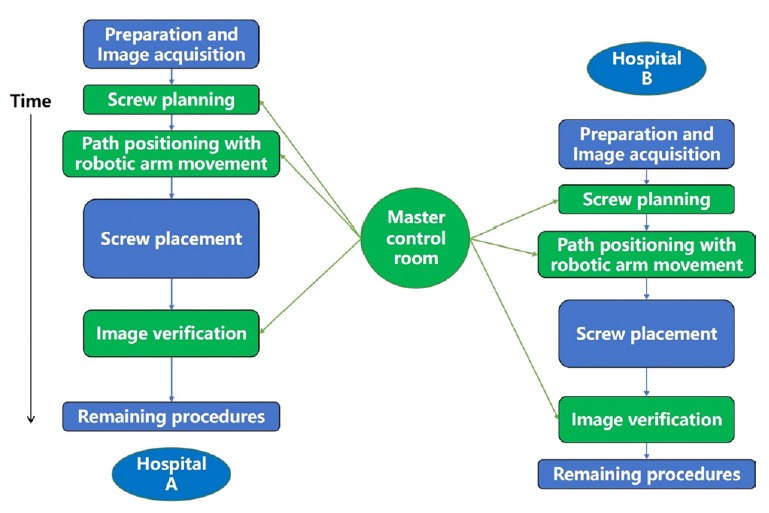
The workflow of “one-to-many” 5G (5th generation wireless systems) remote orthopedic robot-assisted surgery.

References

    1. Chen AF, Kazarian GS, Jessop GW, et al. Robotic technology in orthopaedic surgery. J Bone Joint Surg Am. 2018;100:1984–92. - PubMed
    1. Fehlings MG, Ahuja CS, Mroz T, et al. Future advances in spine surgery: The AOSpine North America Perspective. Neurosurgery. 2017;80(3S):S1–S8. - PubMed
    1. Fan Y, Du JP, Liu JJ, et al. Accuracy of pedicle screw placement comparing robot-assisted technology and the free-hand with fluoroscopy-guided method in spine surgery: An updated meta-analysis. Medicine (Baltimore) 2018;97:e10970. - PMC - PubMed
    1. Tian W, Liu YJ, Liu B, et al. Guideline for posterior atlantoaxial internal fixation assisted by orthopaedic surgical robot. Orthop Surg. 2019;11:160–6. - PMC - PubMed
    1. Tian W, Liu YJ, Liu B, et al. Guideline for thoracolumbar pedicle screw placement assisted by orthopaedic surgical robot. Orthop Surg. 2019;11:153–9. - PMC - PubMed

LinkOut - more resources