Review
. 2020 Apr 2;12(4):986.
doi: 10.3390/nu12040986.

Food, Eating, and the Gastrointestinal Tract

Affiliations
Review

Food, Eating, and the Gastrointestinal Tract

Dan M Livovsky et al. Nutrients. .

Abstract

Food ingestion induces a metered response of the digestive system. Initially, the upper digestive system reacts to process and extract meal substrates. Later, meal residues not absorbed in the small bowel, pass into the colon and activate the metabolism of resident microbiota. Food consumption also induces sensations that arise before ingestion (e.g., anticipatory reward), during ingestion (e.g., gustation), and most importantly, after the meal (i.e., the postprandial experience). The postprandial experience involves homeostatic sensations (satiety, fullness) with a hedonic dimension (digestive well-being, mood). The factors that determine the postprandial experience are poorly understood, despite their potential role in personalized diets and healthy eating habits. Current data suggest that the characteristics of the meal (amount, palatability, composition), the activity of the digestive system (suited processing), and the receptivity of the eater (influenced by multiple conditioning factors) may be important in this context.

Keywords: digestion; digestive well-being; food ingestion; satiety.


Conflict of interest statement

The authors declare no conflict of interest.

Figures
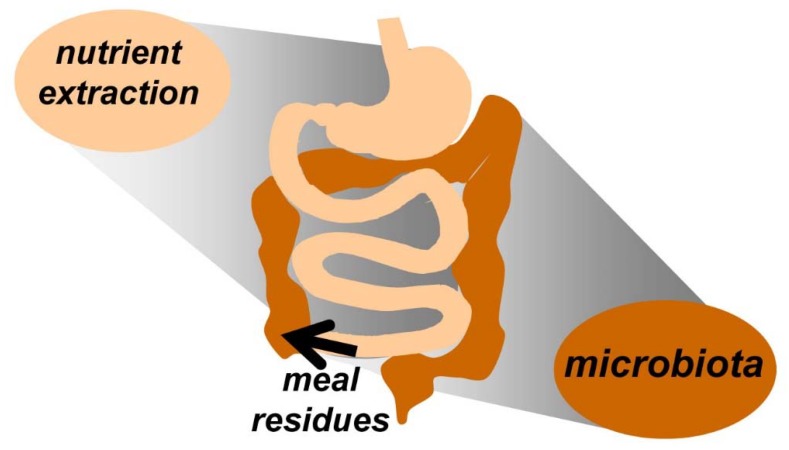
Figure 1
Figure 1
Digestive response to ingestion. The upper digestive system extracts meal substrates by a process of digestion and absorption. Non-absorbed meal residues pass into the colon and feed the microbiota.
Figure 2
Figure 2
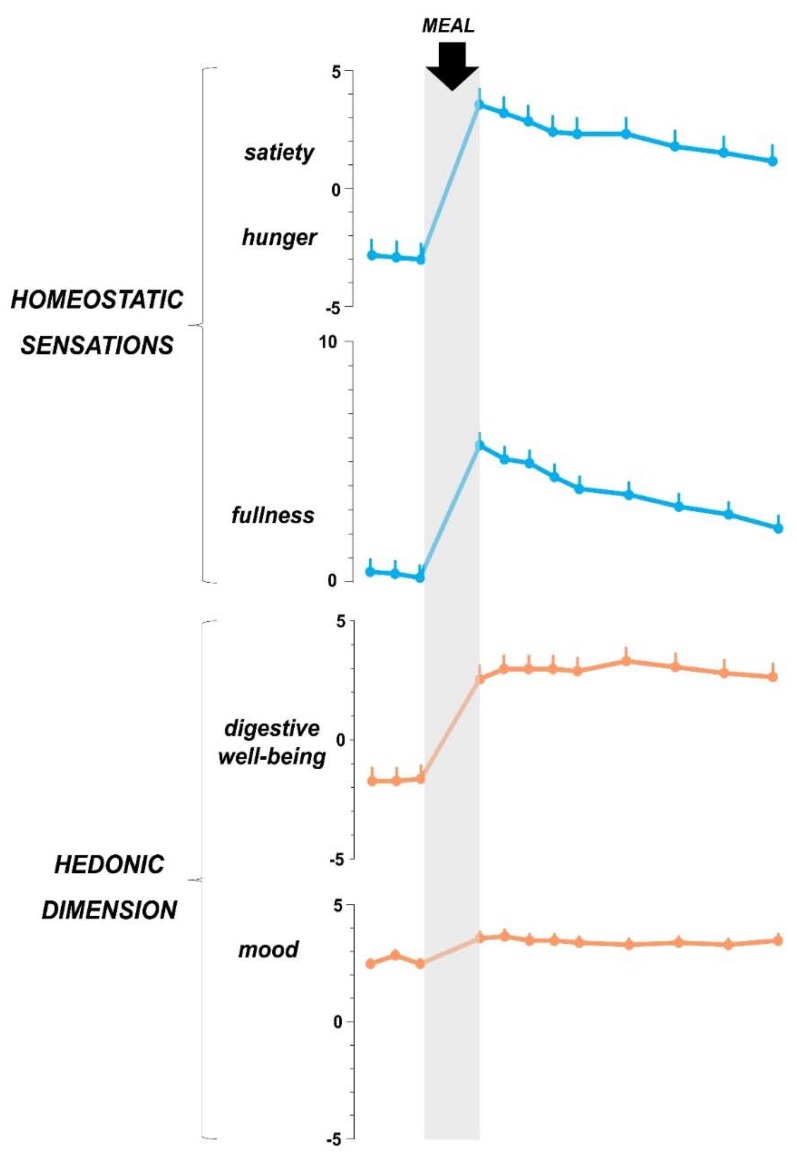
Sensations related to food ingestion. In healthy women (n = 12) a. palatable comfort meal induced homeostatic sensations (satiety, fullness) with pleasant hedonic dimension (increased digestive well-being and mood). Data from reference 79.
Figure 3
Figure 3
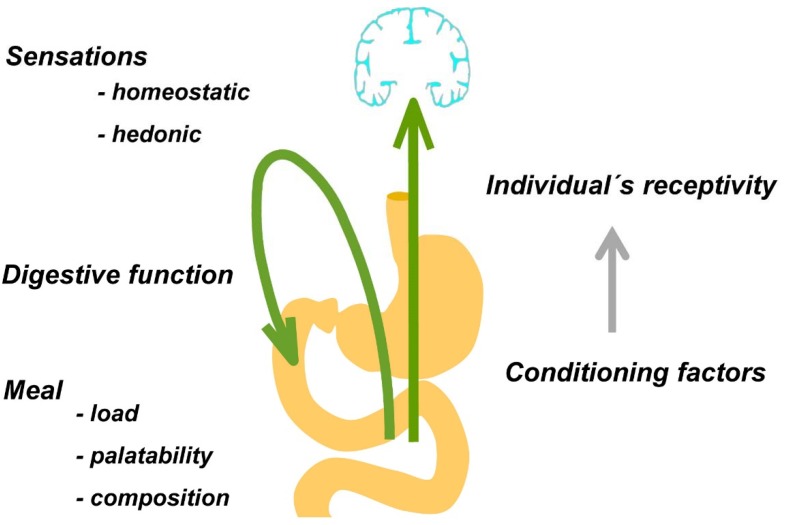
Biological responses to food ingestion. Meal ingestion induces digestive and sensory responses. Homeostatic (satiety, fullness) and hedonic sensations (digestive well-being and mood) depend on the characteristics of the meal, the digestive response, and the individual’s receptivity, which can be influenced by multiple conditioning factors. Adapted from reference [1].

References

    1. Pribic T., Azpiroz F. Biogastronomy: Factors that determine the biological response to meal ingestion. Neurogastroenterol. Motil. 2018;30:e13309. doi: 10.1111/nmo.13309. - DOI - PubMed
    1. Deloose E., Tack J. Redefining the functional roles of the gastrointestinal migrating motor complex and motilin in small bacterial overgrowth and hunger signaling. Am. J. Physiol. Gastrointest. Liver Physiol. 2016;310:G228–G233. doi: 10.1152/ajpgi.00212.2015. - DOI - PubMed
    1. Azpiroz F., Feinle C., Grundy D., Tack J. Gastric sensitivity and reflexes: Basic mechanism underlying clinical problems. J. Gastroenterol. 2014;49:206–218. doi: 10.1007/s00535-013-0917-8. - DOI - PubMed
    1. Boeckxstaens G., Camilleri M., Sifrim D., Houghton L.A., Elsenbruch S., Lindberg G., Azpiroz F., Parkman H.P. Fundamentals of Neurogastroenterology: Physiology/Motility—Sensation. Gastroenterology. 2016;150:1292–1304. doi: 10.1053/j.gastro.2016.02.030. - DOI - PubMed
    1. Bendezu R.A., Mego M., Monclus E., Merino X., Accarino A., Malagelada J.R., Navazo I., Azpiroz F. Colonic content: Effect of diet, meals, and defecation. Neurogastroenterol. Motil. 2017;29:e12930. doi: 10.1111/nmo.12930. - DOI - PubMed

LinkOut - more resources