


Trends in the epidemiology of young-onset colorectal cancer: a worldwide systematic review
- PMID: 32252672
- PMCID: PMC7137305
- DOI: 10.1186/s12885-020-06766-9
Trends in the epidemiology of young-onset colorectal cancer: a worldwide systematic review
Abstract
Background: Recent data suggest that the risk of young-onset colorectal cancer (yCRC), in adults less than 50 years of age, is increasing. To confirm findings and identify contemporary trends worldwide, we conducted a systematic review of studies examining population-level trends in yCRC epidemiology.
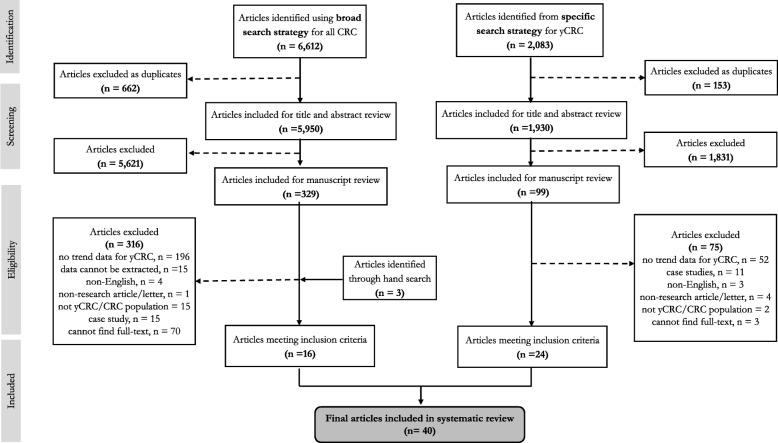
Methods: We searched MEDLINE (1946-2018), EMBASE (1974-2018), CINAHL (1982-2018), and Cochrane Database of Systematic Reviews (2005-2018) for studies that used an epidemiologic design, assessed trends in yCRC incidence or prevalence, and published in English. Extracted information included country, age cut-off for yCRC, and reported trends in incidence or prevalence (e.g. annual percent change [APC]). We pooled similarly reported trend estimates using random effects models.
Results: Our search yielded 8695 articles and after applying our inclusion criteria, we identified 40 studies from 12 countries across five continents. One study assessed yCRC prevalence trends reporting an APCp of + 2.6 and + 1.8 among 20-39 and 40-49 year olds, respectively. 39 studies assessed trends in yCRC incidence but with substantial variability in reporting. Meta-analysis of the most commonly reported trend estimate yielded a pooled overall APCi of + 1.33 (95% CI, 0.97 to 1.68; p < 0.0001) that is largely driven by findings from North America and Australia. Also contributing to these trends is the increasing risk of rectal cancer as among 14 studies assessing cancer site, nine showed an increased risk of rectal cancer in adults less than 50 years with APCi up to + 4.03 (p < 0.001).
Conclusions: Our systematic review highlights increasing yCRC risk in North America and Australia driven by rising rectal cancers in younger adults over the past two decades.
Keywords: Cancer; Epidemiology; Incidence; Meta-analysis; Young-adult cancer.
Conflict of interest statement
The authors have nothing to declare.
Figures
References
Publication types
MeSH terms
Grants and funding
LinkOut - more resources
Full Text Sources
Medical
Miscellaneous
