. 2020 Apr 6;22(1):69.
doi: 10.1186/s13075-020-02160-9.

Expression of interferon-regulated genes in juvenile dermatomyositis versus Mendelian autoinflammatory interferonopathies

Affiliations

Expression of interferon-regulated genes in juvenile dermatomyositis versus Mendelian autoinflammatory interferonopathies

Hanna Kim et al. Arthritis Res Ther. .

Abstract

Background: Juvenile dermatomyositis (JDM) is a systemic autoimmune disease with a prominent interferon (IFN) signature, but the pathogenesis of JDM and the etiology of its IFN signature remain unknown. The Mendelian autoinflammatory interferonopathies, Chronic Atypical Neutrophilic Dermatosis with Lipodystrophy and Elevated temperature (CANDLE) and STING-Associated Vasculopathy with onset in Infancy (SAVI), are caused by genetic mutations and have extremely elevated IFN signatures thought to drive pathology. The phenotypic overlap of some clinical features of CANDLE and SAVI with JDM led to the comparison of a standardized interferon-regulated gene score (IRG-S) in JDM and myositis-specific autoantibody (MSA) JDM subgroups, with CANDLE and SAVI.

Methods: A peripheral 28-component IRG-S assessed by NanoString™ in 57 JDM patients subtyped by MSA was compared with IRG-S in healthy controls (HC) and CANDLE/SAVI patients. Principal component analysis (PCA) was performed, and individual genes were evaluated for their contribution to the score. IRG-S were correlated with disease assessments and patient characteristics.

Results: IRG-S in JDM patients were significantly higher than in HC but lower than in CANDLE or SAVI. JDM IRG-S overlapped more with SAVI than CANDLE by PCA. Among MSA groups, anti-MDA5 autoantibody-positive patients' IRG-S overlapped most with SAVI. The IFI27 proportion was significantly higher in SAVI and CANDLE than JDM, but IFIT1 contributed more to IRG-S in JDM. Overall, the contribution of individual interferon-regulated genes (IRG) in JDM was more similar to SAVI. IRG-S correlated moderately with JDM disease activity measures (rs = 0.33-0.47) and more strongly with skin activity (rs = 0.58-0.79) in anti-TIF1 autoantibody-positive patients. Weakness and joint disease activity (multinomial OR 0.91 and 3.3) were the best predictors of high IRG-S.

Conclusions: Our findings demonstrate peripheral IRG expression in JDM overlaps with monogenic interferonopathies, particularly SAVI, and correlates with disease activity. Anti-MDA5 autoantibody-positive JDM IRG-S were notably more similar to SAVI. This may reflect both a shared IFN signature, which is driven by IFN-β and STING pathways in SAVI, as well as the shared phenotype of vasculopathy in SAVI and JDM, particularly in anti-MDA5 autoantibody-positive JDM, and indicate potential therapeutic targets for JDM.

Trial registration: ClinicalTrials.gov NCT02974595.

Keywords: (3–10): juvenile dermatomyositis; Biomarkers; Interferon; Interferonopathy; Myositis; Myositis-specific autoantibodies; Pediatric rheumatology.


Conflict of interest statement

The authors declare that they have no competing interests.

Figures
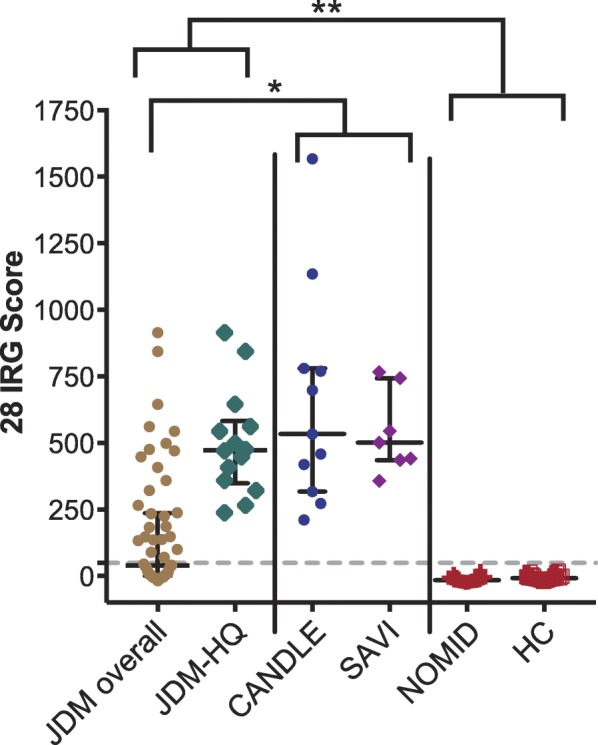
Fig. 1
Fig. 1
Peripheral blood interferon-regulated gene (IRG) scores in juvenile dermatomyositis (JDM) compared to monogenic autoinflammatory disease patients and healthy controls. Median and interquartile ranges are shown. Dotted horizontal line represents 95th percentile of healthy controls [22]. CANDLE (n = 11), SAVI (n = 7), NOMID (n = 18), HC (n = 26). JDM overall (n = 57):*q < 0.05, **q < 0.01. JDM-HQ (n = 14): **p < 0.01. JDM overall and JDM-HQ are higher than NOMID and HC; JDM overall is lower than CANDLE and SAVI. Abbreviations: IRG, interferon-regulated gene; JDM, juvenile dermatomyositis; JDM-HQ, highest-quartile scores in JDM; CANDLE, Chronic Atypical Neutrophilic Dermatosis with Lipodystrophy and Elevated temperature; SAVI, STING-Associated Vasculopathy with onset during Infancy; NOMID, neonatal-onset multisystem inflammatory disease; HC, healthy controls; IQR, interquartile range
Fig. 2
Fig. 2
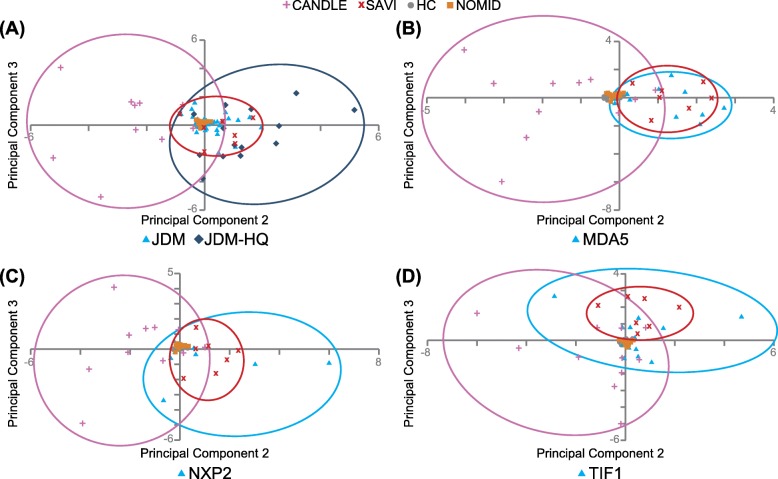
Principal component 2 (PC2) and 3 (PC3) scores from principal component analysis (PCA) of interferon-regulated gene (IRG) scores from JDM patients with other conditions. a PCA-A with JDM (including JDM highest quartile IRG score, JDM-HQ), CANDLE, SAVI, NOMID, and HC. b PCA-B with anti-MDA5 autoantibody-positive subgroup of JDM, CANDLE, SAVI, NOMID, and HC. c PCA-C with anti-NXP2 autoantibody-positive subgroup of JDM, CANDLE, SAVI, NOMID, and HC. d PCA-D with anti-TIF1 autoantibody-positive subgroup of JDM, CANDLE, SAVI, NOMID, and HC. Dotted circles represent each group, including CANDLE (pink), SAVI (red), and JDM-HQ or JDM myositis-specific autoantibody (MSA) group (anti-TIF1, anti-NXP2, anti-MDA5) (blue). JDM, as opposed to JDM-HQ, in a represents the lower 3 quartiles of JDM IRG scores. Abbreviations: IRG, interferon-regulated gene; JDM, juvenile dermatomyositis; JDM-HQ, highest-quartile scores in JDM; TIF1, subgroup of JDM with anti-TIF1 myositis-specific autoantibodies; NXP2, subgroup of JDM with anti-NXP2 myositis-specific autoantibodies; MDA5, subgroup of JDM with anti-MDA5 myositis-specific autoantibodies; neg, subgroup of JDM that was negative on testing for myositis-specific autoantibodies; CANDLE, Chronic Atypical Neutrophilic Dermatosis with Lipodystrophy and Elevated temperature; SAVI, STING-Associated Vasculopathy with onset during Infancy; NOMID, neonatal-onset multisystem inflammatory disease; HC, healthy controls
Fig. 3
Fig. 3
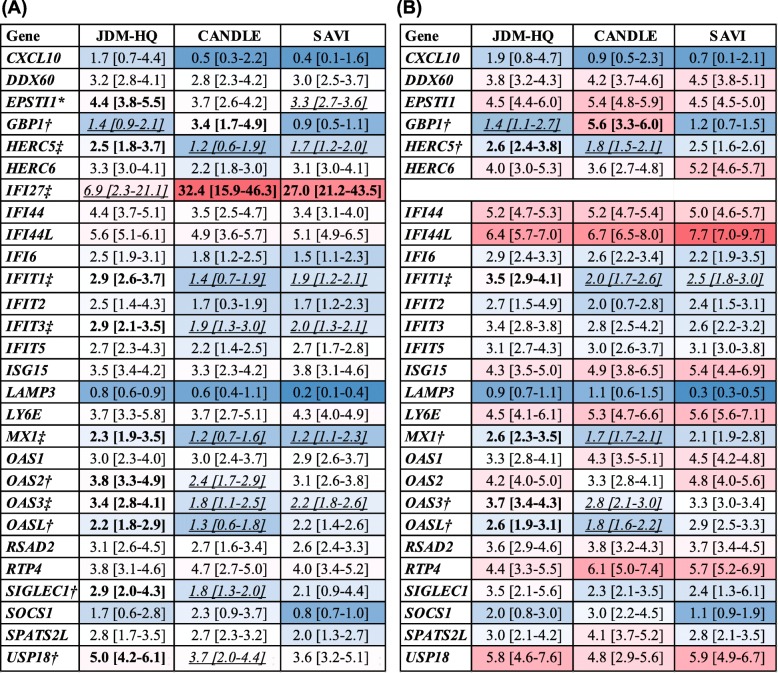
Proportion of individual genes from 28 normalized IRG-S for JDM highest quartile (JDM-HQ), CANDLE, SAVI. *JDM-HQ gene proportion significantly different from SAVI. JDM-HQ gene proportion significantly different from CANDLE. JDM-HQ gene proportion significantly different from CANDLE and SAVI. Heat map of median proportion of the respective gene by normalized Z-score with red for highest proportion and dark blue for lowest proportion. Bold indicates values in a diagnosis group(s) significantly higher compared to values in the italicized/underlined group(s). Italicized/underlined indicates values in a diagnosis group(s) significantly lower compared to values in bold group(s). a All 28 IRGs are included. b IFI27 has been removed. Individual gene percentages (%) of the total IRG score, by normalized Z-scores (see the “Methods” section) are shown in alphabetical order by gene as median and interquartile ranges for JDM highest-quartile, CANDLE, and SAVI patients. Medians percentages of each gene by diagnosis may not sum to 100 due to skewing in the group, but they do in individual patients. JDM-HQ (n = 14) included 4 with anti-TIF1 Ab, 4 with anti-MDA4 Ab, 3 with anti-NXP2 Ab, and 3 MSA-neg. The JDM Physician Global Activity (PGA) median is 4.1/10 with an interquartile range of 2.4 to 4.7. Abbreviations: IRG, interferon-regulated gene; JDM-HQ, juvenile dermatomyositis patients with the highest quartile of IRG scores; CANDLE, Chronic Atypical Neutrophilic Dermatosis with Lipodystrophy and Elevated temperature; SAVI, STING associated Vasculopathy with onset during Infancy; anti-TIF1 Ab, includes subgroup of JDM patients with anti-TIF1 autoantibodies; anti-NXP2 Ab, subgroup of JDM patients with anti-NXP2 autoantibodies; anti-MDA5 Ab, includes subgroup of JDM patients with anti-MDA5 autoantibodies; MSA-neg, includes subgroup of JDM that is negative for myositis-specific autoantibodies; PGA. Physician Global Activity on 0–10 visual analog scale

References

    1. Pachman LM, Khojah AM. Advances in juvenile dermatomyositis: myositis specific antibodies aid in understanding disease heterogeneity. J Pediatr. 2018;195:16–27. doi: 10.1016/j.jpeds.2017.12.053. - DOI - PMC - PubMed
    1. Tansley SL, Simou S, Shaddick G, Betteridge ZE, Almeida B, Gunawardena H, Thomson W, Beresford MW, Midgley A, Muntoni F, et al. Autoantibodies in juvenile-onset myositis: their diagnostic value and associated clinical phenotype in a large UK cohort. J Autoimmun. 2017;84:55–64. doi: 10.1016/j.jaut.2017.06.007. - DOI - PMC - PubMed
    1. Rider LG, Nistala K. The juvenile idiopathic inflammatory myopathies: pathogenesis, clinical and autoantibody phenotypes, and outcomes. J Intern Med. 2016;280(1):24–38. doi: 10.1111/joim.12444. - DOI - PMC - PubMed
    1. Habers GE, Huber AM, Mamyrova G, Targoff IN, O'Hanlon TP, Adams S, Pandey JP, Boonacker C, van Brussel M, Miller FW, et al. Brief report: association of myositis autoantibodies, clinical features, and environmental exposures at illness onset with disease course in juvenile myositis. Arthritis Rheumatol. 2016;68(3):761–768. doi: 10.1002/art.39466. - DOI - PMC - PubMed
    1. Miller FW, Lamb JA, Schmidt J, Nagaraju K. Risk factors and disease mechanisms in myositis. Nat Rev Rheumatol. 2018;14(5):255–268. doi: 10.1038/nrrheum.2018.48. - DOI - PMC - PubMed

Publication types

MeSH terms

Associated data