Fructose Production and Metabolism in the Kidney
- PMID: 32253274
- PMCID: PMC7217403
- DOI: 10.1681/ASN.2019101015
Fructose Production and Metabolism in the Kidney
Abstract
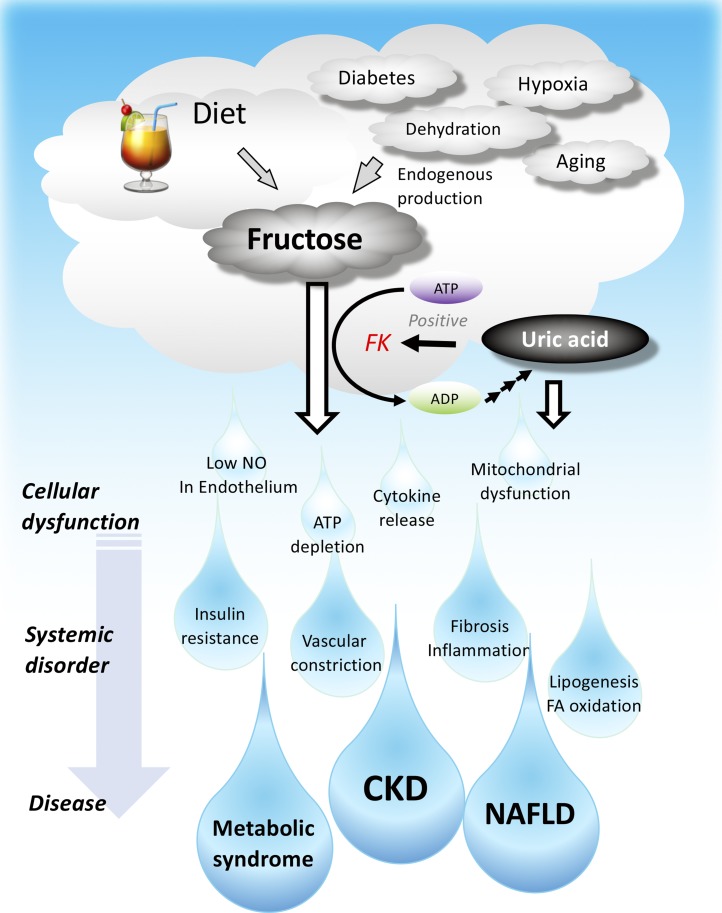
Understanding fructose metabolism might provide insights to renal pathophysiology. To support systemic glucose concentration, the proximal tubular cells reabsorb fructose as a substrate for gluconeogenesis. However, in instances when fructose intake is excessive, fructose metabolism is costly, resulting in energy depletion, uric acid generation, inflammation, and fibrosis in the kidney. A recent scientific advance is the discovery that fructose can be endogenously produced from glucose under pathologic conditions, not only in kidney diseases, but also in diabetes, in cardiac hypertrophy, and with dehydration. Why humans have such a deleterious mechanism to produce fructose is unknown, but it may relate to an evolutionary benefit in the past. In this article, we aim to illuminate the roles of fructose as it relates to gluconeogenesis and fructoneogenesis in the kidney.
Keywords: fructolysis; fructoneogenesis; fructose; gluconeogenesis; glycolysis.
Copyright © 2020 by the American Society of Nephrology.
Figures


References
-
- Junk WJ: Temporary fat storage, an adaptation of some fish species to the water level fluctuations and related environmental changes of the Amazon river. Amazoniana 9: 315–351, 1985
-
- Bairlein F: How to get fat: Nutritional mechanisms of seasonal fat accumulation in migratory songbirds. Naturwissenschaften 89: 1–10, 2002 - PubMed
-
- Stenvinkel P, Jani AH, Johnson RJ: Hibernating bears (Ursidae): Metabolic magicians of definite interest for the nephrologist. Kidney Int 83: 207–212, 2013 - PubMed
-
- Carey HV, Andrews MT, Martin SL: Mammalian hibernation: Cellular and molecular responses to depressed metabolism and low temperature. Physiol Rev 83: 1153–1181, 2003 - PubMed
Publication types
MeSH terms
Substances
Grants and funding
LinkOut - more resources
Full Text Sources
Miscellaneous