


The remodelling index risk stratifies patients with hypertensive left ventricular hypertrophy
- PMID: 32255186
- PMCID: PMC8110315
- DOI: 10.1093/ehjci/jeaa040
The remodelling index risk stratifies patients with hypertensive left ventricular hypertrophy
Abstract
Aims: Hypertensive left ventricular hypertrophy (LVH) is associated with increased cardiovascular events. We previously developed the remodelling index (RI) that incorporated left ventricular (LV) volume and wall-thickness in a single measure of advanced hypertrophy in hypertensive patients. This study examined the prognostic potential of the RI in reference to contemporary LVH classifications.
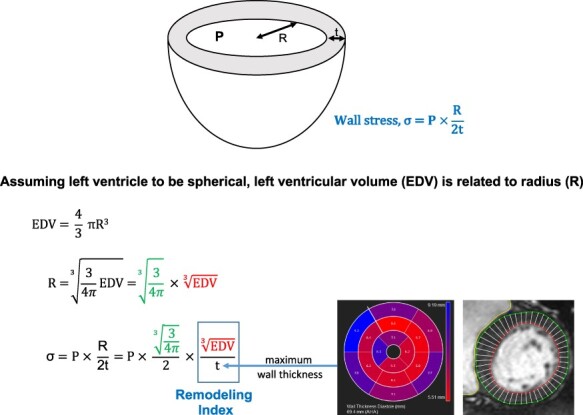
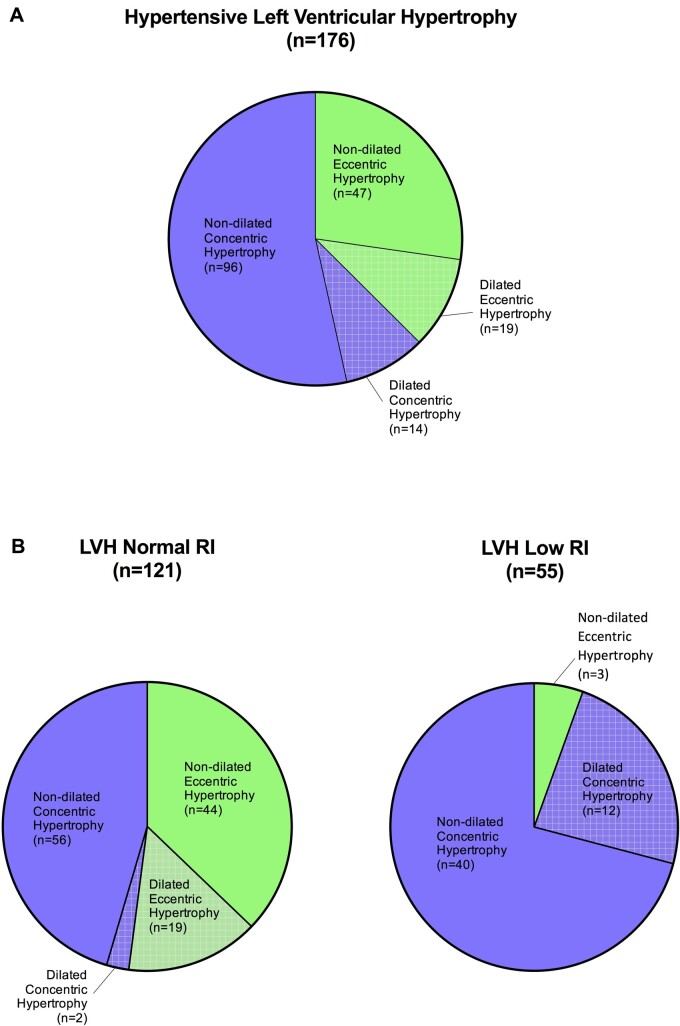
Methods and results: Cardiovascular magnetic resonance was performed in 400 asymptomatic hypertensive patients. The newly derived RI (EDV3t, where EDV is LV end-diastolic volume and t is the maximal wall thickness across 16 myocardial segments) stratified hypertensive patients: no LVH, LVH with normal RI (LVHNormal-RI), and LVH with low RI (LVHLow-RI). The primary outcome was a composite of all-cause mortality, acute coronary syndromes, strokes, and decompensated heart failure. LVHLow-RI was associated with increased LV mass index, fibrosis burden, impaired myocardial function and elevated biochemical markers of myocardial injury (high-sensitive cardiac troponin I), and wall stress. Over 18.3 ± 7.0 months (601.3 patient-years), 14 adverse events occurred (2.2 events/100 patient-years). Patients with LVHLow-RI had more than a five-fold increase in adverse events compared to those with LVHNormal-RI (11.6 events/100 patient-years vs. 2.0 events/100 patient-years, respectively; log-rank P < 0.001). The RI provided incremental prognostic value over and above a model consisting of clinical variables, LVH and concentricity; and predicted adverse events independent of clinical variables, LVH, and other prognostic markers. Concentric and eccentric LVH were associated with adverse prognosis (log-rank P = 0.62) that was similar to the natural history of hypertensive LVH (5.1 events/100 patient-years).
Conclusion: The RI provides prognostic value that improves risk stratification of hypertensive LVH.
Keywords: cardiac remodelling; cardiovascular magnetic resonance; hypertensive heart disease; left ventricular hypertrophy.
© The Author(s) 2020. Published by Oxford University Press on behalf of the European Society of Cardiology.
Figures


References
-
- Vakili BA, Okin PM, Devereux RB.. Prognostic implications of left ventricular hypertrophy. Am Heart J 2001;141:334–41. - PubMed
-
- Verdecchia P, Carini G, Circo A, Dovellini E, Giovannini E, Lombardo M. et al. Left ventricular mass and cardiovascular morbidity in essential hypertension: the MAVI study. J Am Coll Cardiol 2001;38:1829–35. - PubMed
-
- Schillaci G, Verdecchia P, Porcellati C, Cuccurullo O, Cosco C, Perticone F.. Continuous relation between left ventricular mass and cardiovascular risk in essential hypertension. Hypertension 2000;35:580–6. - PubMed
-
- Ganau A, Devereux RB, Roman MJ, de Simone G, Pickering TG, Saba PS. et al. Patterns of left ventricular hypertrophy and geometric remodeling in essential hypertension. J Am Coll Cardiol 1992;19:1550–8. - PubMed
-
- Marwick TH, Gillebert TC, Aurigemma G, Chirinos J, Derumeaux G, Galderisi M. et al. Recommendations on the use of echocardiography in adult hypertension: a report from the European Association of Cardiovascular Imaging (EACVI) and the American Society of Echocardiography (ASE). Eur Heart J Cardiovasc Imaging 2015;16:577–605. - PubMed
MeSH terms
LinkOut - more resources
Full Text Sources
Medical
Research Materials
