


Educational, supportive and behavioural interventions to improve usage of continuous positive airway pressure machines in adults with obstructive sleep apnoea
- PMID: 32255210
- PMCID: PMC7137251
- DOI: 10.1002/14651858.CD007736.pub3
Educational, supportive and behavioural interventions to improve usage of continuous positive airway pressure machines in adults with obstructive sleep apnoea
Abstract
Background: Although highly effective in the treatment of obstructive sleep apnoea (OSA), continuous positive airway pressure (CPAP) is not universally accepted by users. Educational, supportive and behavioural interventions may help people with OSA initiate and maintain regular and continued use of CPAP.
Objectives: To assess the effectiveness of educational, supportive, behavioural, or mixed (combination of two or more intervention types) strategies that aim to encourage adults who have been prescribed CPAP to use their devices.
Search methods: Searches were conducted on the Cochrane Airways Group Specialised Register of trials. Searches are current to 29 April 2019.
Selection criteria: We included randomised controlled trials (RCTs) that assessed intervention(s) designed to inform participants about CPAP/OSA, to support them in using CPAP, or to modify their behaviour to increase use of CPAP devices.
Data collection and analysis: We assessed studies to determine their suitability for inclusion in the review. Data were extracted independently and were entered into RevMan for analysis. 'Risk of bias' assessments were performed, using the updated 'Risk of bias 2' tool, for the primary outcome, CPAP usage. Study-level 'Risk of bias' assessments were performed using the original 'Risk of bias' tool. GRADE assessment was performed using GRADEpro.
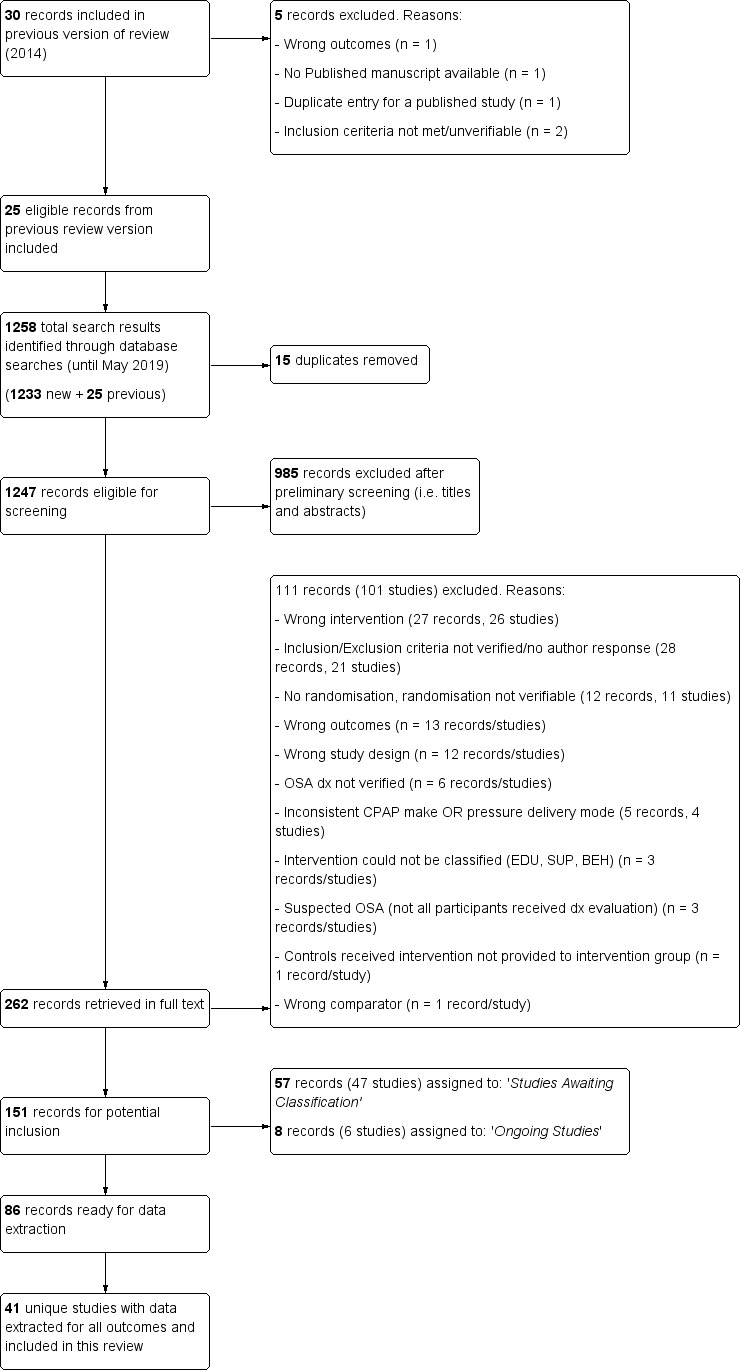
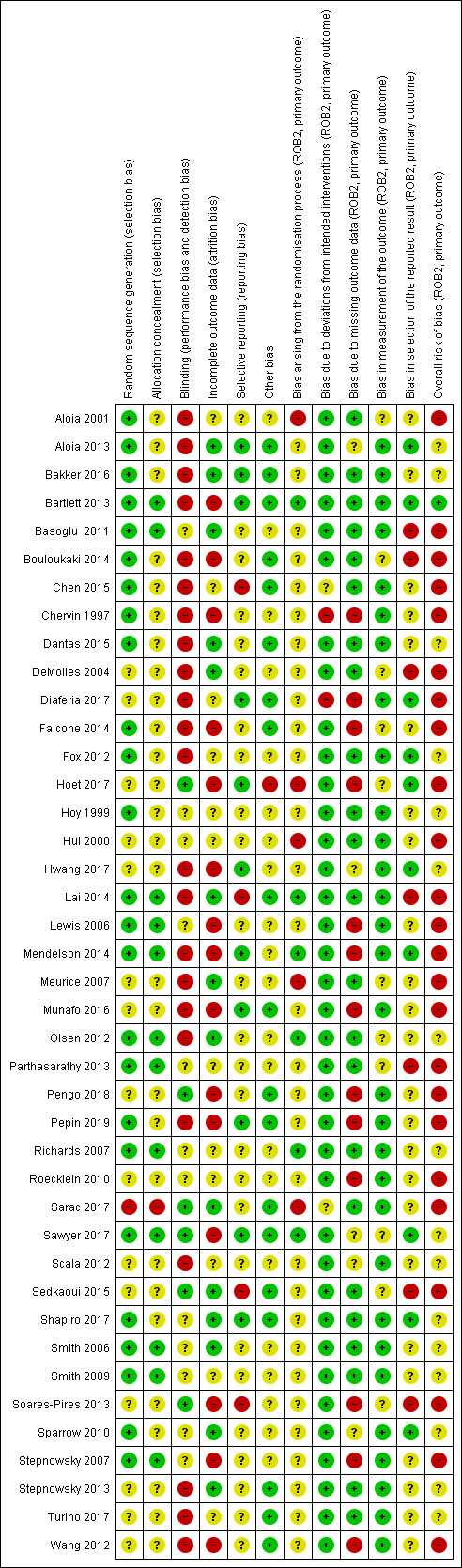
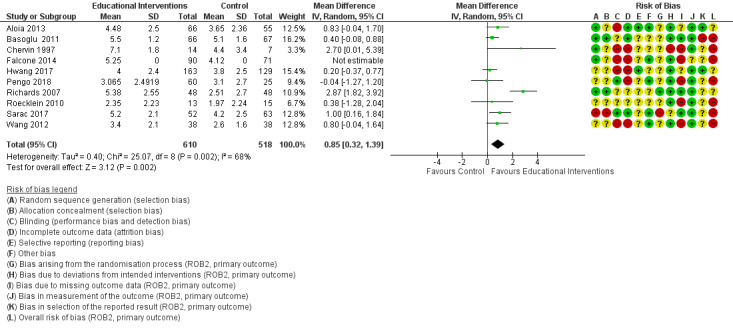
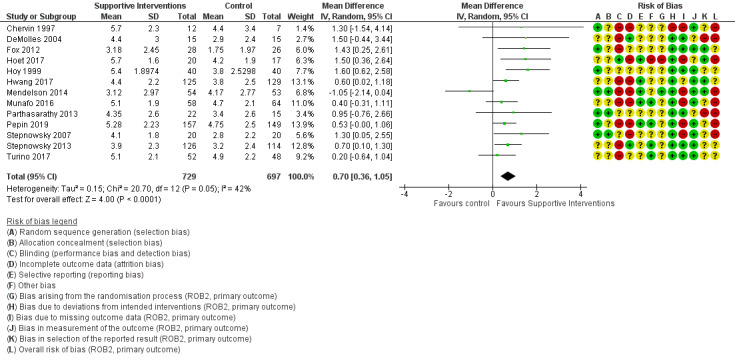
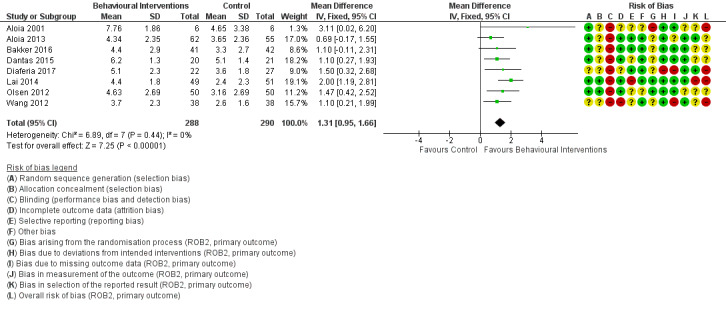
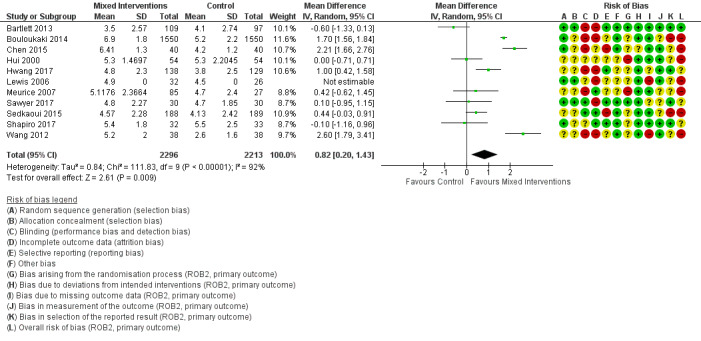
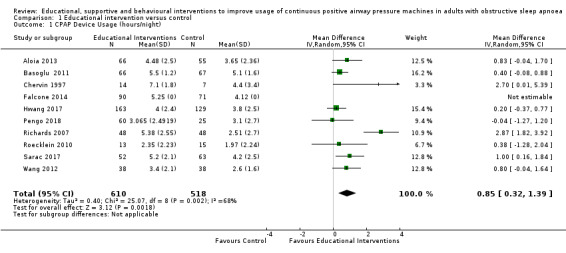
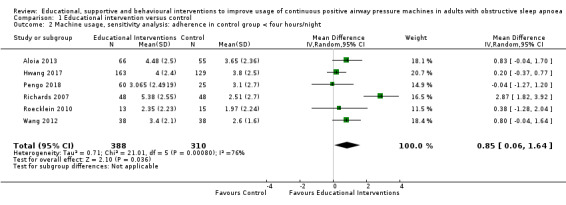
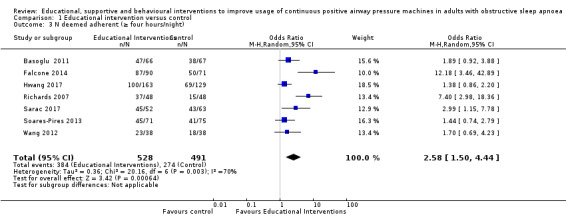
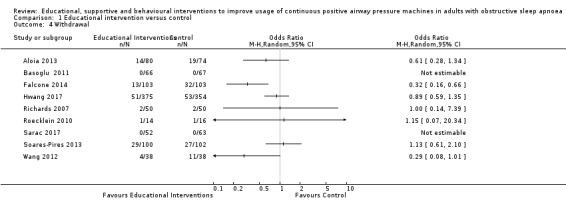
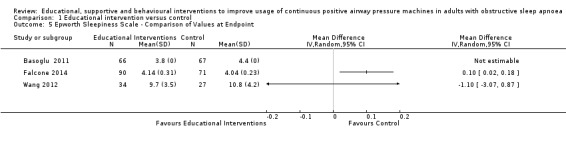
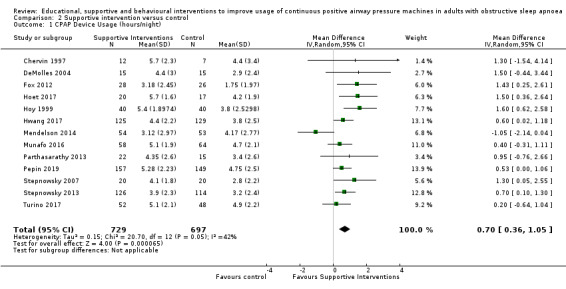
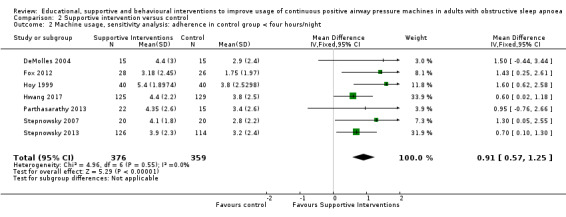
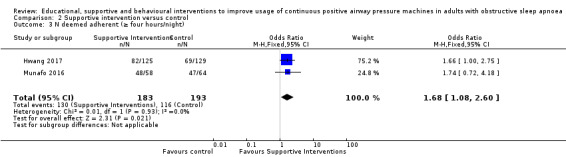
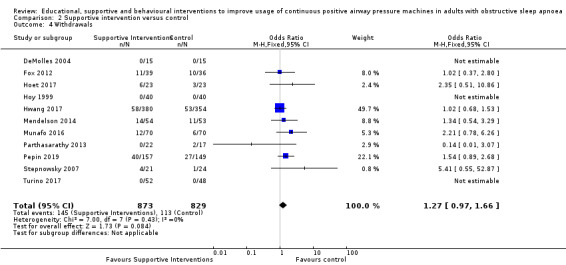
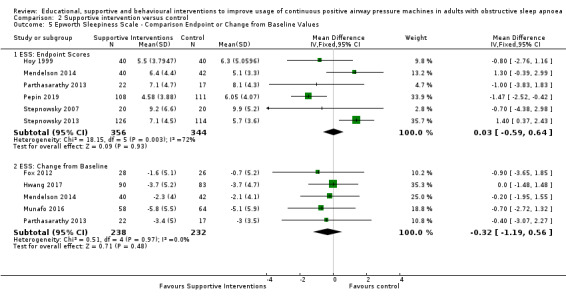
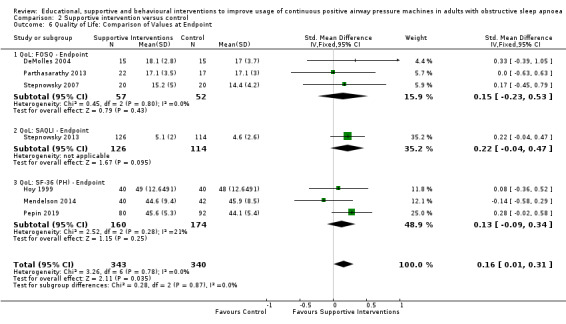
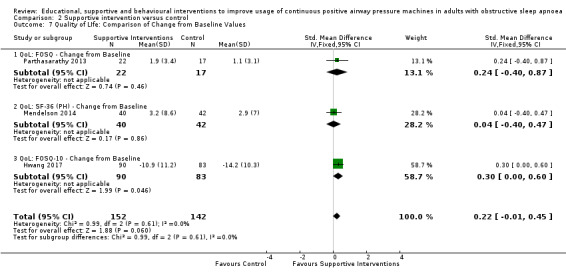
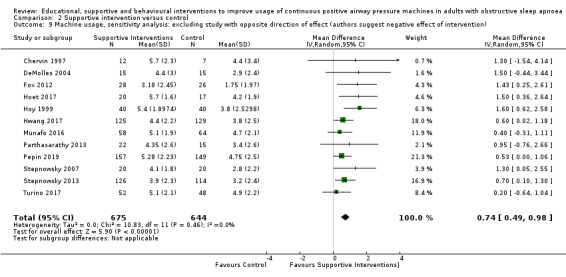
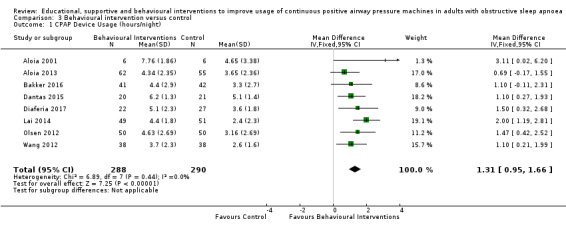
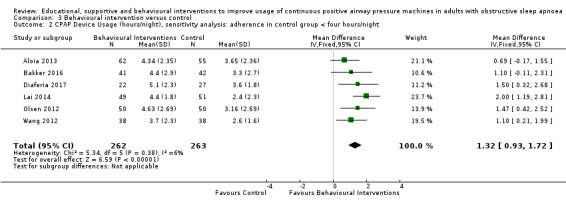
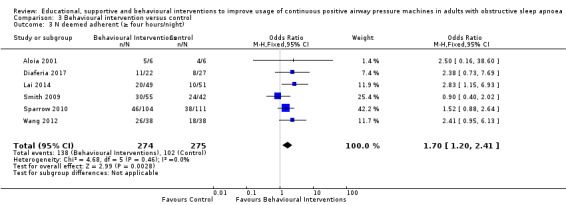
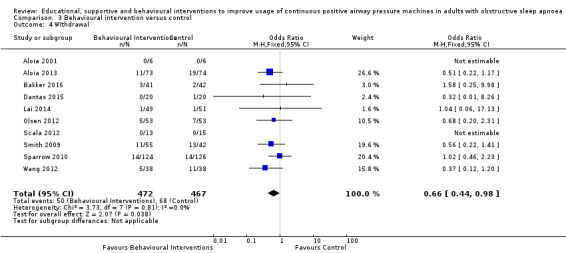
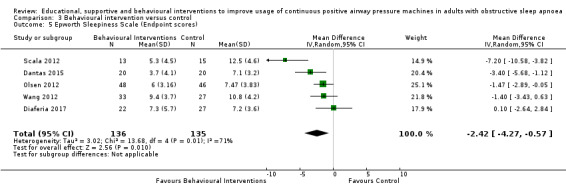
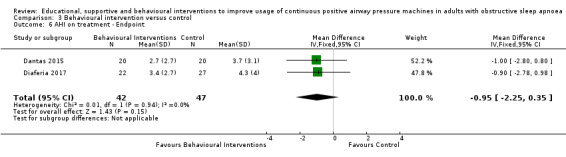
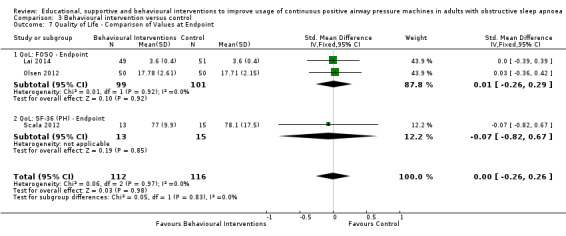
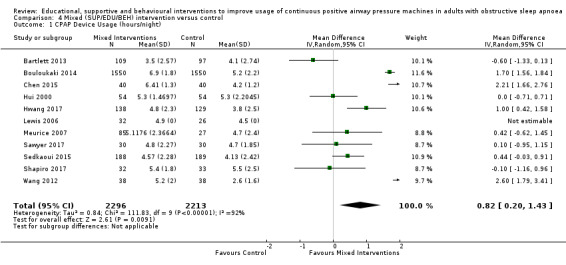
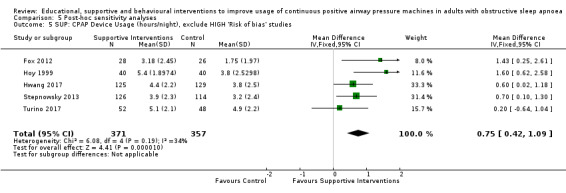
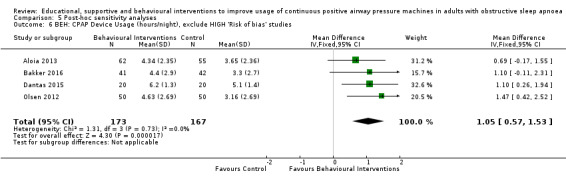
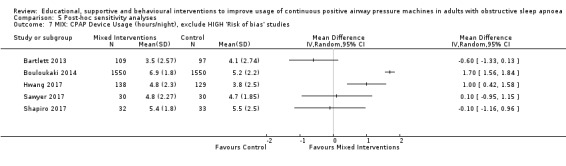
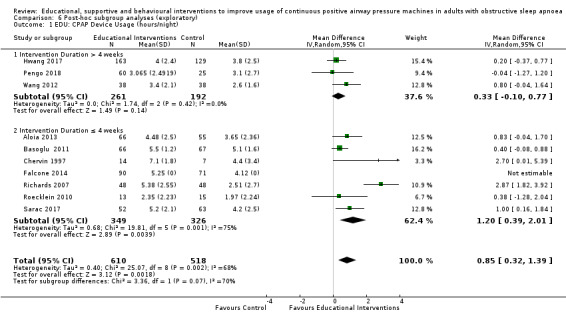
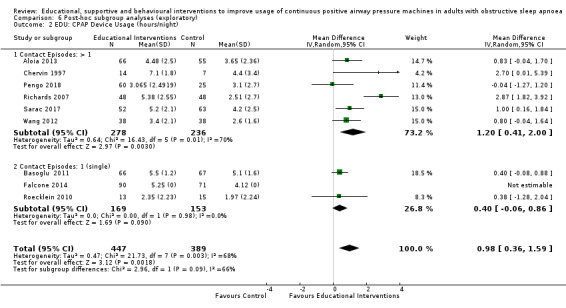
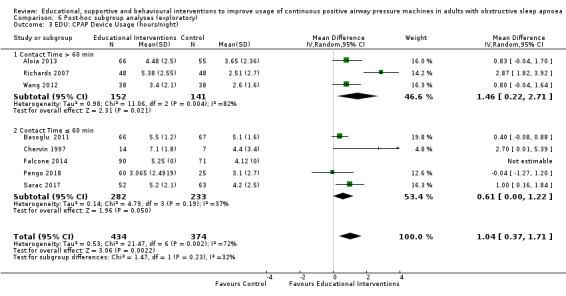
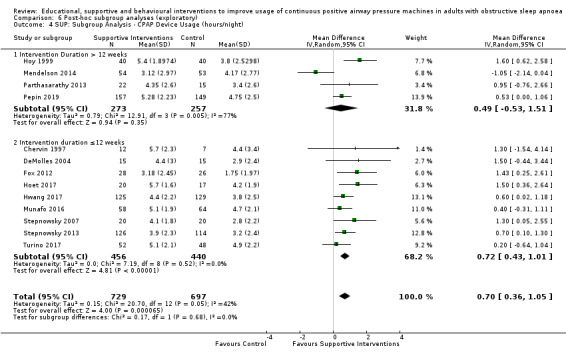
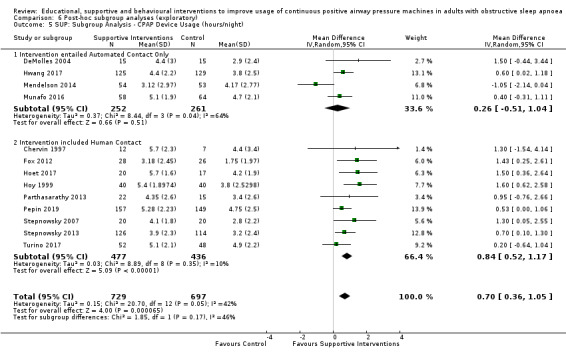
Main results: Forty-one studies (9005 participants) are included in this review; 16 of these studies are newly identified with updated searches. Baseline Epworth Sleepiness Scale (ESS) scores indicate that most participants suffered from excessive daytime sleepiness. The majority of recruited participants had not used CPAP previously. When examining risk of bias for the primary outcome of hourly machine usage/night, 58.3% studies have high overall risk (24/41 studies), 39.0% have some concerns (16/41 studies), and 2.4% have low overall risk (1/41 studies). We are uncertain whether educational interventions improve device usage, as the certainty of evidence was assessed as very low. We were unable to perform meta-analyses for number of withdrawals and symptom scores due to high study heterogeneity. Supportive interventions probably increase device usage by 0.70 hours/night (95% confidence interval (CI) 0.36 to 1.05, N = 1426, 13 studies, moderate-certainty evidence), and low-certainty evidence indicates that the number of participants who used their devices ≥ 4 hours/night may increase from 601 to 717 per 1000 (odds ratio (OR), 1.68, 95% CI 1.08 to 2.60, N = 376, 2 studies). However, the number of withdrawals may also increase from 136 to 167 per 1000 (OR 1.27, 95% CI 0.97 to 1.66, N = 1702, 11 studies, low-certainty evidence). Participants may experience small improvements in symptoms (ESS score -0.32 points, 95% CI -1.19 to 0.56, N = 470, 5 studies, low-certainty evidence), and we are uncertain whether quality of life improves with supportive interventions, as the certainty of evidence was assessed as very low. When compared with usual care, behavioural interventions produce a clinically-meaningful increase in device usage by 1.31 hours/night (95% CI 0.95 to 1.66, N = 578, 8 studies, high-certainty evidence), probably increase the number of participants who used their machines ≥ 4 hours/night from 371 to 501 per 1000 (OR 1.70, 95% CI 1.20 to 2.41, N = 549, 6 studies, high-certainty evidence), and reduce the number of study withdrawals from 146 to 101 per 1000 (OR 0.66, 95% CI 0.44 to 0.98, N = 939, 10 studies, high-certainty evidence). Behavioural interventions may reduce symptoms (ESS score -2.42 points, 95% CI -4.27 to -0.57, N = 272, 5 studies, low-certainty evidence), but probably have no effect on quality of life (Functional Outcomes of Sleep Questionnaire (FOSQ), standardised mean difference (SMD) 0.00, 0.95% CI -0.26 to 0.26, N = 228, 3 studies, moderate-certainty evidence). We are uncertain whether behavioural interventions improve apnoea hypopnoea index (AHI), as the certainty of evidence was assessed as very low. We are uncertain if mixed interventions improve device usage, increase the number of participants using their machines ≥ 4 hours/night, reduce study withdrawals, improve quality of life, or reduce anxiety symptoms, as the certainty of evidence for these outcomes was assessed to be very low. Symptom scores via the ESS could not be measured due to considerable heterogeneity between studies.
Authors' conclusions: In CPAP-naïve people with OSA, high-certainty evidence indicates that behavioural interventions yield a clinically-significant increase in hourly device usage when compared with usual care. Moderate certainty evidence shows that supportive interventions increase usage modestly. Very low-certainty evidence shows that educational and mixed interventions may modestly increase CPAP usage. The impact of improved CPAP usage on daytime sleepiness, quality of life, and mood and anxiety scores remains unclear since these outcomes were not assessed in the majority of included studies. Studies addressing the choice of interventions that best match individual patient needs and therefore result in the most successful and cost-effective therapy are needed.
Copyright © 2020 The Cochrane Collaboration. Published by John Wiley & Sons, Ltd.
Conflict of interest statement
K. Askland: none known.
L. Wright: is employed by AstraZeneca Canada. AstraZeneca Canada has no financial interest in the findings of this non‐pharmaceutical review, nor do they have business involvement with CPAP devices or any competing interventions for sleep apnoea.
D. Wozniak: none known.
T. Emmanuel: none known.
J. Caston: none known.
I. Smith: 2018 speakers fee at conference sponsored by Fisher and Paykel (topic aviation medicine). 2018 support for conference attendance Itamar Medical, manufacturer of sleep diagnostic equipment.
Figures
Update of
-
Educational, supportive and behavioural interventions to improve usage of continuous positive airway pressure machines in adults with obstructive sleep apnoea.Cochrane Database Syst Rev. 2014 Jan 8;(1):CD007736. doi: 10.1002/14651858.CD007736.pub2. Cochrane Database Syst Rev. 2014. Update in: Cochrane Database Syst Rev. 2020 Apr 7;4:CD007736. doi: 10.1002/14651858.CD007736.pub3. PMID: 24399660 Updated.
Comment in
-
Interventions to Improve Use of CPAP Machines in Adults with Obstructive Sleep Apnea.Am Fam Physician. 2021 Oct 1;104(4):356-358. Am Fam Physician. 2021. PMID: 34652100 No abstract available.
References
References to studies included in this review
Aloia 2001 {published data only}
-
- Aloia MS, Dio L, Ilnicky N, Perlis ML, Greenblatt DW, Giles DE. Improving compliance with nasal CPAP in older adults with OAHS. Sleep and Breathing 2001;5(1):13‐21. - PubMed
-
- Aloia MS, Ilnicky N, Dio P, Perlis M, Greenblatt DW, Giles DE. Neuropsychological changes and treatment compliance in older adults. Journal of Psychosomatic Research 2003;54(1):71‐6. - PubMed
Aloia 2013 {published data only}
-
- Aloia MS, Arnedt JT, Strand M, Millman RP, Borrelli B. Motivational enhancement to improve adherence to positive airway pressure in patients with obstructive sleep apnea: a randomized controlled trial. Sleep MISC1 ‐ SLP. Darien IL 60561, United States: United States Associated Professional Sleep Societies,LLC, 2012; Vol. 812 0087;36(11):1655‐62 U. [CRSSTD ‐ 4224356] - PMC - PubMed
Bakker 2016 {published data only}
-
- Bakker JP, Wang R, Weng J, Aloia MS, Toth C, Morrical MG, Gleason KJ, et al. Motivational enhancement for increasing adherence to CPAP: a randomized controlled trial. Chest. United States Elsevier B.V., 2016; Vol. 150 MISC1 ‐ SLP(2 AID ‐ S0012‐3692(16)45716‐8):337‐345. [10.1016/j.chest.2016.03.019 CNO ‐ CN‐01139857] - PMC - PubMed
-
- NCT01261390. Sleep apnea intervention for cardiovascular disease reduction. clinicaltrials.gov/show/NCT01261390 2010. [CRSSTD ‐ 6863291]
-
- Yaggi HK, Sico J, Concato J, Qin L, Tobias L, Bravata D. Diagnosing and treating sleep apnea in patients with acute cerebrovascular disease: the sleep tight study. Sleep [Conference]. Associated Professional Sleep Societies,LLC, 2013; Vol. 39 MISC1 ‐ SLP():A134. [Ref ID: 26333]
Bartlett 2013 {published data only}
-
- Bartlett D, Moy E, Wong K, Richards D, Espie C, Cistulli P, et al. Can we increase adherence to CPAP treatment for obstructive sleep apnea (OSA) with a group cognitive behavioural therapy (CBT) treatment intervention: a randomised trial. Conference poster RTY. 2013; Vol. CRSSTD ‐ 4218951:NA. [CRSSTD ‐ 4218951]
-
- Bartlett DJ, Hoyos CM, Wong KK, Dianne R, Ronald GR, Peter LY. The role of social cognitive theory (SCT) in CPAP adherence: Data from two randomised controlled studies. Sleep and Biological Rhythms. Conference: Worldsleep2011. Blackwell Publishing, 2011; Vol. 9 MISC1 ‐ SLP(4):295.
Basoglu 2011 {published and unpublished data}
-
- Basoglu OK, Midilli M, Midilli R, Bilgen C. Adherence to continuous positive airway pressure therapy in obstructive sleep apnea syndrome: effect of visual education. Sleep and Breathing 2012;16(4):1193‐200. - PubMed
Bouloukaki 2014 {published data only}
-
- Bouloukaki I, Giannadaki K, Mermigkis C, Mauroudi E, Moniaki V, Siafakas N, et al. Intense versus standard follow up to improve continuous positive airway pressure compliance [Abstract]. European Respiratory Society Annual Congress, 2013 Sept 7‐11. Barcelona, Spain: European Respiratory Society, 2013; Vol. 42 MISC1 ‐ SLP(Suppl 57):739s[P3591]. - PubMed
-
- Bouloukaki I, Giannadaki K, Mermigkis C, Tzanakis N, Mauroudi E, Moniaki V, et al. Intensive versus standard follow‐up to improve continuous positive airway pressure compliance. European Respritory Journal 2014;44:1262‐74. - PubMed
-
- NCT02016339. Intensive versus standard follow up to improve continuous positive airway pressure (CPAP) compliance. clinicaltrials.gov/ct2/show/NCT02016339 (first received 20 December 2013). [NCT02016339]
Chen 2015 {published data only}
Chervin 1997 {published data only}
-
- Chervin RD, Theut S, Bassetti C, Aldrich MS. Compliance with nasal CPAP can be improved by simple interventions. Sleep 1997;20(4):284‐9. - PubMed
Dantas 2015 {published data only}
-
- Dantas AP, Winck JC, Figueiredo‐Braga M. Adherence to APAP in obstructive sleep apnea syndrome: effectiveness of a motivational intervention. Schlaf & Atmung [Sleep & breathing]. 2014; Vol. 19 MISC1 ‐ SLP(1):327‐34. - PubMed
-
- Dantas AP, Winck JC, Figueiredo‐Braga M. Adherence to APAP in obstructive sleep apnea syndrome: effectiveness of a motivational intervention. Sleep Breath 2015;19:327‐34. - PubMed
DeMolles 2004 {published data only}
-
- DeMolles DA, Sparrow D, Gottlieb DJ, Friedman R. A pilot trial of a telecommunications system in sleep apnea management. Medical Care 2004;42(8):764‐9. - PubMed
Diaferia 2017 {published data only}
-
- Diaferia G, Santos‐Silva R, Truksinas E, Haddad FL, Santos R, Bommarito S, et al. Myofunctional therapy improves adherence to continuous positive airway pressure treatment. Sleep and Breathing. Springer Verlag, 2016; Vol. MISC2 ‐ 2016‐12:1‐9. - PubMed
-
- Diaféria G, Santos‐Silva R, Truksinas E, Haddad FL, Santos R, Bommarito S, et al. Myofunctional therapy improves adherence to continuous positive airway pressure treatment. Sleep and Breathing 2017;21(2):387‐95. - PubMed
Falcone 2014 {published data only}
-
- Falcone VA, Damiani MF, Quaranta VN, Capozzolo A, Resta O. Polysomnograph chart view by patients: a new educational strategy to improve CPAP adherence in sleep apnea therapy. Respiratory Care 2014;59(2):193‐8. - PubMed
Fox 2012 {published data only}
-
- Fox N, Hirsch‐Allen A, Goodfellow E, Wenner J, Fleetham JA, Ryan C, et al. Can a telemedicine monitoring system improve CPAP adherence In patients with obstructive sleep apnea (OSA)? [Abstract]. American Journal of Respiratory and Critical Care Medicine. American Thoracic Society, 2010; Vol. 181 MISC1 ‐ SLP (1 MeetingAbstracts):A5570.
-
- NCT00561860. Use of a remote‐monitoring system to diagnose and treat obstructive sleep apnea. clinicaltrials.gov/show/NCT00561860 21 November 2007.
Hoet 2017 {published data only}
-
- Hoet F, Libert W, Sanida C, Broecke S, Bruyneel AV, Bruyneel M. Telemonitoring in continuous positive airway pressure‐treated patients improves delay to first intervention and early compliance: a randomized trial. Sleep Medicine 2017;39:77‐83. - PubMed
-
- NCT02773953. Impact of telemonitoring to improve adherence in continuous positive airway pressure (CPAP)‐treated patients. clinicaltrials.gov/ct2/show/NCT02773953 (first received 16 May 2016). [NCT02773953]
Hoy 1999 {published data only}
-
- Hoy CJ, Vennelle M, Kingshott RN, Engleman HM, Douglas NJ. Can intensive support improve continuous positive airway pressure use in patients with the sleep apnea/hypopnea syndrome?. American Journal of Respiratory and Criticalcal Care Medicine 1999;159(4):1096‐100. - PubMed
Hui 2000 {published data only}
-
- Hui DS, Chan JK, Choy DK, Ko FW, Li TS, Leung RC, et al. Effects of augmented continuous positive airway pressure education and support on compliance and outcome in a Chinese population. Chest 2000;117(5):1410‐5. - PubMed
Hwang 2017 {published data only}
-
- Chang J, Derose S, Benjafield A, Crocker M, Kim J, Becker K, et al. Acceptance and impact of telemedicine in patient sub‐groups with obstructive sleep apnea: analysis from the tele‐OSA randomized clinical trial. Sleep. Conference: 31st anniversary meeting of the associated professional sleep societies, LLC, SLEEP. Netherlands Associated Professional Sleep Societies,LLC, 2017; Vol. 40 MISC1 ‐ SLP():A201‐A202. [CRSSTD ‐ 6863244 DBP ‐ 201723 ]
-
- Chang J, Kim J, Becker K, Benjafield A, Crocker M, Woodrum R, et al. Impact of automated web‐education and CPAP tele‐monitoring on CPAP adherence at 3 months and 1 year: the tele‐OSA randomized clinical trial. Sleep. Conference: 31st anniversary meeting of the associated professional sleep societies, LLC, SLEEP. Netherlands Associated Professional Sleep Societies,LLC, 2017; Vol. 40 MISC1 ‐ SLP():A189‐A190.
-
- Chang J, Liang J, Becker KA, Kim JB, Woodrum R, Vega DT, et al. Impact of interactive web‐based education and automated feedback program on CPAP adherence for the treatment of obstructive sleep apnea. Sleep. Associated Professional Sleep Societies,LLC, 2016; Vol. 39 MISC1 ‐ SLP():A386.
-
- Crocker M, Chang J, Liang J, Becker K, Kim J, Woodrum R, et al. CRSSTD ‐ 6863244Crocker M; Chang J; Liang J; Becker Automated Tele‐Monitoring on CPAP Adherence at 1 Year: the Tele‐OSA Trial. European Respiratory journal. 2017; Vol. 50 MISC1 ‐ SLP(suppl 61):PA4729. [CRSSTD ‐ 6863244]
-
- Hwang D, Chang J, Liang J, Becker K, Kim JB, Woodrum RR, et al. Impact of Interactive web‐based education and automated feedback program on CPAP adherence for the treatment of obstructive sleep apnea. American Journal of Respiratory and Critical Care Medicine. 2016; Vol. 193 MISC1 ‐ SLP(Meeting Abstracts):A4186.
Lai 2014 {published data only}
-
- Lai A, Lam J, Fong D, Ip M. Long‐term efficacy of motivational interviewing on improving continuous positive airway pressure adherence in obstructive sleep apnea: A randomized controlled trial [Abstract]. European Respiratory Society Annual Congress, 2013 Sept 7‐11. Barcelona, Spain: European Respiratory Society, 2013; Vol. 1142 MISC1 ‐ SLP(Suppl 57):740 s [P3595].
-
- Lai AY, Fong DY, Lam JC, Weaver TE, Ip MS. The efficacy of a brief motivational enhancement education program on CPAP adherence in OSA: a randomized controlled trial.. Chest 2014;146(3):600‐10. - PubMed
-
- NCT01173406. Education programme on continuous positive airway pressure treatment. clinicaltrials.gov/ct2/show/NCT01173406 (first received 2 August 2010). [NCT01173406]
-
- NCT01428921. Long term efficacy of education programme on continuous positive airway pressure treatment. clinicaltrials.gov/ct2/show/NCT01428921 (first received 5 September 2011).
Lewis 2006 {published data only}
-
- Lewis KE, Bartle IE, Watkins AJ, Seale L, Ebden P. Simple interventions improve re‐attendance when treating the sleep apnoea syndrome. Sleep Medicine 2006;7(3):241‐7. - PubMed
Mendelson 2014 {published data only}
-
- Mendelson M, Vivodtzev I, Taminiser R, Laplaud D, Dias‐Domingos S, Baguet J‐P, et al. Continuous positive airway pressure (CPAP) supported by telemedicine improves sleepiness and quality of life but not blood pressure in high cardiovascular risk obstructive sleep apnea (OSA): A randomized, controlled trial [Abstract]. European Respiratory Society Annual Congress. European Respiratory Society, 2013; Vol. 42 MISC1 ‐ SLP(Suppl 57):406s [P2044].
Meurice 2007 {published data only}
-
- Meurice JC, Ingrand P, Portier F, Arnulf I, Rakotonanahari D, Fournier E, et al. The ANTADIR Working Group "PPC", CMTS ANTADIR. A multicentre trial of education strategies at CPAP induction inthe treatment of severe sleep apnoea–hypopnoea syndrome. Sleep Medicine 2007;8(1):37‐42. [DOI: 10.1016/j.sleep.2006.05.010] - DOI - PubMed
Munafo 2016 {published data only}
-
- Munafo D, Hevener W, Sridasome S, Gansevich B, Crocker M, Willes L, et al. A web based automated messaging program for CPAP adherence coaching reduced the coaching labor required while yielding similar adherence and efficacy to standard of care coaching (Abstract). American Journal of Respiratory and Critical Care Medicine. American Thoracic Society, 2014; Vol. 189 MISC1 ‐ SLP():A6570.
Olsen 2012 {published data only}
-
- Olsen S, Smith S, Oei T, Douglas J. Motivational Interviewing (MINT) improves continuous positive airway pressure (CPAP) acceptance and adherence: a randomised controlled trial. Journal of Consulting and Clinical Psychology 2012;80(1):151‐63. - PubMed
-
- Olsen S, Smith S, Oei TP, Douglas J. Motivational intervention improves CPAP acceptance and adherence. Sleep and Biological Rhythms. 2009; Vol. 7 MISC1 ‐ SLP(Suppl 1):A202009.
Parthasarathy 2013 {published and unpublished data}
-
- NCT01164683. A pilot study of CPAP adherence promotion by peer buddies with sleep apnea (CPAPPs). clinicaltrials.gov/ct2/show/NCT01164683 (first received 19 July 2010).
-
- Parthasarathy S, Wendel C, Haynes PL, Atwood C, Kuna ST. A pilot study of CPAP adherence promotion by peer buddies with sleep apneaAmerican journal of respiratory and critical care medicine. SLP(Meeting Abstracts). American Thoracic Society, 2012; Vol. 185 MISC1‐SLP (Meeting Abstracts):A3845.
Pengo 2018 {published data only}
-
- Berry M, Czaban M, Pengo M, Nirmalan P, Steier J. The effect of positive and negative message framing on continuous positive airway pressure (CPAP) therapy adherence in patients with obstructive sleep apnoea [Abstract]. European Respiratory Journal. 2014; Vol. 44 MISC1 ‐ SLP(Suppl 58):P49192014.
Pepin 2019 {published data only}
-
- NCT01226641. Usefulness of a telemedicine system for OSA patients follow‐up with high cardiovascular risk (TELESAS). clinicaltrials.gov/show/NCT01226641 2010.
-
- Pepin J, Sapene M, Benmerad M, Bailly S, Grillet Y, Stach B, et al. Effectiveness of multimodal remote patient monitoring at CPAP initiation in obstructive sleep apnea (OSA) with high cardiovascular risk: a randomized trial DBP ‐ 201830. American Journal of Respiratory and Critical Care Medicine CNO ‐ CN‐01619216. Netherlands American Thoracic Society RTY, 2018; Vol. 197(Meeting Abstracts):A746. [CRSSTD ‐ 10905747]
-
- Pepin J‐L, Jullian‐Desayes I, Sapene M, Treptow E, Joyeux‐Faure M, Benmerad M, et al. Multimodal remote monitoring of high cardiovascular risk OSA patients initiating CPAP: a randomized trial. Chest. United States Elsevier Inc, 2019; Vol. 155(4):730‐9. [CRSSTD ‐ 10905822] - PubMed
-
- Pepin J‐L, Mendelson M, Vivodtzev I, Tamisier R, Laplaud D, Dias Domingos S, et al. Continuous positive airway pressure (CPAP) supported by telemedicine improves sleepiness and quality of life but not blood pressure in high cardiovascular risk obstructive sleep apnea (OSA): A randomized, controlled trial. American Journal of Respiratory and Critical Care Medicine. American Thoracic Society, 2014; Vol. 189 MISC1 ‐ SLP():A5626.
-
- Pépin JL, Jullian‐Desayes I, Sapène M, Treptow E, Joyeux‐Faure M, Benmerad M, et al. Multimodal remote monitoring of high cardiovascular risk patients with OSA initiating CPAP: a randomized trial. Chest 2019;155(4):730‐9. - PubMed
Richards 2007 {published data only}
-
- Richards D, Bartlett DJ, Wong K, Malouff J. Increased adherence to CPAP with a group cognitive behavioral treatment intervention: a randomized trial. Sleep 2007;30(5):635‐40. - PubMed
Roecklein 2010 {published data only}
-
- Roecklein KA, Schumacher JA, Gabriele JM, Fagan C, Baran AS, Richert AC. Personalized feedback to improve CPAP adherence in obstructive sleep apnea. Behavioral Sleep Medicine 2010; Vol. 8, issue 2:105‐12. - PubMed
Sarac 2017 {published data only}
Sawyer 2017 {published data only}
-
- Sawyer AM, Sawyer DA, King TS, Weaver TE, Varrasse M, Franks J, et al. Complex tailored intervention pilot randomized controlled trial: social cognitive intervention to promote positive airway pressure (PAP) adherence ‐‐ the SCIP‐PA trial...28th annual scientific session. Nursing Research. Baltimore, Maryland: Lippincott Williams & Wilkins, 2016; Vol. 65(2 MISC1 ‐ SLP):E52‐E53. [CRSSTD ‐ 9291866]
Scala 2012 {published data only}
-
- Scala D, Starace A, Lembo L, Falco F, Niola M, Lisi R, et al. Therapeutic patient education program for patient with obstructive sleep apnea syndrome (OSAS): preliminary results. Bollettino della Società Italiana di Farmacia Ospedaliera 2012;59(5):195‐201.
Sedkaoui 2015 {published data only}
-
- Didier A, Leseux L, Sedkaoui K, Pontier S, Adrover L, Fraysse JL. Education of patients with sleep apnea syndrome: feasibility of a phone coaching procedure. European Respiratory Journal. European Respiratory Society, 2011; Vol. 38 MISC1 ‐ SLP(Suppl 55):321.
-
- Sedkaoui K, Leseux L, Pontier S, Rossin N, Leophonte P, Fraysse JL, Didier A. Efficiency of a phone coaching program on adherence to continuous positive airway pressure in sleep apnea hypopnea syndrome: a randomized trial. BMC Pulmonary Medicine. England BioMed Central Ltd, 2015; Vol. 15 MISC1 ‐ SLP():102. - PMC - PubMed
-
- Sedkaoui K, Pontier S, Rossin N, Leseux L, Adrover L, Leophonte P, et al. Education of patients with sleep apnea‐hypopnea syndrome: Efficiency of a phone coaching procedure [Abstract]. European Respiratory Society Annual Congress, MISC1 ‐ SLP(Suppl 57). Barcelona, Spain: European Respiratory Society, 2013; Vol. 42 MISC1‐SLP(Suppl 57):717s [3504].
Shapiro 2017 {published data only}
-
- Shapiro AL. Effect of the CPAP‐SAVER Intervention on Adherence Among Adults with Newly Diagnosed Obstructive Sleep Apnea (Unpublished doctoral dissertation). ProQuest Publications 2017. [ProQuest ID: 10266828]
Smith 2006 {published data only}
-
- Smith CE, Dauz ER, Clements F, Puno FN, Cook D, Doolittle G, et al. Telehealth services to improve non‐adherence: a placebo‐controlled study. Telemedicine Journal and E‐Health 2006;12(3):289‐96. - PubMed
Smith 2009 {published data only}
Soares‐Pires 2013 {published data only}
-
- Soares Pires F, Drummond M, Marinho A, Sampaio R, Pinto T, Gonçalves M, et al. Effectiveness of a group education session on adherence with APAP in obstructive sleep apnea‐ a randomized controlled study. Sleep and Breathing 2013;17(3):993‐1001. - PubMed
Sparrow 2010 {published data only}
-
- NCT00232544. Telecommunications system in sleep apnea. clinicaltrials.gov/ct2/show/NCT00232544 (first received 4 October 2005.
-
- NCT01715194. Telemedicine to enhance adherence to CPAP therapy in patients with OSAS. linicaltrials.gov/ct2/show/NCT01715194.
-
- Sparrow D, Aloia M, Demolles DA, Gottlieb DJ. A telemedicine intervention to improve adherence to continuous positive airway pressure: a randomised controlled trial. Thorax 2010;65(12):1061‐6. - PubMed
Stepnowsky 2007 {published data only}
-
- Stepnowsky C, Palau JJ, Marler MM, Gifford AL. Effect of wireless monitoring on CPAP adherence and treatment efficacy: a pilot study [Abstract]. Sleep. 2006; Vol. 29 MISC1 ‐ SLP(Suppl):A173. [Stepnowsky 2007]
-
- Stepnowsky CJ, Palau JJ, Zamora T, Marler M. Effect of wireless monitoring on CPAP adherence and treatment efficacy. Telemedicine and E‐Health 2008;14((Suppl 1)):25.
Stepnowsky 2013 {published data only}
-
- Stepnowsky C, Edwards C, Zamora T, Agha Z, Ancoli‐Israel S, Loredo J. Effect of an internet intervention on CPAP adherence [Abstract]. Sleep. 2013; Vol. 34 MISC1 ‐ SLP MISC2 ‐ 6/12:A120[0341].
Turino 2017 {published data only}
-
- NCT02517346. Efficacy of telemonitoring on CPAP treatment compliance in obstructive sleep apnea (OSA) patients. clinicaltrials.gov/show/NCT02517346 (first received 7 April 2015).
-
- Turino C, Batlle J, Woehrle H, Mayoral A, Castro A, Gomez S, et al. Management of CPAP treatment compliance using telemonitoring in obstructive sleep apnoea. American Journal of Respiratory and Critical Care Medicine. Netherlands American Thoracic Society, 2017; Vol. 195 MISC1 ‐ SLP(Meeting Abstracts):A6540.
-
- Turino C, Batlle J, Woehrle H, Mayoral A, Castro‐Grattoni AL, Gómez S, et al. Management of continuous positive airway pressure treatment compliance using telemonitoring in obstructive sleep apnoea. European Respiratory Journal 2017;49(2):1‐8. - PubMed
Wang 2012 {published data only}
-
- Wang W, He G, Wang M, Liu L, Tang H. Effects of patient education and progressive musclerelaxation alone or combined on adherence to continuous positive airway pressure treatment in obstructive sleep apnea patients. Sleep & Breathing 2012;16(4):1049‐1057. [DOI: 10.1007/s11325-011-0600-3] - DOI - PubMed
References to studies excluded from this review
Aloia 2005 {published data only}
-
- Aloia MS, Arnedt J, Zimmerman M, Skrekas J, Harris S, Carlise C, et al. Combined therapy to improve adherence to CPAP. Sleep 2005;28:A192.
Andreu 2012 {published data only}
-
- Andreu AL, Chiner E, Sancho‐Chust JN, Pastor E, Llombart M, Gomez‐Merino, et al. Effect of an ambulatory diagnostic and treatment programme in patients with sleep apnoea. European Respiratory Journal 2012;39:305‐12. - PubMed
Andrews 2010 {published data only}
-
- Andrews ND, Auckley D, Benca R, Iber C, Kapur VK, Redline S, et al. The impact of PAP education and troubleshooting on 3‐month adherence in subjects with obstructive sleep apnea (OSA) participating in the HomePAP study [Abstract]. Sleep 2010;33(Supp):A167.
Antic 2009 {published data only}
-
- Antic NA, Buchan C, Esterman A, Hensley M, Naughton MT, Rowland S, et al. A randomized controlled trial of nurse‐led care for symptomatic moderate‐severe obstructive sleep apnea. American Journal ofRespiratory and Critical Care Medicine 2009;179(6):501‐8. - PubMed
Arrua 2016 {published data only}
-
- Arrua VM, Garmendia O, Moraleda A, Farre R, Guerrero G, Ruiz C, et al. Applicability, efficacy and cost effectiveness of sleep apnoea management by an information and communication based technology (ICT). Rationale, design and methods. European Respiratory Journal 2016;48:PA2375.
Bague 2015 {published and unpublished data}
-
- Bague A. Pneumotoning (oropharyngeal and pulmonary exercises, electrical stimulation and manual therapy) to improve the CPAP compliance in patients with obstructive sleep apnea‐hypopnea. A pilot study. Somnologie 2015;19(SUPPL. 1):38.
Bague‐Cruz 2014 {published and unpublished data}
-
- Bague‐Cruz A, Esteller E. Pneumotoning (oropharyngeal and pulmonary exercises, electrical stimulation and manual therapy) to improve the continuous positive airway pressure's compliance in patients with obstructive sleep apnoea‐hypopnoea. A pilot study. European Respiratory Journal 2014;58:4678.
Baltzan 2014 {published data only}
-
- Baltzan M, Capozzolo B, Champagne K, Tanzimat G, Wolkove N, Verschelden P. Final results of a double‐blind, randomized, parallel group trial of initial zopiclone prescription on the adherence with continuous positive airway pressure (CPAP) in adults treated for obstructive sleep apnea (OSA). American Journal of Respiratory and Critical Care Medicine 2014;189:A3669.
Barbe 2013 {published and unpublished data}
-
- NCT01918449. Follow‐up of patients with obstructive sleep apnea in primary care. clinicaltrials.gov/ct2/show/NCT01918449 (first received 7 August 2013).
Barbe 2014 {published data only}
-
- Barbe F, Esquinas C, Nadal N, Serra S, Pascual L, Cortijo A, et al. Primary care vs specialist sleep center management of continuous positive airway pressure treatment in obstructive sleep apnea patients. A randomized controlled trial (Abstract). American Journal of Respiratory and Critical Care Medicine 2014;189:A3671.
Berry 2008 {published data only}
Billings 2010 {published data only}
Bittencourt 2015 {published data only}
-
- Bittencourt L, Servante D, Javaheri S, Tufik S. Effects of exercise training and CPAP in patients with heart failure and obstructive sleep apnea. Sleep 2015;38:A177.
Cartwright 2017 {published and unpublished data}
-
- Cartwright A, Depew A, Burleson A, Vannoni V, Simmons B, Goelz K, et al. Use of a personalized video to enhance PAP adherence: preliminary report from a randomized clinical trial. Sleep 2017;40:A190.
Chai‐Coetzer 2011 {published data only}
-
- Chai‐Coetzer CL, Antic N, Rowland LS, Reed R, Esterman A, Vowles N, et al. A randomised controlled trial to evaluate a simplified model of care for obstructive sleep apnea in general practice. Journal of Sleep Research 2011;20(Supp 1):14.
Chai‐Coetzer 2012 {published data only}
-
- Chai‐Coetzer CL, Antic NA, Rowland LS, Reed RL, Esterman A, Catcheside P. A randomised controlled trial to evaluate a simplified model of care for obstructive sleep apnea in primary care [Abstract]. American Journal of Respiratory and Critical Care Medicine 2012;185:A3853.
Chai‐Coetzer 2013 {published data only}
-
- Chai‐Coetzer CL, Antic NA, Rowland LS, Reed RL, Esterman A, Catcheside PG, et al. Primary care vs specialist sleep center management of obstructive sleep apnea and daytime sleepiness and quality of life: a randomized trial. JAMA 2013;309(10):997‐1004. - PubMed
Cotton 2012 {published data only}
-
- Cotton J, Zarrouf FA. Weekly text messaging to improve CPAP compliance: A randomized prospective trial. Sleep 2012;35:A165.
Damjanovic 2005 {published data only}
-
- Damjanovic D, Fluck A, Idzko M, Muller‐Quernheim J, Sorichter S. Nasal CPAP in the therapy of OSAS ‐ does a closer patient guidance and support increase compliance? [Abstract]. European Respiratory Journal 2005;26(Supp 49):A4521.
Damjanovic 2009 {published data only}
-
- Damjanovic D, Fluck A, Bremer H, Muller‐Quernheim J, Idzko M, Sorichter S. Compliance in sleep apnoea therapy: influence of home care support and pressure mode. European Respiratory Journal 2009;33(4):804‐11. - PubMed
Dawson 2015 {published data only}
-
- Dawson JD, Yu L, Aksan NS, Tippin J, Rizzo M, Anderson SW. Feedback from naturalistic driving improves treatment compliance in drivers with obstructive sleep apnea. Proceeding of the International Driving Symposium on Human Factors in Driver Assessment Training and Vehicle Design 2015;Jun:30‐5. - PMC - PubMed
Deng 2013 {published data only}
-
- Deng T, Wang Y, Sun M, Chen B. Stage‐matched intervention for adherence to CPAP in patients with obstructive sleep apnea: A randomized controlled trial. Sleep and Breathing Abstract Supp 2013;2:791‐801. - PubMed
Di Elia 2008 {published data only}
-
- Elia CA, Bittencourt LR, Truksinas E, Mello MT, Sousa BS, Silva AC, et al. Effects of exercise training associated with CPAP in moderate to severe obstructive sleep apnea patients [Abstract]. Abstracts of the 22nd Annual Meeting of the Associated Professional Sleep Societies, LLC 2012;31:A183.
Engleman 1993 {published data only}
-
- Engleman HM, Douglas NJ. CPAP compliance. Sleep 1993;16(Supp 8):s114. - PubMed
Epstein 2000 {unpublished data only}
-
- Epstein L, Graham L Turner A, Larkin E, Garshick E, Ayas N, et al. Comparison of two methods for achieving CPAP compliance. American Journal of Respiratory and Critical Care Medicine 2000;161(3 Suppl):A358.
Escourrou 2012 {published data only}
-
- Escourrou P, Durand‐Zaleski I, Charrier N, Agostini H, Alfandary D, Orvoen‐Frija E, et al. Respiradom: a telemedicine system for the follow‐up of patients with Sleep Apnea Syndrome (abstract). Journal of Sleep Research 2012;21:50.
Fields 2016 {published data only}
Fletcher 1991 {published data only}
-
- Fletcher EC, Luckett RA. The effect of positive reinforcement on hourly compliance in nasal continuous positive airway pressure users with obstructive sleep apnea. American Review of Respiratory Diseases 1991;143(5 Pt 1):936‐41. - PubMed
Fresnelli 2016 {published data only}
-
- Frasnelli M, Baty F, Niedermann J, Brutsche MH, Schoch OD. Effect of telemetric monitoring in the first 30 days of continuous positive airway pressure adaptation for obstructive sleep apnoea syndrome ‐ a controlled pilot study. Journal of Telemedicine and Telecare 2016;22(4):209‐14. - PubMed
Gupta 2011 {published data only}
-
- Gupta S, Bollavaram N, Knapik S. At home patient directed daytime continuous positive airway pressure (CPAP) mask acclimatization prior to starting CPAP therapy. Chest 2011;140(4):824A.
Ha 2015 {published data only}
-
- Ha S, Lee D, Abdullah V, Hasselt C. Compliance improvement to use CPAP for patients with obstructive sleep apnea diagnosed by portable device. Sleep Medicine 2015;16(Supp 1):S128‐9.
Harris 2014 {published data only}
-
- Harris DL, Nielsen DB, Densley A, Caldwell M, Muhlestein J, Bradshaw D. CPAP compliance > 4 hours per night in the CPAP utilization development from directed learning, education and supervision (CUDDLES) study. Sleep 2014;37:A119‐120.
Hayes 2009 {published data only}
-
- Hayes A, Mehra R. Predictors of continuous positive airway pressure adherence in a randomized controlled trial [Abstract]. Sleep 2009;32:A202.
Hood 2013 {published data only}
-
- Hood MM, Corsica J, Cvengros J, Wyatt J. Impact of a brief dietary self‐monitoring intervention on weight change and CPAP adherence in patients with obstructive sleep apnea. Journal of Psychosomatic Research 2013;74(2):170‐4. - PubMed
Hostler 2014 {published data only}
-
- Hostler J, Sheikh K, Khramtsov A, Andrada T, Holley A. An educational smart phone application improves CPAP adherence. Sleep 2014;37:A106‐7.
Hostler 2017 {published data only}
-
- Hostler JM, Sheikh KL, Andrada TF, Khramtsov A, Holley PR, Holley AB. A mobile, web‐based system can improve positive airway pressure adherence. Journal of Sleep Research 2017;26(2):139‐46. - PubMed
Hwang 2014 {published data only}
-
- Hwang D, Becker K, Adenuga O, Vega D, Chang N, Farooqi S, et al. Impact of automated educational and followup mechanisms on patient engagement in the management of obstructive sleep apnea. Sleep 2014;37:A384.
Igelstrom 2018 {published data only}
-
- Igelstrom H, Emtner M, Asenlof P, Lindberg E. Improvement in obstructive sleep apnea syndrome after a tailored behavioural medicine intervention targeting healthy eating and physical activity. European respiratory journal. 2016; Vol. 48:NA.
Ip‐Buting 2017 {published data only}
Isetta 2014a {published and unpublished data}
-
- Isetta V, Leon C, Embid C, Duran‐Cantolla J, Campos‐Rodriguez F, Galdeano M, et al. Telemedicine‐based strategy in the management of sleep apnea: a multicenter randomized controlled trial. American Journal of Respiratory and Critical Care Medicine 2014;189:A6358.
Isetta 2014b {unpublished data only}
-
- Isetta V, Leon C, Embid C, Pena M, Cambrodi R, Puertas FJ, et al. Telemedicine‐based strategy for sleep apnea management: A multicenter randomized controlled trial [Abstract]. European Respiratory Journal 2014;Supp 58:P2020.
Isetta 2015 {published data only}
-
- Isetta V, Negrín MA, Monasterio C, Masa JF, Feu N, Álvarez A, et al. A Bayesian cost‐effectiveness analysis of a telemedicine‐based strategy for the management of sleep apnoea: a multicentre randomised controlled trial. Thorax 2015;70(11):1054‐61. - PubMed
-
- NCT01716676. Telemedicine in sleep breathing disorders: a multicenter study. clinicaltrials.gov/show/nct01716676 (firsts received 30 October 2012).
Jones 2016 {published data only}
-
- Jones B, Nielsen DB, Woodward W, Harris D. CPAP utilization development from directed learning, education and supervision (CUDDLES) study. Sleep 2016;39:A385.
Jurado‐Gamez 2015 {published data only}
-
- Jurado‐Gamez B, Bardwell WA, Cordova‐Pacheco LJ, Garcia‐Amores M, Feu‐Collado N, Buela‐Casal G. A basic intervention improves CPAP adherence in sleep apnoea patients: a controlled trial. Sleep and Breathing 2015;19(2):509‐14. - PubMed
Kataria 2017 {published data only}
-
- Kataria LV, Sundahl CA, Skalina LM, Shah M, Pfeiffer MH, Balish MS, et al. ANNIE: the veterans health administration's personalized text message application promotes compliance with positive airway pressure. SleepAbstract Supp 2017;40:A198.
-
- Kataria LV, Sundahl CA, Skalina LM, Shah M, Pfeiffer MH, Balish MS, et al. Text message reminders and intensive education improves positive airway pressure compliance and cognition in veterans with traumatic brain injury and obstructive sleep apnea: annie pilot study. Sleep 2017;40:A198.
Klein 2010 {published data only}
-
- Klein C, Damjanovic D, Idzko M, Seuthe B, Walterspacher S, Kabitz H, et al. Compliance in sleep apnoea therapy: Influence of home care support and pressure mode ‐ A 5‐year follow‐up [Abstract O98]. Journal of Sleep Research 2010;19(Supp 2):20.
Kreutzer 2003 {published data only}
-
- Kreutzer ML, Guilleminault C. Adherence to nasal continuous positive airway pressure (CPAP) in patients with congestive heat failure[Abstract]. Sleep 2003;26:A260.
Kuna 2011 {published data only}
-
- Kuna ST, Gurubhagavatula I, Maislin G, Hin S, Hartwig KC, McCloskey S, et al. Non inferiority of functional outcome in ambulatory management of obstructive sleep apnea. American Journal of Respiratory CriticalCare Medicine 2011;183(9):1238‐44. - PubMed
-
- NCT00880165. Cost effectiveness of ambulatory management for veterans with sleep apnea. clinicaltrials.gov/show/nct00880165 (first received 13 April 2009).
Kuna 2015 {published data only}
-
- NCT01335854. Promoting continuous positive airway pressure (CPAP) adherence. clinicaltrials.gov/ct2/show/NCT01335854 (first received 14 April 2011).
Kushida 2011 {published data only}
-
- NCT00636181. Positive pressure treatment of obstructive sleep apnea. clinicaltrials.gov/show/nct00636181 (first received 14 March 2008).
Lang 2018 {published data only}
-
- Lang KP. CBT group intervention to increase CPAP adherence among veterans with sleep apnea: a pilot investigation. ProQuest LLC, 2018.
Lettieri 2009 {published data only}
-
- Lettieri CJ, Shah AA, Holley AB, Kelly WF, Chang AS, Roop SA, et al. Effects of a short course of eszopiclone on continuous positive airway pressure adherence: a randomized trial. Annals of Internal Medicine 2009;151(10):696‐702. - PubMed
-
- NCT00612157. Continuous positive airway pressure (CPAP) promotion and prognosis ‐ the army sleep apnea program (ASAP) (CPAPASAP). clinicaltrials.gov/show/nct00612157 (first received 11 February 2008).
Lopez‐Martin 2005 {published data only}
-
- Lopez‐Martin S, Sanchez‐Munoz G, Gonzalez‐Moro JM, Miguel‐Diez J, Pedraza‐Serrano F, Lucas‐Ramos P. CPAP treatment compliance in patients with obstructive sleep apnea syndrome (OSAS) does it improve when the treatment is inhaled under supervision. American Thoracic Society International Conference; 2005 May 20‐25; San Diego. 2005:C29.
Luyster 2018 {published data only}
-
- Luyster FS, Aloia MS, Buysse DJ, Dunbar‐Jacob J, Martire LM, Sereika SM, et al. A couples‐oriented intervention for positive airway pressure therapy adherence: a pilot study of obstructive sleep apnea patients and their partners. Behavioural Sleep Medicine 2018;17(5):561‐572. Epub 2018 Feb 1. - PMC - PubMed
-
- NCT01377584. COMMunication and Education for the New CPAP Experience (COMMENCE). clinicaltrials.gov/ct2/show/nct01377584 (first received 20 June 2011).
Marques 2017 {published data only}
-
- Marques S, Bento AR, Monteiro S, Gralho A, Silva F, Duarte M, et al. The impact of a telemedicine monitoring on positive airway pressure in naive obstructive sleep apnea patients' outcomes: a randomized controlled trial. Sleep Medicine Abstract Supp 2017;40:e83.
Marshall 2003 {published data only}
-
- Marshall MJ, Scammels C, Lowe S. Does proactive intervention influence compliance on continuous positive airway pressure therapy (CPAP)?. Respiratory Care 2003;48(11):1094.
Moore 2012 {published data only}
-
- Moore WR, Olson EJ, Vickers Douglas K, Dierkhising RA, Sikkink VK, Heim‐Penokie PC, et al. Can video based positive airway pressure (PAP) education impact acceptance, self efficacy and adherence to PAP in the management of obstructive sleep apnea?. Sleep 2012;35:A170.
Nadeem 2013 {published data only}
-
- Nadeem R, Rishi MA, Srinivasan L, Copur AS, Naseem J. Effect of visualization of raw graphic polysomnography data by sleep apnea patients on adherence to CPAP therapy. Repiratory Care 2013;58(4):607‐13. - PubMed
NCT00310310 {published data only}
-
- NCT00310310. Effect of self‐management on improving sleep apnea outcomes. clinicaltrials.gov/show/nct00310310 (first received 22 March 2017).
NCT00873977 {published data only}
-
- NCT00873977. Treatment adherence and outcomes in three modalities of continuous positive airway pressure treatment for obstructive sleep apnea. clinicaltrials.gov/show/nct00873977 (first received 2 April 2009).
NCT00939601 {published data only}
-
- NCT00939601. Evaluating behavioral treatments to improve adherence to CPAP in people with obstructive sleep apnea (BREATHE). clinicaltrials.gov/ct2/show/NCT00939601 (first received 15 July 2009).
NCT01013207 {published data only}
-
- NCT01013207. Nexus Compliance Study. clinicaltrials.gov/ct2/show/NCT01013207 (first received 13 November2009).
NCT01102920 {published data only}
-
- NCT01102920. Life‐style changes in obstructive sleep apnea [Health behaviour modifications in obstructive sleep apnea. Tailored behavioural medicine strategies to promote physical activity and weight loss]. clinicaltrials.gov/ct2/show/NCT01102920 (first received 13 April 2010).
NCT01535586 {unpublished data only}
-
- NCT01535586. A Rrandomized cross over trial of two treatments for obstructive sleep apnea in veterans with post traumatic stress disorder. clinicaltrials.gov/ct2/show/nct01535586 (first received 17 February 2012).
NCT01538069 {unpublished data only}
-
- NCT01538069. Heart failure and sleep apnea: exercise training and continuous positive airway pressure [Comparison between exercise training and CPAP treatment for patients with heart failure and sleep apnea.]. clinicaltrials.gov/ct2/show/record/NCT01538069 (first received 23 February 2012).
NCT01569022 {published data only}
-
- El‐Solh AA, Homish GG, Ditursi G, Lazarus J, Rao N, Adamo D, et al. A randomized crossover trial evaluating continuous positive airway pressure versus mandibular advancement device on health outcomes in veterans with posttraumatic stress disorder. Journal of ClinicalSleep Medicine 2017;13(11):1327‐35. - PMC - PubMed
-
- NCT01569022. A randomized cross over trial of two treatments for sleep apnea in veterans with post‐traumatic stress disorder. clinicaltrials.gov/show/nct01569022 (first received 2 April 2012).
NCT01924507 {unpublished data only}
-
- NCT01924507. Bedside sleep medicine. clinicaltrials.gov/show/nct01924507 (first recieved 16 August 2013).
NCT01960465 {unpublished data only}
-
- NCT01960465. Race and CPAP effectiveness (RACE). clinicaltrials.gov/ct2/show/record/NCT01960465 (first received 10 October 2013).
NCT02085720 {unpublished data only}
-
- NCT02085720. Prevalence of OSAS in Chinese elderly and its CPAP compliance. clinicaltrials.gov/ct2/show/nct02085720 (first received 21 August 2014).
NCT02278094 {unpublished data only}
-
- NCT02278094. The influences of intervention with home‐based recovery activity in obstructive sleep apnea syndrome. clinicaltrials.gov/show/nct02278094 (first received 29 October 2014).
NCT02331992 {unpublished data only}
-
- NCT02331992. Positive airway pressure program. clinicaltrials.gov/ct2/show/nct02331992 (first received 6 January 2015).
NCT02339597 {unpublished data only}
-
- NCT02339597. Therapy adherence of APAP therapy initiation in sleep‐lab versus at home. https://clinicaltrials.gov/ct2/show/NCT02339597 (first received 15 January 2015).
NCT02375321 {published and unpublished data}
-
- NCT02375321. Quality of life in patients with obstructive sleep apnea: the role of CPAP associated to psychological support (QUOLOSA). clinicaltrials.gov/ct2/show/NCT02375321 (first received 2 March 2015). [NCT02375321]
NCT02459548 {unpublished data only}
-
- NCT02459548. Continuous positive airway pressure (CPAP) for primary care (CPAP‐SU‐MAP). clinicaltrials.gov/ct2/show/nct02459548 (first received 2 June 2015).
NCT02509247 {unpublished data only}
-
- Anttalainen U, Melkko S, Hakko S, Laitinen T, Saaresranta T. Telemonitoring of CPAP therapy may save nursing time. Schlaf & Atmung [Sleep & breathing]. 2016; Vol. 20 MISC1 ‐ SLP(4):1209‐15. - PubMed
-
- NCT02509247. Telemonitoring in CPAP treatment. https://clinicaltrials.gov/ct2/show/NCT02509247 first received 27 July 2015.
NCT02553694 {unpublished data only}
-
- Guralnick AS, Balachandran JS, Szutenbach S, Adley K, Emami L, Mohammadi M, et al. Educational video to improve CPAP use in patients with obstructive sleep apnoea at risk for poor adherence: a randomised controlled trial. Thorax. United Kingdom BMJ Publishing Group, 2017; Vol. 72 MISC1 ‐ SLP(12):1132‐9. [CRSSTD ‐ 6863267 DBP ‐ 2017/07/02 06:00] - PubMed
-
- Guralnick AS, Balachandran JS, Szutenbach S, Adley K, Emami L, Mohammadi M, et al. Video education to improve cpap adherence (sleep apnea video education for CPAP or save‐CPAP study): a randomized controlled trial. American Journal of Respiratory and Critical Care Medicine. Netherlands American Thoracic Society, 2017; Vol. 195 MISC1 ‐ SLP(Meeting Abstracts):A6544.
-
- NCT02553694. Sleep Apnea Video Education for CPAP (SAVE‐CPAP). https://clinicaltrials.gov/ct2/show/record/NCT02553694 first received 17 September 2015.
NCT02553902 {unpublished data only}
-
- NCT02553902. Economic evaluation of treatment modalities for position dependent obstructive sleep apnea. clinicaltrials.gov/ct2/show/record/NCT02553902 (first received 18 September 2015).
NCT02755831 {unpublished data only}
-
- NCT02755831. Targeted CPAP therapy for OSA in pregnancy. clinicaltrials.gov/show/nct02755831 (first received 29 April 2016).
NCT02779894 {unpublished data only}
-
- NCT02779894. Sleep apnoea management by a communication based technology (ICT). clinicaltrials.gov/show/NCT02779894 (first received 23 May 2016).
NCT02953028 {unpublished data only}
-
- NCT02953028. Obstructive sleep apnea ‐ patient specific factors, success rate and compliance. clinicaltrials.gov/show/nct02953028 (first received 2 November 2016).
NCT03007745 {unpublished data only}
-
- NCT03007745. Remote sleep apnea management. clinicaltrials.gov/ct2/show/NCT03007745 (first received 2 January 2017).
NCT03202602 {unpublished data only}
-
- NCT03202602. Benefits of telemedicine in CPAP treatment. clinicaltrials.gov/show/nct03202602 (first received 28 June 2017).
NCT03472612 {unpublished data only}
-
- NCT03472612. OSA recurrence in CPAP withdrawal. clinicaltrials.gov/show/nct03472612 (first received 21 March 2018).
Palmer 2004 {published data only}
-
- Palmer S, Selvaraj S, Dunn C, Osman LM, Cairns J, Franklin D, et al. Annual review of patients with sleep apnea/hypopnea syndrome‐‐a pragmatic randomised trial of nurse home visit versus consultant clinic review. Sleep Medicine 2004;5:61‐5. - PubMed
Pepin 1996 {unpublished data only}
-
- Pepin JL, Deschaux C, Krieger J, Cornette A, Rodenstein D, Grillier Lanoir V, et al. A three months effective compliance with nasal CPAP: a European cooperative prospective study in 109 patients. European Respiratory Journal 1996;9(23):464s. - PubMed
Pepin 1999 {unpublished data only}
-
- Pepin JL, Krieger J, Rodenstein D, Cornette A, Sforza E, Delguste P, et al. Effective compliance during the first 3 months of continuous positive airway pressure. A European prospective study of 121 patients. Respiratory and Critical Care Medicine 1999;160(4):1124‐9. - PubMed
Pepin 2018 {unpublished data only}
-
- Pepin JL. CALLSAS Study: effect of continuous positive airway pressure treatment for obstructive apnea on phone usage habits (CALLSAS). clinicaltrials.gov/show/NCT03537066 (first received 25 May 2018).
Rodgers 2015 {published data only}
-
- Rodgers B, Brown LK, Lopez S, Glasser J. Increased engagement and adherence in adults with obstructive sleep apnea. Sleep Abstract Supp 2015;38:A182.
Ruhle 1999 {unpublished data only}
-
- Ruhle KH, Randerath W, Quessada J. Optimising CPAP accommodation time by feedback‐supported training phases in patients with obstructive sleep apnea syndrome. Pneumologie 1999;53:540‐3. - PubMed
Sanchez‐de‐la‐Torre 2015 {published data only}
-
- Sanchez‐de‐la‐Torre M, Nadal N, Cortijo A, Masa JF, Duran‐Cantolla J, Valls J, et al. Role of primary care in the follow‐up of patients with obstructive sleep apnoea undergoing CPAP treatment: a randomised controlled trial. Thorax 2015;70(4):346‐52. - PubMed
Sanchez‐Quiroga 2018 {published data only}
-
- Sanchez‐Quiroga MA, Corral J, Gomez‐de‐Terreros FJ, Carmona‐Bernal C, Asensio‐Cruz MI, Cabello M, et al. Primary care physicians can comprehensively manage sleep apnea patients: a non‐inferiority randomized controlled trial. American Journal of Respiratory and Critical Care Medicine 2018;198(5):648‐56. - PMC - PubMed
Schiefelbein 2005 {published data only}
-
- Schiefelbein J. Internet interventions for older persons with obstructive sleep apnea: preparedness and problem‐solving confidence [Dissertation]. University of Kansas. University of Kansas, 2005.
Signes‐Costa 2005 {unpublished data only}
-
- Signes‐Costa J, Chiner E, Andreu AL, Pastor E, Llombart M, Gomez‐Merino E, et al. Patient compliance with CPAP home based diagnosis and review preliminary report. European Respiratory Journal 2017;50(61):A3496.
Singhal 2016 {published data only}
-
- Singhal P, Joshi Y, Singh G, Kulkarni S. Study of factors affecting compliance of continuous positive airway pressure (CPAP) in obstructive sleep apnea‐hypopnea syndrome (OSAHS) Study of factors affecting compliance of continuous positive airway pressure (CPAP) in obstructive sleep apnea‐hypopnea syndrome (OSAHS). European Respiratory Journal 2016;48:PA2362.
Tarasiuk 2012 {published data only}
Tarraubella 2017 {unpublished data only}
-
- Tarraubella N, Nadal N, Batlle J, Benitez ID, Cortijo A, Urgeles MC, et al. Management of patients with suspected obstructive sleep apnea (OSA) in primary care (PC) compared to sleep unit (SU): a non‐inferiority randomized controlled trial. American Journal of Respiratory and Critical Care Medicine 2017;195:A6563.
Tatousek 2015 {published data only}
-
- Tatousek J, Lacroix J, Visser T, Teuling N. Promoting adherence to CPAP with tailored education and feedback: A randomized controlled clinical trial. Sleep 2015;38:A182.
Taylor 2006 {unpublished data only}
-
- Taylor Y, Eliasson A, Andrada T, Kristo D, Howard R. The role of telemedicine in CPAP compliance for patients with obstructive sleep apnea syndrome. Sleep and Breathing 2006;10(3):132‐8. - PubMed
-
- Taylor YL. A comparison between a telemedicine and traditional management model of care with nasal continuous positive airway pressure use among individuals with obstructive sleep apnea syndrome [Dissertation]. George Washington University, 2003.
-
- Taylor YL, Eliasson A, Kristo D, Andrala T, Bigott T, Ephraim P, et al. Can telemedicine improve compliance with nasal CPAP? [Abstract]. Sleep 2003;26:A263.
Wenzel 2008 {published data only}
-
- Wenzel M, Neifer C, Wenzel G, Kerl J, Jurgens K, Suchi S, et al. Follow‐up examination and probatory CPAP therapy of obstructive sleep apnoea increase the long‐term compliance [Poststationäre nachsorge und probatorische CPAP‐therapie schlafbezogener obstruktiver atemstörungen steigern die langzeitcompliance]. Penumologie 2008;62(2):75‐9. - PubMed
Wiese 2005 {published data only}
Williams 2014 {published and unpublished data}
References to studies awaiting assessment
Alessi 2018 {unpublished data only}
-
- Alessi C, Martin JL, Fung CH, Dzierzewski JM, Fiorentino L, Stepnowsky C, et al. Randomized controlled trial of behavioral treatment for coexisting insomnia and obstructive sleep apnea: results in middle‐aged versus older veterans. Journal of the American Geriatrics Society 2018;66((Suppl 2)):S128.
-
- Alessi CA, Martin JL, Fung CH, Dzierzewski JM, Fiorentino L, Stepnowsky C, et al. Randomized controlled trial of an integrated behavioral treatment in veterans with obstructive sleep apnea and coexisting insomnia DBP ‐ 201824. Sleep CNO ‐ CN‐01612581. Netherlands Oxford University Press, 2018; Vol. 41 (Suppl 1):A155.
Aloia 2013a {published data only}
-
- Aloia M, Harrington J, Cartwright A, Goelz K, Edinger JD, Lee‐Chiong T. Personalized video to improve adherence to PAP therapy DBP ‐ EM:201428. Sleep CNO 2013;36:A407‐8.
-
- Aloia M, Harrington J, Cartwright A, Goelz K, Edinger JD, Lee‐Chiong T. Personalized video to improve adherence to PAP therapy. Sleep. 2013; Vol. 36 MISC1 ‐ SLP():A407‐A408.
Becker 2012 {unpublished data only}
-
- Becker K, Chang NS, Chang JW, Moss B, Daclan AL, Bertone IE, et al. Effectiveness of a respiratory therapist based CPAP follow‐up program. Sleep Abstract Supp 2012;35:A172.
ChiCTR‐ONC‐17013132 {unpublished data only}
-
- ChiCTR‐ONC‐17013132. Clinical phenotypes and precise treatment of adult OSA (obstructive sleep apnea): a multicenter study. chictr.org.cn/showprojen.aspx?proj=21189 (first received 27 October 2017).
Chin 2018 {unpublished data only}
-
- Chin K, Murase K, Tanizawa K, Takahashi N, Tsuda T, Ohi M, et al. Telemedicine system for optimizing CPAP adherence in Japan: multicenter randomized trial. American Journal of Respiratory and Critical Care Medicine 2018;197:A7450.
Daaz‐Cambrilles 2002 {published data only}
-
- DAaz‐Cambriles T, DAaz‐Atauri MJ, Parez‐Rojo R, Rey L, Valeri‐Busto V, Lapez‐Encuentra A. CPAP treatment for obstructive sleep apnoea syndrome after CPAP training term. European Respiratory Journal 2002;20(Supp 38):102s.
Deng 2017 {unpublished data only}
-
- Deng ZH, Li JR, Hou Q, Chen NN, Cui ZY, Li LZ, et al. Role of sleep apnea monitoring management platform in the treatment of patients with obstructive sleep apnea hypopnea syndrome. Journal of Clinical Otorhinolaryngology, Head, and Neck Surgery 2017;31:1646‐8;1652. - PubMed
Duncan 2018 {unpublished data only}
Georgoulis 2018 {unpublished data only}
-
- Georgoulis M, Labrou K, Yiannakouris N, Mourati I, Vagiakis E, Kechribari I, et al. Effects of a weight‐loss Mediterranean lifestyle intervention on obstructive sleep apnea: preliminary results of a randomized controlled clinical trial. Journal of Sleep Research 2018;27((Suppl 1)):149‐50.
Kataria 2018 {unpublished data only}
-
- Kataria L, Sundahl C, Skalina L, Shah M, Pfeiffer M, Balish M, et al. Text message reminders and intensive education improves positive airway pressure compliance and cognition in veterans with traumatic brain injury and obstructive sleep apnea: ANNIE pilot study. Neurology 2018;90(Suppl 1):15.
Liaw 2018 {unpublished data only}
-
- Liaw S‐T, Marks G, Buchanan P, Williamson J, Johnson A, Tam M, et al. Long term follow up of obstructive sleep apnoea in primary care‐a pilot study. Journal of Sleep Research 2018;27((Suppl 2)):P130.
Marques 2018 {unpublished data only}
-
- Marques S, Bento A, Gralho A, Duarte M, Mayoralas S, Caneiras C. Adherence in positive airway pressure in naive obstructive sleep apnea patients: the importance of the first month of treatment and the impact of telemedicine monitoring. Journal of Sleep Research CNO ‐ CN‐01647290. Netherlands Blackwell Publishing Ltd, 2018; Vol. 27 (Suppl 1):154.
-
- Marques S, Bento A, Gralho A, Duarte M, Mayoralas S, Caneiras C. The impact of a telemedicine monitoring on positive airway pressure in naive obstructive sleep apnea patients' outcomes: a randomized controlled trial. Journal of Sleep Research 2018;27((Suppl 1)):154‐5.
Murase 2018 {unpublished data only}
-
- Murase K, Chin K. The approach to establish telemedicine system of CPAP therapy in Japan. Sleep and Biological Rhythms 2018;16(4):471.
Naik 2015 {published data only}
-
- Naik S, Kreinin I, Qin L, Kryger M. Active remote monitoring of CPAP treatment in obstructive sleep apnea may improve adherence in military veterans. Sleep 2015;38:A422.
NCT01259440 {unpublished data only}
-
- NCT01259440. Using telemedicine to improve veteran sleep apnea care. clinicaltrials.gov/ct2/show/nct01259440 (first received 14 December 2010).
NCT01642160 {unpublished data only}
-
- NCT01642160. Continous positive airway pressure (CPAP) compliance study (ICAN). clinicaltrials.gov/ct2/show/nct01642160 (first received 17 July 2012).
NCT01715194 {unpublished data only}
-
- NCT01715194. Telemedicine to enhance adherence to CPAP therapy in patients with OSAS. https://clinicaltrials.gov/ct2/show/NCT01715194 first received 26 October 2012.
NCT01785303 {unpublished data only}
-
- NCT01785303. Multidisciplinary approach to the treatment of insomnia and comorbid sleep apnea. clinicaltrials.gov/ct2/show/NCT01785303 (first received 7 April 2013).
NCT01796769 {unpublished data only}
-
- NCT01796769. Multidisciplinary and coordinated follow‐up based on a telemonitoring web platform for improving CPAP compliance in low cardiovascular risk sleep apnea patients : OPTISAS 1 Study. clinicaltrials.gov/ct2/show/nct01796769 (first received 22 February 2013). [NCT01796769]
NCT01848509 {unpublished data only}
-
- NCT01848509. Telemedicine for sleep apnea patients. clinicaltrials.gov/ct2/show/nct01848509 (first received 7 May 2013).
NCT01916655 {unpublished data only}
-
- NCT01916655. Improving the frequency and quality of sleep apnea care management. clinicaltrials.gov/ct2/show/nct01916655 (first received 5 August 2013).
-
- Stepnowsky C, Zamora T. Effect of a self‐management intervention on OSA outcomes [Abstract]. Sleep. 2010; Vol. 33:A163.
NCT02056002 {unpublished data only}
-
- NCT02056002. Peer‐driven intervention for sleep apnea (PCORI). clinicaltrials.gov/ct2/show/nct02056002 (first received 5 February 2014).
NCT02159885 {unpublished data only}
-
- NCT02159885, Crescenz MJ. Telemedici ne management of veterans with newly diagnosed obstructive sleep apnea (OSA). clinicaltrials.gov/ct2/show/nct02159885 (first received 10 June 2014).
NCT02641496 {published data only}
-
- NCT02641496. Cognitive behavioral therapy to increase CPAP adherence in veterans with PTSD. clinicaltrials.gov/ct2/show/record/NCT02641496 (first received 29 December 2015).
NCT02657304 {published data only}
-
- NCT02657304. Effect of early education on the observance of CPAP treatment (CoachSAS). clinicaltrials.gov/show/nct02657304 (first received 15 January 2016).
NCT03116958 {unpublished data only}
-
- NCT03116958. MyOSA: management and treatment of patients with obstructive sleep apnea syndrome (OSAS) through a telemedicine system. clinicaltrials.gov/show/nct03116958 (first received 17 April 2017).
NCT03243487 {unpublished data only}
-
- NCT03243487. Therapy adherence management in veterans. clinicaltrials.gov/show/nct03243487 (first received 9 August 2017).
NCT03345524 {unpublished data only}
-
- NCT03345524. Predictive analytics and peer‐driven intervention for guideline‐based care for sleep apnea. clinicaltrials.gov/show/nct03345524 (first received 17 November 2017).
NCT03446560 {unpublished data only}
-
- NCT03446560. Cloud based follow up of CPAP treatment. clinicaltrials.gov/show/nct03446560 (first received 27 February 2018).
NCT03536572 {unpublished data only}
-
- NCT03536572. Self‐management of continuous positive airway pressure settings (ImPRESS). clinicaltrials.gov/show/nct03536572 (first received 24 May 2018).
NCT03792880 {unpublished data only}
-
- NCT03792880. Global self‐management telematic support for patients with obstructive sleep apnea (TELESAS). clinicaltrials.gov/ct2/show/nct03792880 (first received 4 January 2019). [NCT03792880]
NCT03835702 {unpublished data only}
-
- NCT03835702. SAMPAP trial ‐impact of a novel sleep apnea management group intervention on positive airway pressure adherence. clinicaltrials.gov/ct2/show/nct03835702 (first received 8 February 2019). [NCT03835702]
Nilius 2012 {unpublished data only}
-
- Nilius G, Cottin U, Domanski U, Van'THoog T, Franke K‐J, Burian S, et al. Effects of intensive outpatient training on the adherence of CPAP therapy for patients with OSA: A randomised trial. Somnologie 2016;16 MISC1 ‐ SLP(4):251‐6.
Ordonez‐Dios 2013 {unpublished data only}
-
- Ordonez Dios I, Jimenez Romero A, Garcia Amores M, Villar Pastor B, Feu Collado N, et al. Importance of CPAP school. Improving treatment adherence?. Sleep Medicine 2013;14 MISC1 ‐ SLP:e247.
Pak 2016 {unpublished data only}
-
- Pak KJ, Seoane L, Bakker JP, Bertisch S, Pham C, McNaughton N, et al. Effect of mobile health technology on positive airway pressure adherence in patients with sleep apnea. American Journal of Respiratory and Critical Care Medicine 2016;193:A4185.
Park 2014 {unpublished data only}
-
- Park J, Moore W. Internet‐based CPAP adherence via the net (ICAN) trial. Sleep 2014;37:A122.
-
- Park J, Moore W. Internet‐based CPAP adherence via the net (ICAN) trial DBP ‐ EM:201427. Sleep 2014;37:A122.
Peach 2003 {unpublished data only}
-
- Peach RF, Jelic S, Zhong X, Basner RC, Zimmerman BJ. Effect of self‐regulation and self‐monitoring on CPAP adherence in obstructive sleep apnea (OSA) [Abstract]. Sleep 2003;26:A263.
Royant‐Parola 2013 {unpublished data only}
-
- Royant‐Parola S, Hartley S, Violaine L, Lefevre P, Dagneaux S, Escourrou P. Improving CPAP use with telemonitoring and social media. Sleep Medicine 2013;14:e249‐50.
Schoch 2017 {unpublished data only}
-
- Schoch O, Benz G, Baty F, Niedermann J, Brutsche M. Telemetrically triggered interventions in the first month of cpap treatment‐a prospective, randomized controlled intervention trial in patients with a new diagnosis of obstructive sleep apnea syndrome. European Respiratory Journal 2016;48:PA3431.
-
- Schoch OD, Baty F, Benz G, Niedermann J, Brutsche MH. Telemetrically triggered interventions in the first month of CPAP: 6‐months results of a prospective, randomized controlled trial. Respiration 2017;94(1):82‐3.
-
- Schoch OD, Benz G, Baty F, Niedermann J, Brutsche MH. Telemetrically triggered interventions in the first month of CPAP treatment ‐ A prospective, randomized controlled intervention trial in patients with a new diagnosis of obstructive sleep apnea syndrome. Respiration 2016;91:420‐1.
-
- Schoch OD, Benz G, Baty F, Niedermann J, Brutsche MH. Telemetrically triggered interventions in the first month of cpap treatment‐a prospective, randomized controlled intervention trial in patients with a new diagnosis of obstructive sleep apnea syndrome. Kardiovaskulare Medizin CNO ‐ CN‐01914481 2016;Conference: Joint Annual Meeting of the Swiss Society of Cardiology, the Swiss Society of Cardiac and Thoracic Vascular Surgery and the Swiss Society of Pneumology. 2016; Vol. 19 (5 Supplement 26):26S‐27S.
Shaikh 2009 {unpublished data only}
-
- Shaikh KR, Zaldivar G, Zarrouf F, Sirbu C, Cameron J, Linton J. Weekly phone calls vs. Brief patient education to improve cpap compliance: a randomized controlled trial [Abstract]. Sleep 2009;32:A215.
Stepnowsky 2009 {unpublished data only}
-
- Stepnowsky C, Zamora T. Effect of a self‐management intervention on OSA outcomes [Abstract]. Sleep. 2013; Vol. 33 MISC1 ‐ SLP MISC2 ‐ 6/12.
-
- Stepnowsky CJ, Zamora T. Effect of a self‐management intervention on CPAP adherence and treatment efficacy [Abstract]. Sleep 2009;32:A225.
Stepnowsky 2014a {unpublished data only}
-
- NCT00682838. Improving obstructive sleep apnea management via wireless telemonitoring. clinicaltrials.gov/show/nct00682838 (first received 22 May 2008).
-
- Stepnowsky CJ, Agha Z, Barker R, Zamora T, Sarmiento K. Wireless telemonitoring uses less staff time to achieve acceptable CPAP adherence. Sleep 2014;37:A384‐5.
Stepnowsky 2014b {unpublished data only}
-
- Stepnowsky CJ, Zamora T, Barker R, Sarmiento K. Use of clinical video teleconferencing to improve veterans sleep apnea care. Sleep 2014;37:A146.
Suarez 2017 {unpublished data only}
-
- Suarez MC, Garmendia O, Lugo VM, Moraleda A, Farre R, Guerrero G, et al. Simple telemedicine intervention to improve CPAP compliance on OSA patients to minimal (>4 h) and optimal (> 5.5 h) use: study design (CPAP‐rescue). Sleep Medicine 2017;40(1):e317.
Tolson 2016 {unpublished data only}
-
- Tolson J, Miles JC, Bartlett DJ, Barnes M, Jackson ML. An intensive CPAP program to improve treatment adherence and self‐efficacy in patients with obstructive sleep apnea. Sleep 2016;39:A150‐1.
Van Der Kleij 2018 {unpublished data only}
-
- Kleij S, Hanraets B, Backer I, Asin J. The effectiveness of remote monitoring in improving CPAP compliance: a randomised, controlled study. Journal of Sleep Research 2018;27((Suppl 1)):270.
Zaldivar 2009 {published data only}
-
- NCT00945776. Weekly phone calls versus brief patient education to improve continuous positive airway pressure (CPAP) compliance. clinicaltrials.gov/ct2/show/NCT00945776 (first received 24 July 2009).
References to ongoing studies
Abreu 2013 {unpublished data only}
-
- Abreu T, Silva AM, Canhão C, Paula P, Cristina B. Evaluation of wireless telemonitoring of CPAP therapy in obstructive sleep apnea ‐ TELEPAP study. European Repiratory Journal 2013;42(suppl 57):P2043.
Bakker 2017 {unpublished data only}
-
- Bakker JP, Cailler M, Khan N, Hanson M, Kirkpatrick A, Dudley KA, et al. A randomized trial demonstrating the feasibility of a group‐based peer‐support intervention for maximizing CPAP adherence. American Journal of Respiratry and Critical Care Medicine 2017;95:A6541.
-
- NCT02538419. Group‐based Ppeer support versus individual education for patients undergoing CPAP treatment. clinicaltrials.gov/show/NCT02538419 2 September 2015.
Castronovo 2017 {unpublished data only}
-
- Castronovo V, Marelli S, Galbiati A, Lombardi GE, Zucconi M, Oldani A, et al. A randomized‐control trial of adherence and acceptance of a telemedicine monitoring system for OSA patients treated with CPAP. Sleep. Conference: 31st anniversary meeting of the associated professional sleep societies, LLC, SLEEP 2017. Netherlands Associated Professional Sleep Societies,LLC, 2017; Vol. 40 MISC1 ‐ SLP():A194‐A195. [CRSSTD ‐ 6863239 DBP ‐ 201723]
-
- Castronovo V, Marelli S, Galbiati A, Lombardi GE, Zucconi M, Oldani A, et al. Adherence and acceptance of a telemedicine monitoring system for OSA patients treated with CPAP. Sleep 2017;40(suppl_1):A194‐5.
Crawford 2016 {published data only}
Kotzian 2018 {published data only}
Seixas 2018 {unpublished data only}
-
- Seixas AA, Trinh‐Shevrin C, Ravenell J, Ogedegbe G, Zizi F, Jean‐Louis G. Culturally tailored, peer‐based sleep health education and social support to increase obstructive sleep apnea assessment and treatment adherence among a community sample of blacks: study protocol for a randomized controlled trial. Trials 2018;19(1):519. - PMC - PubMed
Additional references
Aloia 2007
-
- Aloia MS, Arnedt JT, Stanchina M, Millman RP. How early in treatment is PAP adherence established? Revisiting night‐to‐night variability. Behavioural Sleep Medicine 2007;5(3):229‐40. - PubMed
Ancoli‐Israel 2008
Azarbarzin 2019
-
- Azarbarzin A, Sands SA, Stone KL, Taranto‐Montemurro L, Messineo L, Terrill PI, et al. The hypoxic burden of sleep apnoea predicts cardiovascular disease‐related mortality: the Osteoporotic Fractures in Men Study and the Sleep Heart Health Study. European Heart Journal 2019;40(14):1149‐57. [DOI: 10.1093/eurheartj/ehy624] - DOI - PMC - PubMed
Baker 2016
-
- Baker CA, Hurley RA, Taber K. Update on obstructive sleep apnea: implications for neuropsychiatry. Journal of Neuropsychiatry and Clinical Neurosciences 2016;28(3):A6‐159. - PubMed
Bandura 1982
-
- Bandura A. Self‐efficacy mechanism in human agency. American Psychologist 1982;37:122‐47.
Bandura 1986
-
- Bandura A. Social Foundations of Thought and Action: a Social Cognitive Theory. Englewood Cliffs, NJ: Prentice‐Hall, 1986.
Bandura 2004
-
- Bandura A. Health promotion by social cognitive means. Health Education and Behavior 2004;31:143‐64. - PubMed
Barbé 2012
-
- Barbé F, Durán‐Cantolla J, Sánchez‐de‐la‐Torre M, Martínez‐Alonso M, Carmona C, et al. Effect of continuous positive airway pressure on the incidence of hypertension and cardiovascular events in nonsleepy patients with obstructive sleep apnea: a randomized controlled trial. JAMA 2012;307(20):2161‐8. - PubMed
Beck 1975
-
- Beck AT. Cognitive Therapy and the Emotional Disorders. ISBN 0‐8236‐0990‐1. Madison, CT: International Universities Press, Inc, 1975.
Bollig 2010
-
- Bollig SM. Encouraging CPAP adherence: it is everyone’s job. Respiratory Care 2010;55(9):1230–6. - PubMed
Bravata 2011
Bucks 2013
-
- Bucks RS, Olaithe M, Eastwood P. Neurocognitive function in obstructive sleep apnoea: A meta‐review. Respirology 2013;18(1):61‐70. - PubMed
Campos‐Rodriguez 2005
-
- Campos‐Rodriguez F, Peña‐Griñan N, Reyes‐Nuñez N, Cruz‐Moron I, Perez‐Ronchel J, Vega‐Gallardo F, et al. Mortality in obstructive sleep apnea‐hypopnea patients treated with positive airway pressure. Chest 2005;128(2):624‐33. - PubMed
Campos‐Rodriguez 2014
-
- Campos‐Rodriguez F, Martinez‐Garcia MA, Reyes‐Nuñez N, Caballero‐Martinez I, Catalan‐Serra P, Almeida‐Gonzalez CV. Role of sleep apnea and continuous positive airway pressure therapy in the incidence of stroke or coronary heart disease in women. American Journal of Respiratory and Critical Care Medicine 2014;189(12):1544‐50. - PubMed
Canessa 2011
-
- Canessa N, Castronovo V, Cappa SF, Aloia MS, Marelli S, Falini A, et al. Obstructive sleep apnea: brain structural changes and neurocognitive function before and after treatment. American Journal of Respiratory and Critical Care Medicine 2011;183(10):1419‐26. - PubMed
Castronovo 2014
Chirinos 2017
Crawford 2014
-
- Crawford MR, Espie CA, Bartlett DJ, Grunstein RR. Integrating psychology and medicine in CPAP adherence ‐ New concepts?. Sleep Medicine Reviews 2014;18(2):123‐39. - PubMed
Dalmases 2014
-
- Dalmases M, Sole‐Padulles C, Bartres‐Faz D, Nunez L, Embid C, Torres M, et al. Obstructive sleep apnea in elderly patients: neurocognitive function before and after CPAP treatment (Abstract). American Journal of Respiratory and Critical Care Medicine 2014;189 MISC1:A2418.
Dalmases 2015
-
- Dalmases M, olé‐Padullés C, Torres M, Embid C, Nuñez M, Martinez‐Garcia MA, et al. Effect of CPAP on cognition, brain function, and structure among elderly patients with OSA a randomized pilot study. Chest 2015;148(5):1214‐23. - PubMed
Delhikar 2019
-
- Delhikar N, Sommers L, Rayner G, Schembri R, Robinson SR, Wilson S, et al. Autobiographical memory from different life stages in individuals with obstructive sleep apnea. Journal of Neuropsychology 2019;25(3):266‐74. - PubMed
Devita 2017
Dong 2018
-
- Dong R, Dong Z, Liu H, Shi F, Du J. Prevalence, risk factors, outcomes, and treatment of obstructive sleep apnea in patients with cerebrovascular disease: a systematic review. Journal of Stroke and Cerebrovascular Disease 2018;27(6):1471‐80. - PubMed
Engleman 1994
Faheem 2018
-
- Faheem N, Stevens S. Systematic review and meta‐analysis of randomized control trials examining efficacy of CPAP for prevention of stroke in patients with moderate to severe obstructive sleep apnea. Neurology 2018;90:15 Supplement.
Findley 2000
-
- Findley L, Smith C, Hooper J, Dineen M, Suratt PM. Treatment with nasal CPAP decreases automobile accidents in patients with sleep apnea. American Journal of Respiratory and Critical Care Medicine 2000;161:857‐9. - PubMed
Finkel 2009
-
- Finkel KJ, Searleman AC, Tymkew H, Tanaka CY, Saager L, Safer‐Zadeh E, et al. Prevalence of undiagnosed obstructive sleep apnea among adult surgical patients in an academic medical center. Sleep Medicine 2009;10(7):753‐8. - PubMed
Fleetham 2011
Gagnon 2014
-
- Gagnon K, Baril AA, Gagnon JF, Fortin M, Décary A, Lafond C, et al. Cognitive impairment in obstructive sleep apnea. Pathologie Biologie 2014;62(5):233‐40. - PubMed
Gagnon 2019
Gami 2005
-
- Gami AS, Howard DE, Olson EJ, Somers VK. Day‐night pattern of sudden death in obstructive sleep apnea. New England Journal of Medicine 2005;352(12):1206‐14. - PubMed
Garbarino 2018
-
- Garbarino S, Bardwell WA, Guglielmi O, Chiorri C, Magnavita N, Garbarino S, et al. Association of anxiety and depression in obstructive sleep apnea patients : a systematic review and meta‐analysis association of anxiety and depression in obstructive sleep apnea. Behavioral Sleep Medicine 2018;00(00):1‐23. - PubMed
Garbarino 2018b
Giles 2006
GRADEpro 2015 [Computer program]
-
- McMaster University (developed by Evidence Prime). GRADEpro GDT. Version accessed prior to 17 October 2019. Hamilton (ON): McMaster University (developed by Evidence Prime), 2015.
Gurubhagavatula 2017
-
- Gurubhagavatula I, Sullivan S, Meoli A, Patil S, Olson R, Berneking M, et al. Management of obstructive sleep apnea in commercial motor vehicle operators: recommendations of the aasm sleep and transportation safety awareness task force.. Journal of Clinical Sleep Medicine 2017;13(5):745‐8. [DOI: 10.5664/jcsm.6598] - DOI - PMC - PubMed
Hack 2000
-
- Hack M, Davies RJ, Mullins R, Choi SJ, Ramdassingh‐Dow S, Jenkinson C, et al. Randomised prospective parallel trial of therapeutic versus subtherapeutic nasal continuous positive airway pressure on simulated steering performance in patients with obstructive sleep apnoea.. Thorax 2000;55:224‐31. - PMC - PubMed
Haentjens 2007
-
- Haentjens P, Meerhaeghe A, Moscariello A, Weerdt S, PoppeK, Dupont A, et al. The impact of continuous positive airway pressure on blood pressure in patients with obstructive sleep apnea syndrome: evidence from a meta‐analysis of placebo‐controlled randomized trials.. Archives of Internal Medicine 2007;167:757‐64. - PubMed
Harsch 2004
-
- Harsch IA, Schahin SP, Radespiel‐Troger M, Weintz O, Jahreib H, Fuchs FS, et al. CPAP treatment rapidly improves insulin sensitivity in patients with obstructive sleep apnea syndrome. American Journal of Respiratory and Critical Care Medicine 2004;169:156–62. - PubMed
Hashmi 2014
-
- Hashmi AM, Khawaja IS. Awakening to the dangers of obstructive sleep apnea. Current Psychiatry 2014;13(2):59‐63.
Haynes 1996
-
- Haynes RB, McKibbon KA, Kanani R. Systematic review of randomised trials of interventions to assist patients to follow prescriptions for medications. Lancet 1996;348:383‐6. - PubMed
Haynes 2002a
Haynes 2002b
-
- McDonald HP, Garg AX, Haynes RB. Interventions to enhance patient adherence to medication prescriptions. Scientific review. JAMA 2002;288:2868‐79. - PubMed
Haynes 2005
Haynes 2008
Higgins 2011
-
- Higgins JP, Green S (edits). Cochrane Handbook for Systematic Reviews of Interventions Version 5.1.0 (updated March 2011). The Cochrane Collaboration, 2011. CAvailable from handbook.cochrane.org. The Cochrane Collaboration.
Higgins 2019
-
- Higgins JP, Savović J, Page MJ, Sterne JA, on behalf of the RoB2 Development Group. Revised Cochrane risk‐of‐bias tool for randomized trials (RoB 2). sites.google.com/site/riskofbiastool/welcome/rob‐2‐0‐tool/current‐versio... (accessed prior to 17 October 2019).
Ioannidis 2017
Jackson 2018
Karimi 2015
Kennedy 2019
-
- Kennedy B, Lasserson TJ, Wozniak DR, Smith I. Pressure modification or humidification for improving usage of continuous positive airway pressure machines in adults with obstructive sleep apnoea. Cochrane Database of Systematic Reviews 2009, Issue 4. [DOI: 10.1002/14651858.CD003531.pub4] - DOI - PMC - PubMed
Kim 2016
Kribbs 1993
-
- Kribbs NB, Pack AI, Kline LR, Smith PL, Schwartz AR, Schubert NM, et al. Objective measurement of patterns of nasal CPAP use by patients with obstructive sleep apnea. American Review of Respiratory Disease 1993;147(4):887‐95. - PubMed
Krieger 1992
-
- Krieger J. Long‐term compliance with nasal continuous positive airway pressure (CPAP) in obstructive sleep apnea patients and non‐apneic snorers. Sleep 1992;15(6):S42‐6. - PubMed
Lewis 2004
-
- Lewis KE, Seale L, Bartle IE, Watkins AJ, Ebden P. Early predictors of CPAP use for the treatment of obstructive sleep apnoea. Sleep 2004;27(1):134‐8. - PubMed
Libman 2017
Lindberg 2006
-
- Lindberg E, Berne C, Elmasry A, Hedner J, Janson C. CPAP treatment of a population‐based sample—what are the benefits and the treatment compliance?. Sleep Medicine 2006;7:553‐60. - PubMed
Lochhead 2010
Marin 2005
-
- Marin JM, Carrizo SJ, Vicente E, Agusti AG. Long‐term cardiovascular outcomes in men with obstructive sleep apnoea‐hypopnoea with or without treatment with continuous positive airway pressure: an observational study. Lancet 2005;365(9464):1046‐53. - PubMed
Marin 2012
Marshall 2008
Marshall 2014
Martinez‐Garcia 2009
-
- Martínez‐García MA, Soler‐Cataluña JJ, Ejarque‐Martínez L, Soriano Y, Román‐Sánchez P, Illa FB, et al. Continuous positive airway pressure treatment reduces mortality in patients with ischemic stroke and obstructive sleep apnea: a 5‐year follow‐up study. American Journal of Respiratory and Critical Care Medicine 2009;180(1):36‐41. - PubMed
Martinez‐Garcia 2012
-
- Martínez‐García MA, Campos‐Rodríguez F, Catalán‐Serra P, Soler‐Cataluña JJ, Almeida‐Gonzalez C, Cruz Morón I, et al. Cardiovascular mortality in obstructive sleep apnea in the elderly: role of long‐term continuous positive airway pressure treatment: a prospective observational study. American Journal of Respiratory and Critical Care Medicine 2012;186(9):909‐16. - PubMed
Mazzotti 2019
McEvoy 2016
-
- McEvoy RD, Antic NA, Heeley E, Luo Y, Ou Q, Zhang X, et al. CPAP for prevention of cardiovascular events in obstructive sleep apnea. New England Journal of Medicine 2016;375(10):919‐31. - PubMed
Mehrtash 2019
-
- Mehrtash M, Bakker JP, Ayas N. Predictors of continuous positive airway pressure adherence in patients with obstructive sleep apnea. Lung 2019;197:115‐21. - PubMed
Miller 1994
-
- Miller WR, DiClemente CC, Rychtarik RG, Zweben A. Motivational Enhancement Therapy Manual: A Clinical Research Guide for Therapists Treating Individuals with Alcohol Abuse and Dependence. Vol. 2.. Rockville, MD: U.S. Department of Health and Human Services, 1994.
Mokhlesi 2016
-
- Mokhlesi B, Ham SA, Gozal D. The effect of sex and age on the comorbidity burden of OSA: an observational analysis from a large nationwide US health claims database. European Respiratory Journal 2016;47:1162‐9. - PubMed
Myhill 2012
-
- Myhill PC, Davis WA, Peters KE, Chubb SA, Hillman D, Davis TM. Effect of continuous positive airway pressure therapy on cardiovascular risk factors in patients with type 2 diabetes and obstructive sleep apnea. Journal of Clinical Endocrinology and Metabolism 2012;97(11):4212‐8. - PubMed
Nieuwlaat 2014
Ohayon 2003
-
- Ohayon MM. The effects of breathing‐related sleep disorders on mood disturbances in the general population. Journal of Clinical Psychiatry 2003;64(10):1195‐200. - PubMed
Olaithe 2013
Olaithe 2018
-
- Olaithe M, Bucks RS, Hillman DR, Eastwood PR. Cognitive deficits in obstructive sleep apnea: Insights from a meta‐review and comparison with deficits observed in COPD , insomnia, and sleep deprivation. Sleep Medicine Reviews 2018;38:39‐49. - PubMed
Osorio 2015
Pan 2014
-
- Pan W, Kastin AJ. Can sleep apnea cause Alzheimer's disease?. Neuroscience and Biobehavioral Reviews 2014;47:656‐69. - PubMed
Patil 2019
Pedrosa 2013
Pepin 1995
-
- Pepin L, Leger P, Veale D, Langevin B, Robert D, Levy P. Side effects of nasal continuous positive airway pressure in sleep apnea syndrome: study of 193 patients in two French sleep centers. Chest 1995;107:375‐81. - PubMed
Peppard 2000
-
- Peppard PE, Young T, Palta M, Skatrud J. Prospective study of the association between sleep disordered breathing and hypertension. New England Journal of Medicine 2000;342:1378–84. - PubMed
Pepperell 2002
-
- Pepperell JC, Ramdassingh‐Dow S, Crosthwaite N, Mullins R, Jenkinson C, Stradling JR, et al. Ambulatory blood pressure after therapeutic and subtherapeutic nasal continuous positive airway pressure for obstructive sleep apnoea: a randomised parallel trial. Lancet 2002;359:204‐10. - PubMed
Phillipson 1993
-
- Phillipson EA. Sleep apnea ‐‐ a major public health problem (Editorial). New England Journal of Medicine 1993;328(17):1271‐3. - PubMed
Prochaska 1983
-
- Prochaska JQ, Diclemente CC. Stages and processes of self‐change of smoking: toward an integrative model of change. Journal of Consulting and Clinical Psychology 1983;51(3):390‐5. - PubMed
Punjabi 2009
Pépin 1999
-
- Pépin J‐L, Krieger J, Rodenstein D, Cornette A, Sforza E, Delguste P, et al. Effective compliance during the first 3 months of continuous positive airway pressure. American Journal of Respiratory and CriticalCare Medicine 1999;160:1124‐9. - PubMed
Reeves‐Hoche 1994
-
- Reeves‐Hoche MK, Meck R, Zwillich CW. Nasal CPAP: and objective evaluation of patient compliance. American Journal of Respiratory and Critical Care Medicine 1994;149:149‐54. - PubMed
Richards 2019
Rotenberg 2016
Saunamaki 2007
-
- Saunamaki T, Jehkonen M. Depression and anxiety in obstructive sleep apnea syndrome: a review. Acta Neurologica Scandinavica 2007;116(5):277‐88. - PubMed
Sawyer 2011
Schunemann 2013
-
- Schünemann H, Brożek J, Guyatt G, Oxman A, editors. GRADE Handbook for Grading Quality of Evidence and Strength of Recommendations. Updated October 2013. The GRADE Working Group, 2013, 2013.
Schwab 2013
-
- Schwab RJ, Badr SM, Epstein LJ, Gay PC, Gozal D, Kohler M, et al. An official American Thoracic Society statement: continuous positive airway pressure adherence tracking systems the optimal monitoring strategies and outcome measures in adults. American Journal of Respiratory and Critical Care Medicine 2013;188(5):613‐20. - PMC - PubMed
Senaratna 2016
Somers 2008
-
- Somers VK, White DP, Amin R, Abraham WT, Costa F, Culebras A, et al. Sleep apnea and cardiovascular disease: an American Heart Association/American College of Cardiology Foundation Scientific Statement from the American Heart Association Council for High Blood Pressure Research Professional Education Committee, Council on. Journal of the American College of Cardiology 2008;52(8):686‐717. - PubMed
Sterne 2019
-
- Sterne JA, Savović J, Page MJ, Elbers RG, Blencowe NS, Boutron I, et al. RoB 2: a revised tool for assessing risk of bias in randomised trials.. BMJ 2019;366:l4898. - PubMed
Stradling 2000
-
- Stradling JR, Davies RJ. Is more NCPAP better?. Sleep 2000;23(Suppl 4):S150‐3. - PubMed
Stranks 2016
-
- Stranks EK, Crowe SF. The cognitive effects of obstructive sleep apnea: an updated meta‐analysis. Archives of Clinical Neuropsychology 2016;31:acv087. - PubMed
Sullivan 1981
-
- Sullivan CE, Issa FG, Berthon‐Jones M. Reversal of obstructive sleep apnoea by continuous positive airway pressure applied through the nares. Lancet 1981;1(8225):862–5. - PubMed
Sutherland 2018
-
- Sutherland K, Almeida FR, Chazal P, Cistulli PA. Prediction in obstructive sleep apnoea: diagnosis, comorbidity risk, and treatment outcomes. Expert Review of Respiratory Medicine 2018;12(4):293‐307. [10.1080/17476348.2018.1439743] - PubMed
Thunstrom 2016
-
- Thunstrom E, Manhem K, Rosengren A, Peker Y. Blood pressure response to losartan and continuous positive airway pressure in hypertension and obstructive sleep apnea. American Journal of Respiratory and Critical Care Medicine 2016;193(3):310‐20. - PubMed
Tregear 2009
Verstraeten 2004
-
- Verstraeten E, Cluydts R, Pevernagie D, Hoffmann G. Executive function in sleep apnea: controlling for attentional capacity in assessing executive attention. Sleep 2004;27(4):685‐93. - PubMed
Wang 2017
-
- Wang Y, Ai Li, Luo J, Li R, Chai Y, He X, et al. Effect of adherence on daytime sleepiness, fatigue, depression and sleep quality in the obstructive sleep apnea/hypopnea syndrome patients undertaking nasal continuous positive airway pressure therapy. Patient Preference and Adherence 2017;11:769‐79. - PMC - PubMed
Weaver 2007
Weaver 2010
Yaffe 2011
Yaggi 2005
-
- Yaggi HK, Concato J, Kernan WN, Lichtman JH, Brass LM, Mohsenin V. Obstructive sleep apnea as a risk factor for stroke and death. New England Journal of Medicine 2005;353(19):2034‐41. - PubMed
Yang 2015
-
- Yang M, Huang Y, Lan C, Wu Y, Huang K. Beneficial effects of long‐term CPAP treatment on sleep quality and blood pressure in adherent subjects with obstructive sleep apnea. Respiratory Care 2015;60(12):1810‐8. - PubMed
Young 2002
-
- Young T, Peppard PE, Gottlieb DJ. Epidemiology of obstructive sleep apnea: A population health perspective. American Journal of Respiratory and Critical Care Medicine 2002;165(9):1217‐39. - PubMed
Young 2002a
-
- Young T, Shahar E, Nieto J, Redline S, Newman AB, Gottlieb DJ, et al. Predictors of sleep‐disordered breathing in community‐dwelling adults. Archives of Internal Medicine 2002;162:893‐900. - PubMed
Young 2008
Young 2009
Yu 2017
Zheng 2019
-
- Zheng D, Xu Y, You S, Hackett ML, Woodman RJ, Li Q, et al. Effects of continuous positive airway pressure on depression and anxiety symptoms in patients with obstructive sleep apnoea: results from the sleep apnoea cardiovascular Endpoint randomised trial and meta‐analysis. EClinicalMedicine 2019;11:89‐96. - PMC - PubMed
Zimmerman 2006
-
- Zimmerman ME, Arnedt JT Stanchina M, Millman RP, Aloia MS. Normalization of memory performance and positive airway pressure adherence in memory‐impaired patients with obstructive sleep apnea. Chest 2006;130(6):1772‐8. - PubMed
References to other published versions of this review
Haniffa 2004
Smith 2009b
Wozniak 2014
-
- Wozniak DR, Lasserson TJ, Smith I. Educational, supportive and behavioural interventions to improve usage of continuous positive airway pressure machines in adults with obstructive sleep apnoea. Cochrane Database of Systematic Reviews 2014, Issue 1. [DOI: 10.1002/14651858.CD007736.pub2] - DOI - PubMed
Publication types
MeSH terms
LinkOut - more resources
Full Text Sources
Miscellaneous
