


The results of a stepwise implementation of a fast-track program in total hip and knee replacement patients
- PMID: 32255989
- PMCID: PMC7114635
- DOI: 10.1016/j.jor.2020.03.004
The results of a stepwise implementation of a fast-track program in total hip and knee replacement patients
Abstract
Background: Several reports have shown that enhanced recovery or fast-track (FT) regime introduction in patients undergoing total knee replacement (TKR) and total hip replacement (THR) results in significant reduction in length of stay (LOS) with no associated increase of complications or readmission rate. Despite that, FT programs for arthroplasty have has not been uniformly recognized or accepted by many orthopaedic surgeons and there is still no consensus on the best implementation process. The aim of this study was to report the results of a stepwise implementation of a FT regime in TKR and THR patients in a general orthopaedic department.
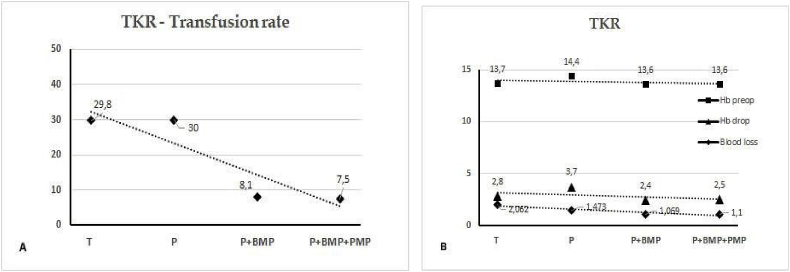
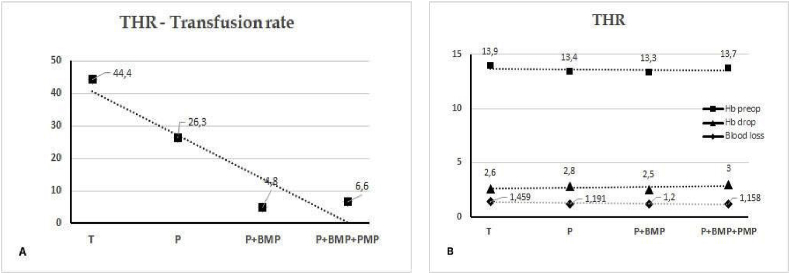
Material and methods: This was a retrospective study of prospectively collected data (from 2014 to 2017) concerning all consecutive unselected patients who underwent TKR or THR on Monday morning. At stage 1 the rehabilitation and physiotherapy component was changed, at stage 2 and 3 a patient's blood management program and a pain management program were prospectively recorded (i.e. respectively Patients' demographics, ASA classification, Charlson index, LOS, blood loss, transfusion rate, complications and 30 - day readmissions).
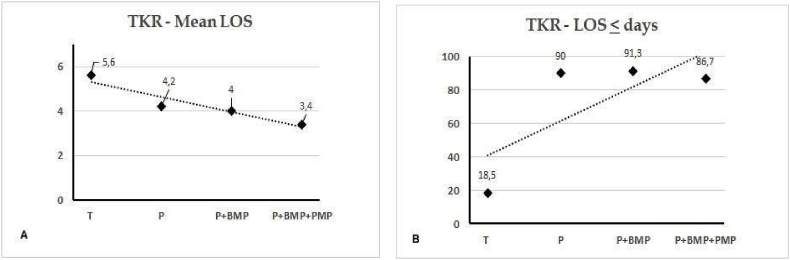
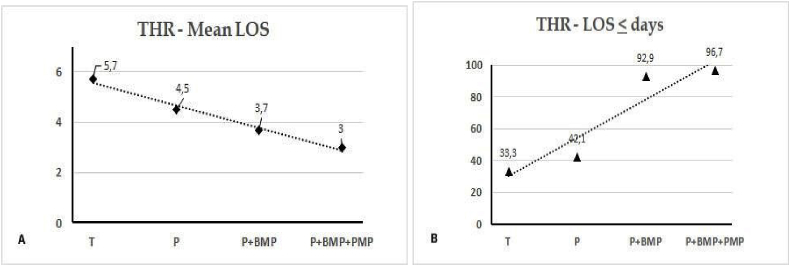
Results: Four hundred and thirty four patients underwent either TKR (n: 302) or THR (n:132) and were included in this study. A gradual reduction of mean LOS was found in THR patients from 5.7 days to 3.0 days and in TKR patients from 5.6 days to 3.4 days. Furthermore, no significant difference was found in complications or regarding the 30-day readmission rate at the different stages of implementation of the different FT components (i.e. at the final stage 96.7% of THR and 86.7% of TKR patients were discharged to home by the fourth post-operative day).
Conclusion: The stepwise implementation of a FT program in an unelected population of THR and TKR patients was effective and safe, reducing the post-surgical recovery time and patients' LOS with no major complications and no increase of 30-day re-admissions.
Keywords: Enhanced recovery after surgery; Fast-track; Total hip arthroplasty; Total knee arthroplasty.
© 2020 Published by Elsevier B.V. on behalf of Professor P K Surendran Memorial Education Foundation.
Conflict of interest statement
Authors declare that they have no conflict of interest.
Figures
References
-
- Ethgen O., Bruyere O., Richy F., Dardennes C., Reginster J.Y. Health-related quality of life in total hip and total knee arthroplasty. A qualitative and systematic review of the literature. J Bone Jt Surg Am Vol. 2004;86-a(5):963–974. - PubMed
-
- Kehlet H., Mythen M. Why is the surgical high-risk patient still at risk? Br J Anaesth. 2011;106(3):289–291. - PubMed
-
- Kurtz S., Ong K., Lau E., Mowat F., Halpern M. Projections of primary and revision hip and knee arthroplasty in the United States from 2005 to 2030. J Bone Jt Surg Am Vol. 2007;89(4):780–785. - PubMed
-
- Husted H., Jensen C.M., Solgaard S., Kehlet H. Reduced length of stay following hip and knee arthroplasty in Denmark 2000-2009: from research to implementation. Arch Orthop Trauma Surg. 2012;132(1):101–104. - PubMed
LinkOut - more resources
Full Text Sources
