


Hyperbolic Graph Convolutional Neural Networks
- PMID: 32256024
- PMCID: PMC7108814
Hyperbolic Graph Convolutional Neural Networks
Abstract
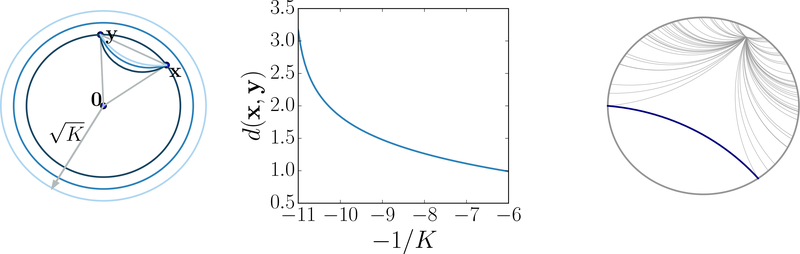
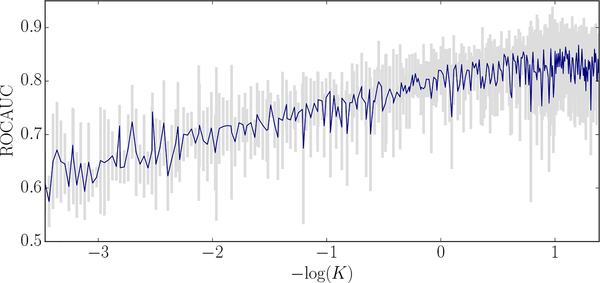
Graph convolutional neural networks (GCNs) embed nodes in a graph into Euclidean space, which has been shown to incur a large distortion when embedding real-world graphs with scale-free or hierarchical structure. Hyperbolic geometry offers an exciting alternative, as it enables embeddings with much smaller distortion. However, extending GCNs to hyperbolic geometry presents several unique challenges because it is not clear how to define neural network operations, such as feature transformation and aggregation, in hyperbolic space. Furthermore, since input features are often Euclidean, it is unclear how to transform the features into hyperbolic embeddings with the right amount of curvature. Here we propose Hyperbolic Graph Convolutional Neural Network (HGCN), the first inductive hyperbolic GCN that leverages both the expressiveness of GCNs and hyperbolic geometry to learn inductive node representations for hierarchical and scale-free graphs. We derive GCNs operations in the hyperboloid model of hyperbolic space and map Euclidean input features to embeddings in hyperbolic spaces with different trainable curvature at each layer. Experiments demonstrate that HGCN learns embeddings that preserve hierarchical structure, and leads to improved performance when compared to Euclidean analogs, even with very low dimensional embeddings: compared to state-of-the-art GCNs, HGCN achieves an error reduction of up to 63.1% in ROC AUC for link prediction and of up to 47.5% in F1 score for node classification, also improving state-of-the art on the Pubmed dataset.
Figures




References
-
- Adcock Aaron B, Sullivan Blair D, and Mahoney Michael W. Tree-like structure in large social and information networks. In 2013 IEEE 13th International Conference on Data Mining, pages 1–10. IEEE, 2013.
-
- Anderson Roy M and May Robert M. Infectious diseases of humans: dynamics and control. Oxford university press, 1992.
-
- Belkin Mikhail and Niyogi Partha. Laplacian eigenmaps and spectral techniques for embedding and clustering. In Advances in neural information processing systems, pages 585–591, 2002.
-
- Bonnabel Silvere. Stochastic gradient descent on riemannian manifolds. IEEE Transactions on Automatic Control, 2013.
-
- Benjamin Paul Chamberlain James Clough, and Deisenroth Marc Peter. Neural embeddings of graphs in hyperbolic space. arXiv preprint arXiv:1705.10359, 2017.
Grants and funding
LinkOut - more resources
Full Text Sources
Other Literature Sources