. 2020 Mar 30:16:43.
doi: 10.1186/s13007-020-00585-6. eCollection 2020.

A convenient, rapid and efficient method for establishing transgenic lines of Brassica napus

Affiliations

A convenient, rapid and efficient method for establishing transgenic lines of Brassica napus

Kai Zhang et al. Plant Methods. .

Abstract

Background: Brassica napus is an important oilseed crop that offers a considerable amount of biomass for global vegetable oil production. The establishment of an efficient genetic transformation system with a convenient transgenic-positive screening method is of great importance for gene functional analysis and molecular breeding. However, to our knowledge, there are few of the aforementioned systems available for efficient application in B. napus.

Results: Based on the well-established genetic transformation system in B. napus, five vectors carrying the red fluorescence protein encoding gene from Discosoma sp. (DsRed) were constructed and integrated into rapeseed via Agrobacterium-mediated hypocotyl transformation. An average of 59.1% tissues were marked with red fluorescence by the visual screening method in tissue culture medium, 96.1% of which, on average, were amplified with the objective genes from eight different rapeseed varieties. In addition, the final transgenic-positive efficiency of the rooted plantlets reached up to 90.7% from red fluorescence marked tissues, which was much higher than that in previous reports. Additionally, visual screening could be applicable to seedlings via integration of DsRed, including seed coats, roots, hypocotyls and cotyledons during seed germination. These results indicate that the highly efficient genetic transformation system combined with the transgenic-positive visual screening method helps to conveniently and efficiently obtain transgenic-positive rapeseed plantlets.

Conclusion: A rapid, convenient and highly efficient method was developed to obtain transgenic plants, which can help to obtain the largest proportion of transgene-positive regenerated plantlets, thereby avoiding a long period of plant regeneration. The results of this study will benefit gene functional studies especially in high-throughput molecular biology research.

Keywords: Agrobacterium-mediated hypocotyl transformation; Brassica napus; DsRed; Visual screening.


Conflict of interest statement

Competing interestsThe authors declare that the research was conducted in the absence of any commercial or financial relationships that could be construed as a potential conflict of interest.

Figures
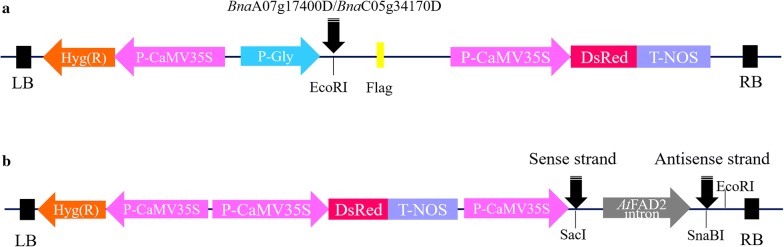
Fig. 1
Fig. 1
Vectors construction for gene over-expression and knock-down. a Diagram of the construction of the over-expression vector. The expression of BnaA07g17400D and BnaC05g34170D is driven by the glycinin promoter. The N-terminus of BnaA07g17400D and BnaC05g34170D is accompanied by a flag. b Diagram of the construction of the RNAi knock-down vector. The expression of sense strands and antisense strands is driven by the 2 × 35S promoter and a 2 × nuclear localization signal (NLS) at the N-terminus. DsRed in both vectors was also under the control of the CaMV35S promoter
Fig. 2
Fig. 2
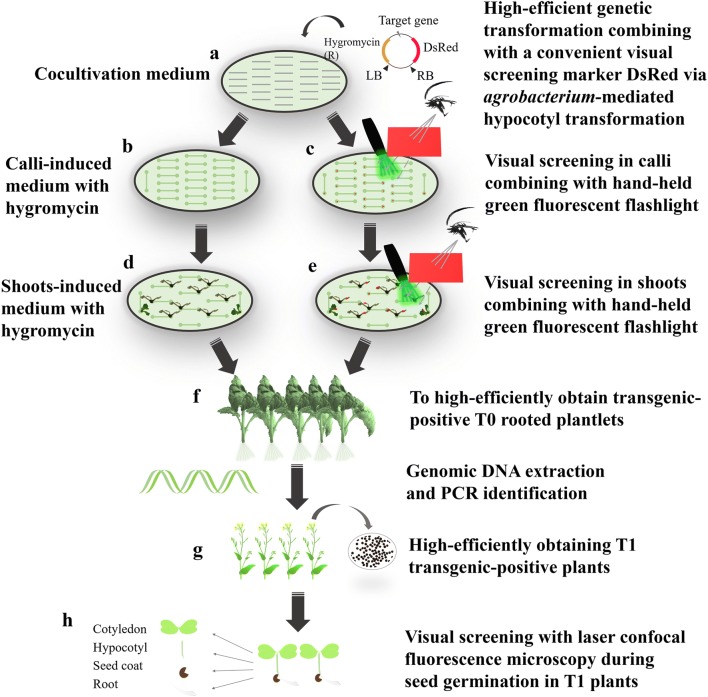
Overview of the efficient method for the high-efficiency acquisition of transgenic lines combined with a visual screening method compared with antibiotics screening in B. napus. a Highly efficient genetic transformation combined with a convenient visual screening marker DsRed via Agrobacterium-mediated hypocotyl transformation in B. napus. Hypocotyls were transformed with a vector accompanied by DsRed and hygromycin via Agrobacterium- mediated transformation. The light grey lines inside the oval represent hypocotyls from B. napus. b , c Calli formation and screening during the callus-induced stage with or without the visual screening method. The calli would survive under antibiotics screening with hygromycin in b, and they were further picked by the visual screening using a hand-held green fluorescent flashlight in c. The endpoints in the line represent the formed callus, and the red spots in the endpoints represented the red fluorescence observed in the calli. d ,e Shoots formation in shoot-induced medium with or without the visual screening method. The calli would survive under antibiotics screening with hygromycin in d, and they were further picked for visual screening using a hand-held green fluorescent flashlight in e. The red spots in the shoots represent the red fluorescence observed in the cotyledons. f, g highly efficient screening of the transgenic-positive rooted T0 plantlets and T1 transgenic-positive plants. Transgenic-positive rooted T0 plantlets and T1 transgenic-positive plants could be rapidly and high efficiently obtained when combined with the convenient visual screening method. h Visual screening in cotyledons, hypocotyls, seed coats and roots during seed germination. The seedlings could be screened with the visual marker DsRed using laser confocal fluorescence microscopy
Fig. 3
Fig. 3
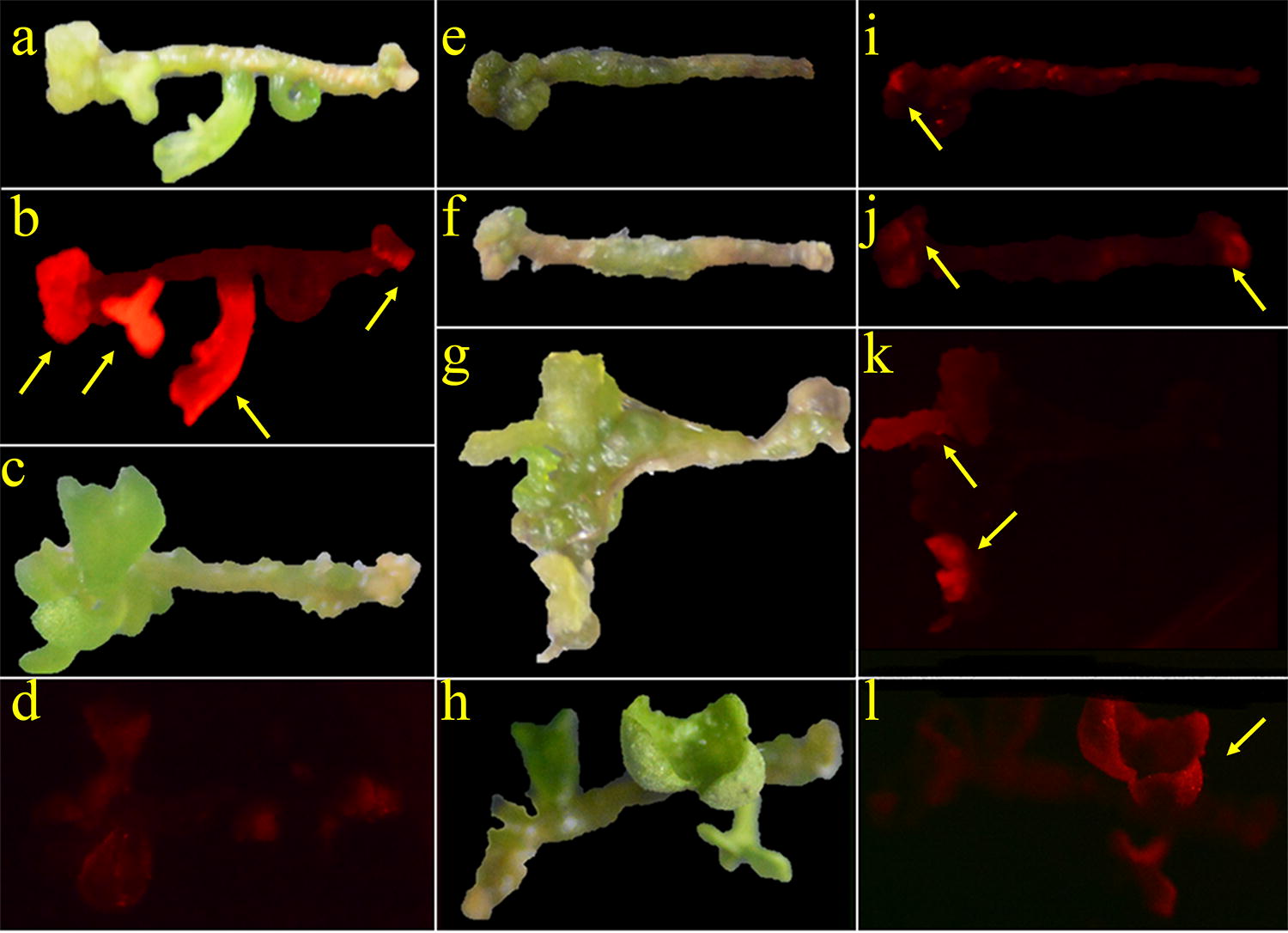
Efficient and convenient screening in the primary stage of tissue culture. a, b Examples of positive tissue with red fluorescence by visual screening. Strong red fluorescence could be observed in calli and shoots. c, d Examples of negative tissue with red fluorescence by visual screening. Nearly no or weak red fluorescence in calli and shoots could be observed. el Diagram of the convenient screening for calli and shoots at the primary culturing stage. Red fluorescence could be clearly observed in calli and shoots by visual screening with a hand-held green fluorescent flashlight. The yellow arrows indicate red fluorescence. a, c, eh are in the white field, while b, d, i, g, k and l are in the excitatory light field
Fig. 4
Fig. 4
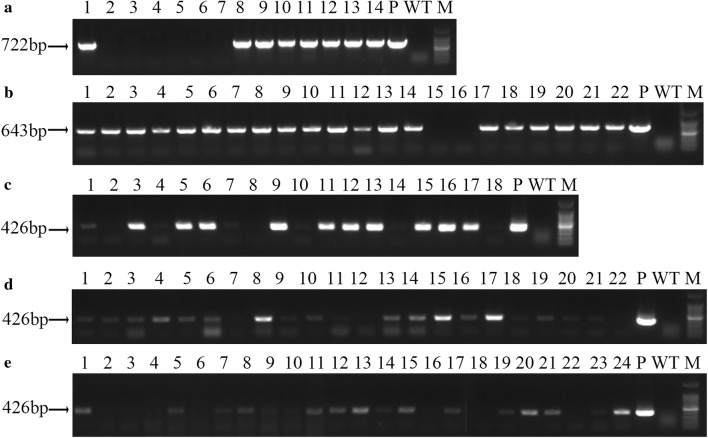
Transgenic-positive plant identification in T0 plants. a Amplification of the BnaA07g17400D gene in E1 transformed lines. b Amplification of the BnaC05g34170D gene in E2 transformed lines. ce Amplification of DsRed gene in R1, R2 and R3 transformed lines. The light bands indicated by the arrow indicate the size of the amplified genes noted on the left side. P, plasmid. WT, wild type plant. Marker, DL 100 bp ladder
Fig. 5
Fig. 5
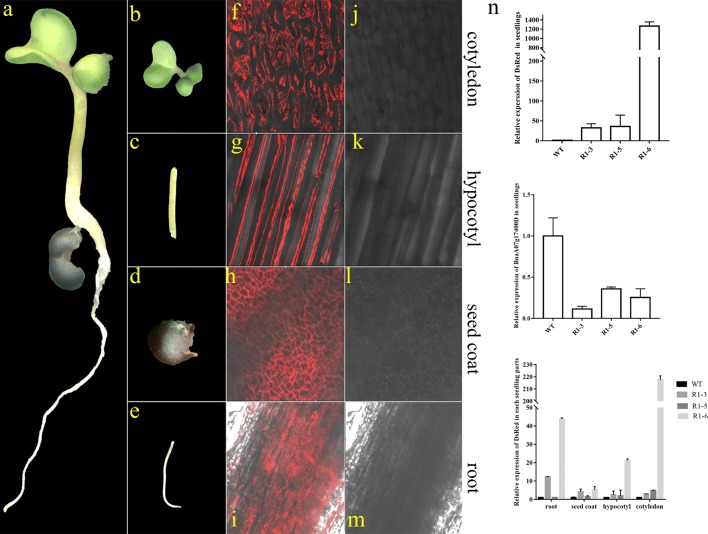
Convenient screening during seed germination. am Observation of red fluorescence through the primary stage of seedling. The red fluorescence could be observed inthe cotyledon (b, f, j), hypocotyl (c, g, k), seed coat (d, h, l) and root (e, i, m) of rapeseed seedlings under a laser confocal fluorescence microscope FV1000, respectively. n RT-PCR identification of the relative gene expression in seedlings. The upper diagram represents the relative gene expression of DsRed in seedlings from different RNAi lines. The middle diagram represents the relative gene expression of BnaA07g17400D in seedlings from different RNAi lines. The lower diagram represents the relative gene expression of DsRed in roots, seed coats, hypocotyls and cotyledons from seedlings of different RNAi lines
Fig. 6
Fig. 6
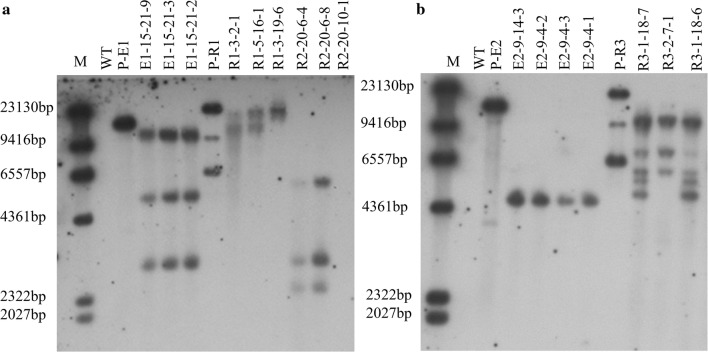
Southern blot analysis of DsRed genes for copy number identification in T3 transgenic rapeseed plants. a Southern blot analysis of BnaA07g17400D over-expression and knock down. b Southern blot analysis of BnaC05g34170D over-expression and knock down. WT, wild type; P-E1/E2, over-expression plasmid pCMABIA-1303; P-R1/R2/R3, knock down plasmid p35S-1390; M: λ DNA/Hind III- Plus DNA marker

References

    1. Gacek K, Bartkowiak-Broda I, Batley J. Genetic and molecular regulation of seed storage proteins (SSPs) to improve protein nutritional value of oilseed rape (Brassica napus L.) seeds. Front Plant Sci. 2018;9:890. doi: 10.3389/fpls.2018.00890. - DOI - PMC - PubMed
    1. Chalhoub B. Early allopolyploid evolution in the post-Neolithic Brassica napus oilseed genome. Science. 2014;345:1255. doi: 10.1126/science.1253435. - DOI - PubMed
    1. Tester M, Langridge P. Breeding technologies to increase crop production in a changing world. Science. 2010;327:818–822. doi: 10.1126/science.1183700. - DOI - PubMed
    1. Zhai Y, Yu K, Cai S, Hu L, Amoo O, Xu L, et al. Targeted mutagenesis of BnTT8 homologs controls yellow seed coat development for effective oil production in Brassica napus L. Plant Biotechnol J. 2019 doi: 10.1111/pbi.13281. - DOI - PMC - PubMed
    1. Bhalla PL, Singh MB. Agrobacterium-mediated transformation of Brassica napus and Brassica oleracea. Nat Protoc. 2008;3:181–189. doi: 10.1038/nprot.2007.527. - DOI - PubMed

LinkOut - more resources