


Percutaneous exclusion of ascending aorta pseudoaneurysms: still an interventional challenge?
- PMID: 32256859
- PMCID: PMC7125363
- DOI: 10.1016/j.jccase.2019.11.009
Percutaneous exclusion of ascending aorta pseudoaneurysms: still an interventional challenge?
Abstract
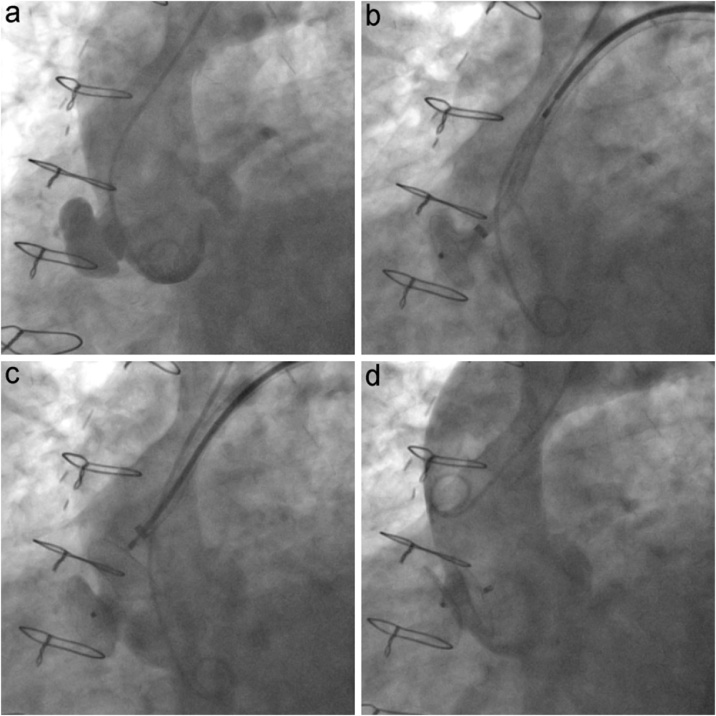
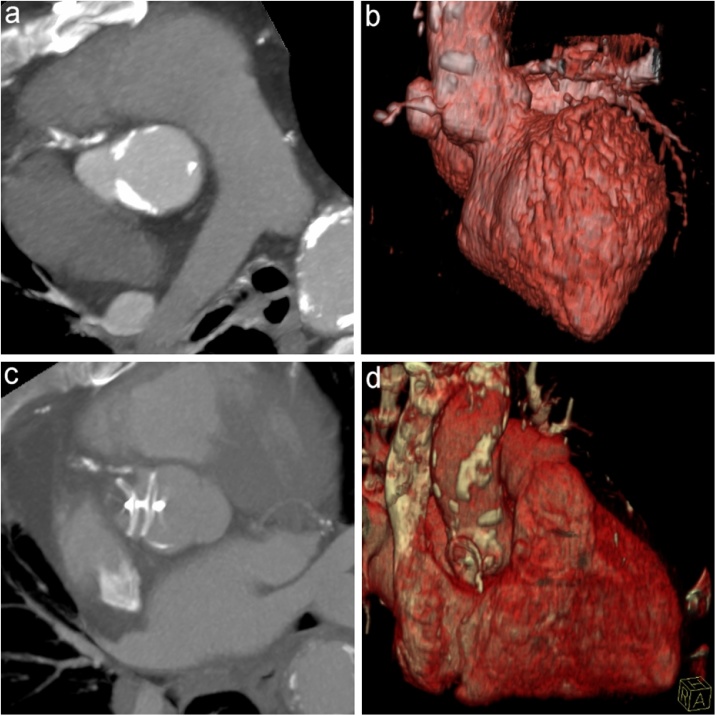
Ascending aortic pseudoaneurysm is a rare pathology that could have multiple etiologies such as thoracic trauma, infection, and percutaneous or surgical procedures. In patients with aortic pseudoaneurysms, open surgical or endovascular interventions are always indicated, if feasible and independent of size. Several types of endovascular treatment have been reported in the literature, but they have been mostly restricted to those cases when traditional surgery has a prohibitive risk. We report the case of a 75-year-old man with a sinotubular junction pseudoaneurysm, likely developed after coronary artery bypass grafting, which was successfully treated by implanting a multifenestrated cribriform septal occluder, a device already used in few similar cases. <Learning objective: Aortic pseudoaneurysm could be a consequence of several types of aortic injuries. In frail patients endovascular approach represents a viable option instead of surgical repair. Such percutaneous treatment has to be individualized also according to the lesion location and size, as in our case where a sinotubular junction pseudoaneurysm was successfully treated by implanting a multifenestrated cribriform septal occluder.>.
Keywords: Ascending aortic pseudoaneurysm; Atrial septal occluder; High surgical risk.
© 2019 Japanese College of Cardiology. Published by Elsevier Ltd. All rights reserved.
Figures
References
-
- Erbel R., Aboyans V., Boileau C., Bossone E., Di Bartolomeo R., Eggebrecht H. ESC Guidelines on the diagnosis and treatment of aortic diseases. Eur Heart J. 2014;35:2873–2926. - PubMed
-
- Mesana T.G., Caus T., Gaubert J., Collart F., Ayari R., Bartoli J. Late complications after prosthetic replacement of the ascending aorta: what did we learn from routine magnetic resonance imaging follow-up? Eur J Cardiothorac Surg. 2000;18:313–320. - PubMed
-
- Quevedo H.C., Alonso A. Endovascular therapy for ascending aorta pseudoaneurysm. Cardiovasc Revasc Med. 2016;17:586–588. - PubMed
-
- Ruge H., Herold U., Lange R. Stent-graft treatment of an ascending aortic false aneurysm after surgical aortic valve replacement. J Thorac Cardiovasc Surg. 2018;1256:183–185. - PubMed
-
- Scholtz W., Jategaonkar S., Haas N.A. Successful interventional treatment of a retrosternal pseudoaneurysm of the ascending aorta with an Amplatzer vascular plug II. J Invasive Cardiol. 2010;22:44–46. - PubMed
Publication types
LinkOut - more resources
Full Text Sources
