


Thermal behavior and viscoelastic properties of gutta-percha used for back-filling the root canal
- PMID: 32256997
- PMCID: PMC7109509
- DOI: 10.1016/j.jds.2019.10.002
Thermal behavior and viscoelastic properties of gutta-percha used for back-filling the root canal
Abstract
Background/purpose: In clinical operations, qualitative differences in the texture and operational feeling of the regular type and soft type back-filled gutta-percha are readily discernible. This study aimed to investigate and compare the thermal behavior and physical properties of the two gutta-percha materials.
Materials and methods: The chemical compositions of regular and soft type Gutta-Percha Obturator® pellets were examined via energy dispersive X-ray spectroscopy. The thermal behaviors of the pellets during heating and cooling were evaluated using a differential scanning calorimeter. Finally, the viscoelastic properties of the two materials during cooling were assessed using a modular compact rheometer.
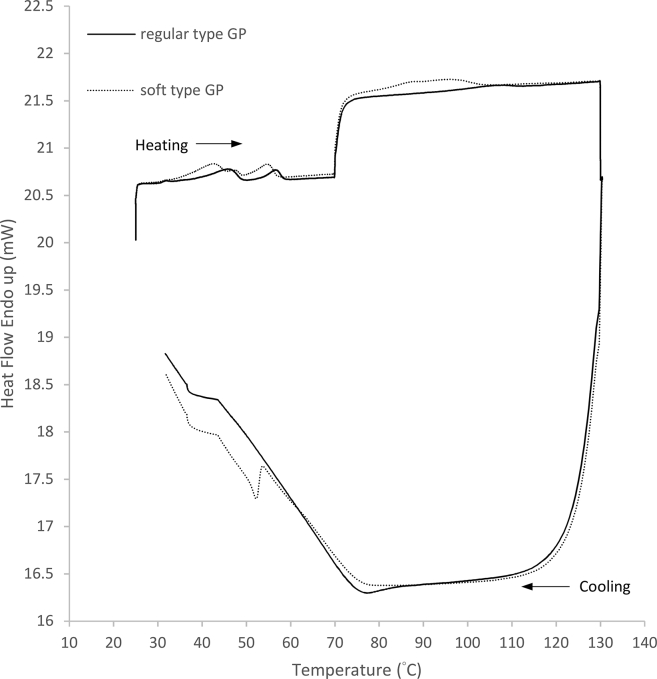
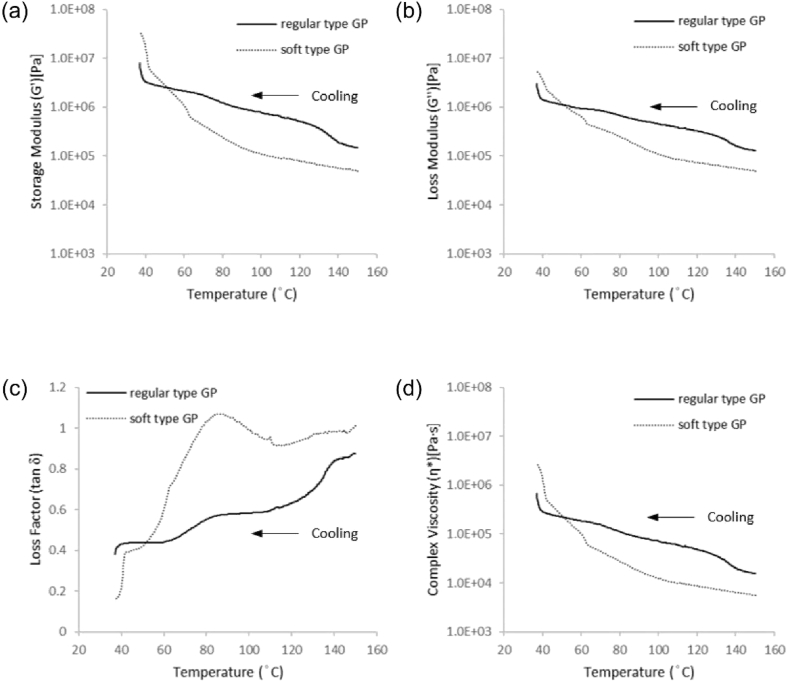
Results: The soft type gutta-percha contained a greater atomic percentage of zinc than the regular type material. In addition, the soft type gutta-percha exhibited exothermic peaks during cooling, whereas the regular type gutta-percha did not. The two materials exhibited different viscoelastic behaviors under cooling. In particular, the rate of change of the loss factor for the soft type gutta-percha was more than that of the regular type gutta-percha at temperature lower than 80°C.
Conclusion: The soft type gutta-percha underwent significant crystallization during cooling, and therefore exhibited pronounced volume shrinkage. Furthermore, the soft type gutta-percha underwent a greater rate of change in viscoelasticity under cooling than the regular type gutta-percha, and exhibited poorer physical stability. Consequently, in the back-packing procedure, soft type gutta-percha must be compacted more often over time than regular type gutta-percha to ensure the same quality of root canal obturation.
Keywords: Differential scanning calorimetry; Gutta-percha; Root canal obturation; Viscoelastic substances.
© 2019 Association for Dental Sciences of the Republic of China. Publishing services by Elsevier B.V.
Conflict of interest statement
The authors deny any conflict of interest related to this study.
Figures

References
-
- Delivanis P.D., Mattison G.D., Mendel R.W. The survivability of F43 strain of Streptococcus sanguis in root canals filled with gutta-percha and Procosol cement. J Endod. 1983;9:407–410. - PubMed
-
- Callahan R.J. Rosin solution for the sealing of the dentinal tubuli and as an adjuvant in the filling of root-canals. J Allied Dent Soc. 1914;39:53–63.
-
- Schilder H. Vertical compaction of warm gutta percha. In: Gerstein H., editor. Techniques in clinical endodontics. WB Saunders; Philadelphia: 1983. pp. 76–98.
-
- Schilder H. Filling root canals in three dimensions. Dent Clin N Am. 1967;11:723–744. - PubMed
-
- Friedman C.M., Sandrik J.L., Heuer M.A., Rapp G.W. Composition and mechanical properties of gutta-percha endodontic points. J Dent Res. 1975;54:921–925. - PubMed
LinkOut - more resources
Full Text Sources
