


Cognitive impairment after cytotoxic chemotherapy
- PMID: 32257280
- PMCID: PMC7104876
- DOI: 10.1093/nop/npz052
Cognitive impairment after cytotoxic chemotherapy
Abstract
Background: Neurotoxicity is a frequent side effect of cytotoxic chemotherapy and affects a large number of patients. Despite the high medical need, few research efforts have addressed the impact of cytotoxic agents on cognition (ie, postchemotherapy cognitive impairment; PCCI). One unsolved question is whether individual cytotoxic drugs have differential effects on cognition. We thus examine the current state of research regarding PCCI. Neurological symptoms after targeted therapies and immunotherapies are not part of this review.
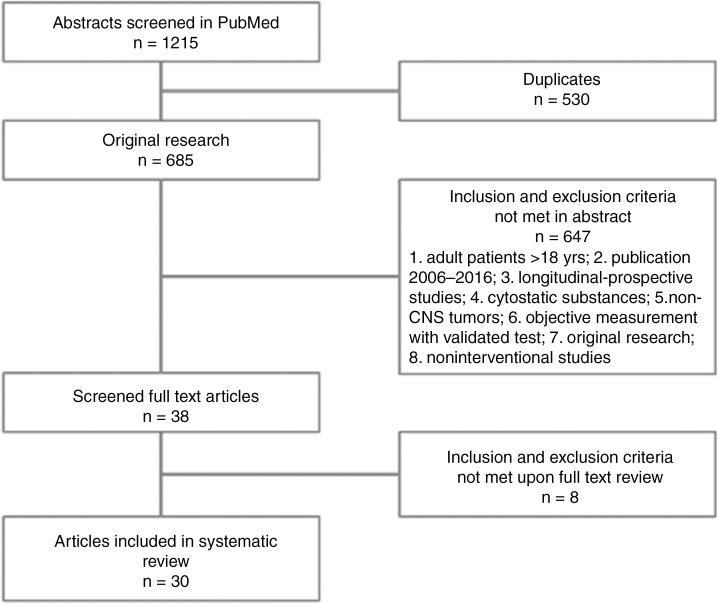
Methods: A literature search was conducted in the PubMed database, and 1215 articles were reviewed for predefined inclusion and exclusion criteria. Thirty articles were included in the systematic review.
Results: Twenty-five of the included studies report significant cognitive impairment. Of these, 21 studies investigated patients with breast cancer. Patients mainly received combinations of 5-fluorouracil, epirubicin, cyclophosphamide, doxorubicin, and taxanes (FEC/FEC-T). Five studies found no significant cognitive impairment in chemotherapy patients. Of these, 2 studies investigated patients with colon cancer receiving 5-fluorouracil and oxaliplatin (FOLFOX). Independent risk factors for PCCI were patient age, mood alterations, cognitive reserve, and the presence of apolipoprotein E e4 alleles.
Conclusions: There is evidence that certain chemotherapy regimens cause PCCI more frequently than others as evidenced by 21 out of 23 studies in breast cancer patients (mainly FEC-T), whereas 2 out of 3 studies with colon cancer patients (FOLFOX) did not observe significant changes. Further studies are needed defining patient cohorts by treatment protocol in addition to cancer type to elucidate the effects of individual cytotoxic drugs on cognitive functions.
Keywords: chemotherapy; cognition; cognitive decline; neurotoxicity.
© The Author(s) 2019. Published by Oxford University Press on behalf of the Society for Neuro-Oncology and the European Association of Neuro-Oncology. All rights reserved. For permissions, please e-mail: journals.permissions@oup.com.
Figures
References
-
- Barnes B, Kraywinkel K, Nowossadeck E, et al. Bericht zum Krebsgeschehen in Deutschland 2016. Berlin: Robert Koch-Institut; 2016.
-
- International Agency for Research on Cancer. World cancer factsheet. 2014. https://www.cancerresearchuk.org/sites/default/files/cs_report_world.pdf
-
- Morgan G, Ward R, Barton M. The contribution of cytotoxic chemotherapy to 5-year survival in adult malignancies. Clin Oncol (R Coll Radiol). 2004;16(8):549–560. - PubMed
-
- Vardy J, Tannock I. Cognitive function after chemotherapy in adults with solid tumours. Crit Rev Oncol Hematol. 2007;63(3):183–202. - PubMed
-
- Ahles TA, Saykin A. Cognitive effects of standard-dose chemotherapy in patients with cancer. Cancer Invest. 2001;19(8):812–820. - PubMed
