


The Links Between the Gut Microbiome, Aging, Modern Lifestyle and Alzheimer's Disease
- PMID: 32257964
- PMCID: PMC7093326
- DOI: 10.3389/fcimb.2020.00104
The Links Between the Gut Microbiome, Aging, Modern Lifestyle and Alzheimer's Disease
Abstract
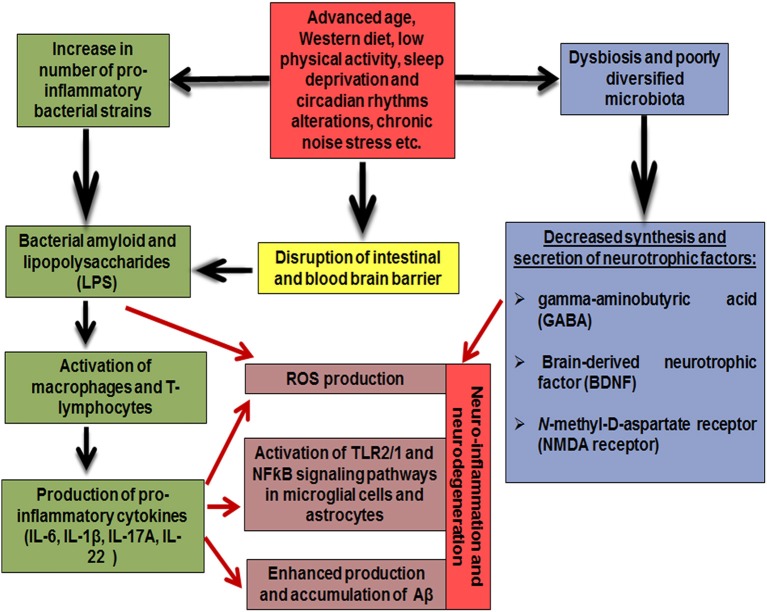
Gut microbiome is a community of microorganisms in the gastrointestinal tract. These bacteria have a tremendous impact on the human physiology in healthy individuals and during an illness. Intestinal microbiome can influence one's health either directly by secreting biologically active substances such as vitamins, essential amino acids, lipids et cetera or indirectly by modulating metabolic processes and the immune system. In recent years considerable information has been accumulated on the relationship between gut microbiome and brain functions. Moreover, significant quantitative and qualitative changes of gut microbiome have been reported in patients with Alzheimer's disease. On the other hand, gut microbiome is highly sensitive to negative external lifestyle aspects, such as diet, sleep deprivation, circadian rhythm disturbance, chronic noise, and sedentary behavior, which are also considered as important risk factors for the development of sporadic Alzheimer's disease. In this regard, this review is focused on analyzing the links between gut microbiome, modern lifestyle, aging, and Alzheimer's disease.
Keywords: Alzheimer's disease; aging; circadian rhythm; gut microbiome; lifestyle.
Copyright © 2020 Askarova, Umbayev, Masoud, Kaiyrlykyzy, Safarova, Tsoy, Olzhayev and Kushugulova.
Figures
References
Publication types
MeSH terms
LinkOut - more resources
Full Text Sources
Other Literature Sources
Medical
