Review
. 2020 Mar 9:2020:6843180.
doi: 10.1155/2020/6843180. eCollection 2020.

Perspectives of the Application of Liquid Biopsy in Colorectal Cancer

Affiliations
Review

Perspectives of the Application of Liquid Biopsy in Colorectal Cancer

Yuhan Ding et al. Biomed Res Int. .

Abstract

Colorectal cancer (CRC) is one of the most common gastrointestinal tumors and the second leading cause of cancer death worldwide. Since traditional biopsies are invasive and do not reflect tumor heterogeneity or monitor the dynamic progression of tumors, there is an urgent need for new noninvasive methods that can supplement and improve the current management strategies of CRC. Blood-based liquid biopsies are a promising noninvasive biomarker that can detect disease early, assist in staging, monitor treatment responses, and predict relapse and metastasis. Over time, an increasing number of experiments have indicated the clinical utility of liquid biopsies in CRC. In this review, we mainly focus on the development of circulating tumor cells and circulating tumor DNA as key components of liquid biopsies in CRC and introduce the potential of exosomal microRNAs as emerging liquid biopsy markers in clinical application for CRC.


Conflict of interest statement

The authors declare that they have no conflicts of interest.

Figures
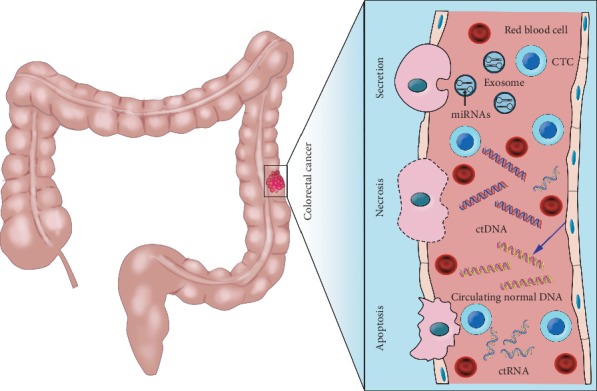
Figure 1
Figure 1
Circulating tumor cells (CTCs), circulating tumor DNA (ctDNA), circulating tumor RNA (ctRNA), and exosomes are promising liquid biopsy markers for colorectal cancer. CTCs from colorectal cancer can be shed from the primary tumor into the bloodstream, which also contains ctDNA released from tumor tissue through apoptosis, necrosis, and secretion, as well as circulating normal DNA released from healthy tissue. MicroRNAs (miRNAs) encapsulated by exosomes can be actively secreted into the extracellular fluid by various types of cells in the tumor or passively released due to the apoptosis and necrosis of tumor cells and can eventually be found in the circulation.
Figure 2
Figure 2
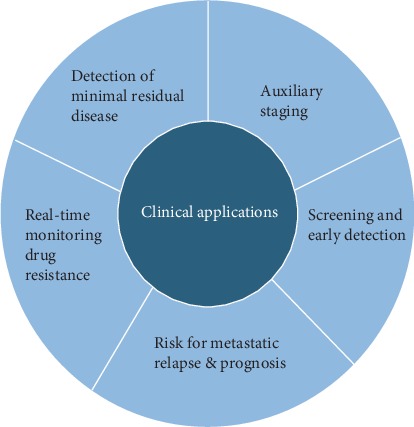
The multifaceted qualities of liquid biopsies demonstrate its potential clinical applications in the management of colorectal cancer.

References

    1. Bray F., Ferlay J., Soerjomataram I., Siegel R. L., Torre L. A., Jemal A. Global cancer statistics 2018: GLOBOCAN estimates of incidence and mortality worldwide for 36 cancers in 185 countries. CA: a Cancer Journal for Clinicians. 2018;68(6):394–424. doi: 10.3322/caac.21492. - DOI - PubMed
    1. Marcuello M., Vymetalkova V., Neves R. P. L., et al. Circulating biomarkers for early detection and clinical management of colorectal cancer. Molecular Aspects of Medicine. 2019;69:107–122. doi: 10.1016/j.mam.2019.06.002. - DOI - PubMed
    1. Normanno N., Cervantes A., Ciardiello F., De Luca A., Pinto C. The liquid biopsy in the management of colorectal cancer patients: current applications and future scenarios. Cancer Treatment Reviews. 2018;70:1–8. doi: 10.1016/j.ctrv.2018.07.007. - DOI - PubMed
    1. Vymetalkova V., Cervena K., Bartu L., Vodicka P. Circulating cell-free DNA and colorectal cancer: a systematic review. International Journal of Molecular Sciences. 2018;19(11):p. 3356. doi: 10.3390/ijms19113356. - DOI - PMC - PubMed
    1. Alix-Panabières C., Pantel K. Circulating tumor cells: liquid biopsy of cancer. Clinical Chemistry. 2013;59(1):110–118. doi: 10.1373/clinchem.2012.194258. - DOI - PubMed

MeSH terms