


Efficacy of Combination Therapies on Neck Pain and Muscle Tenderness in Male Patients with Upper Trapezius Active Myofascial Trigger Points
- PMID: 32258159
- PMCID: PMC7085833
- DOI: 10.1155/2020/9361405
Efficacy of Combination Therapies on Neck Pain and Muscle Tenderness in Male Patients with Upper Trapezius Active Myofascial Trigger Points
Abstract
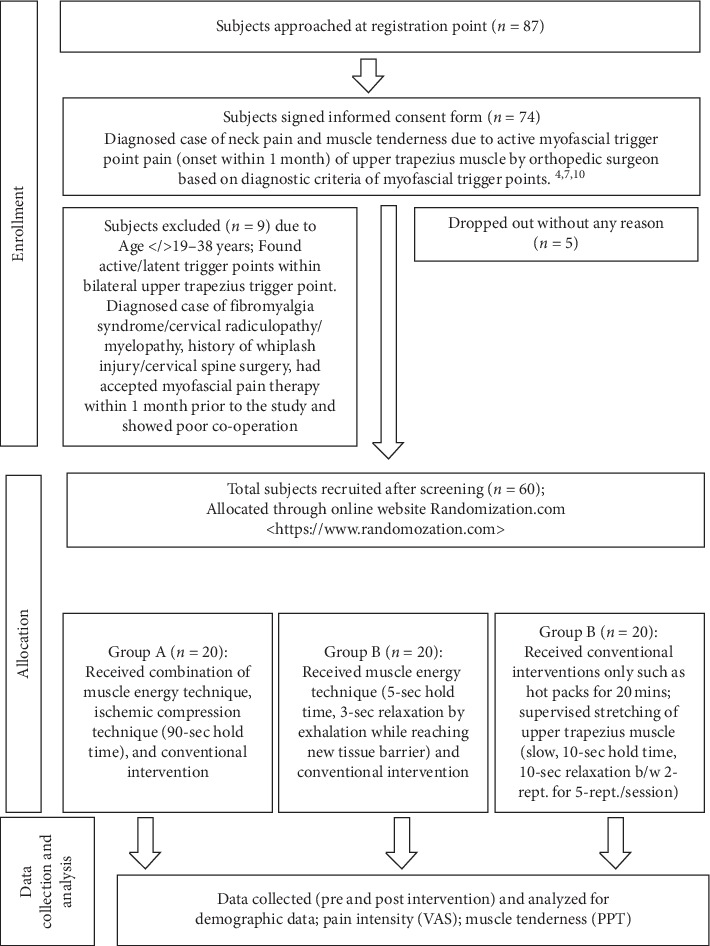
Myofascial pain syndrome, thought to be the main cause of neck pain and shoulder muscle tenderness in the working population, is characterized by myofascial trigger points (MTrPs). This study aimed to examine the immediate and short-term effect of the combination of two therapeutic techniques for improving neck pain and muscle tenderness in male patients with upper trapezius active MTrPs. This study was a pretest-posttest single-blinded randomized controlled trial. Sixty male subjects with mechanical neck pain due to upper trapezius active MTrPs were recruited and randomly allocated into group A, which received muscle energy technique (MET) and ischemic compression technique (ICT) along with conventional intervention; group B, which received all the interventions of group A except ICT; and group C, which received conventional treatment only. Baseline (Pr), immediate postintervention (Po), and 2-week follow-up (Fo) measurements were made for all variables. Pain intensity and pressure pain threshold (PPT) were assessed by a visual analog scale (VAS) and pressure threshold meter, respectively. All the three groups received their defined intervention plans only. Repeated-measures analysis of variance was used to perform intra- and intergroup analyses. Cohen's d test was used to assess the effect size of the applied interventions within the groups. The intergroup analysis revealed significant differences among groups A, B, and C in VAS and PPT at Po (VAS-Po: F = 13.88, p=0.0001; PPT-Po: F = 17.17, p=0.0001) and even after 2 weeks of follow-up (VAS-Fo: F = 222.35, p=0.0001; PPT-Fo: F = 147.70, p=0.0001). Cohen's d revealed a significant treatment effect size within all groups except group C (only significant for VAS-Po-VAS-Pr: mean difference = 1.33, p < 0.05, d = 1.09); however, it showed a maximum effect size in group A for its variables (VAS-Fo-VAS-Pr: mean difference = 5.27, p=0.01, d = 4.04; PPT-Fo-PPT-Pr: mean difference = 2.14, p < 0.01, d = 3.89). Combination therapies (MET plus ICT) showed immediate and short-term (2-week follow-up) improvements in neck pain and muscle tenderness in male patients with upper trapezius active MTrPs.
Copyright © 2020 Ahmad H. Alghadir et al.
Conflict of interest statement
The authors declare no potential conflicts of interest with respect to the research, authorship, and/or publication of this article.
Figures
References
-
- Fryer G., Hodgson L. The effect of manual pressure release on myofascial trigger points in the upper trapezius muscle. Journal of Bodywork and Movement Therapies. 2005;9(4):248–255. doi: 10.1016/j.jbmt.2005.02.002. - DOI
-
- Simons D. G., Travell J. G., Simons L. S. Travell & Simons’ Myofascial Pain and Dysfunction: Upper Half of Body. Philadelphia, PA, USA: Lippincott Williams & Wilkins; 1999.
-
- Simons D. G. Understanding effective treatments of myofascial trigger points. Journal of Bodywork and Movement Therapies. 2002;6(2):81–88. doi: 10.1054/jbmt.2002.0271. - DOI
Publication types
MeSH terms
LinkOut - more resources
Full Text Sources
Medical
Research Materials
Miscellaneous
