


Prevalence and genotypic characterization of Giardia duodenalis isolates from asymptomatic school-going children in Lusaka, Zambia
- PMID: 32258446
- PMCID: PMC7125351
- DOI: 10.1016/j.fawpar.2020.e00072
Prevalence and genotypic characterization of Giardia duodenalis isolates from asymptomatic school-going children in Lusaka, Zambia
Abstract
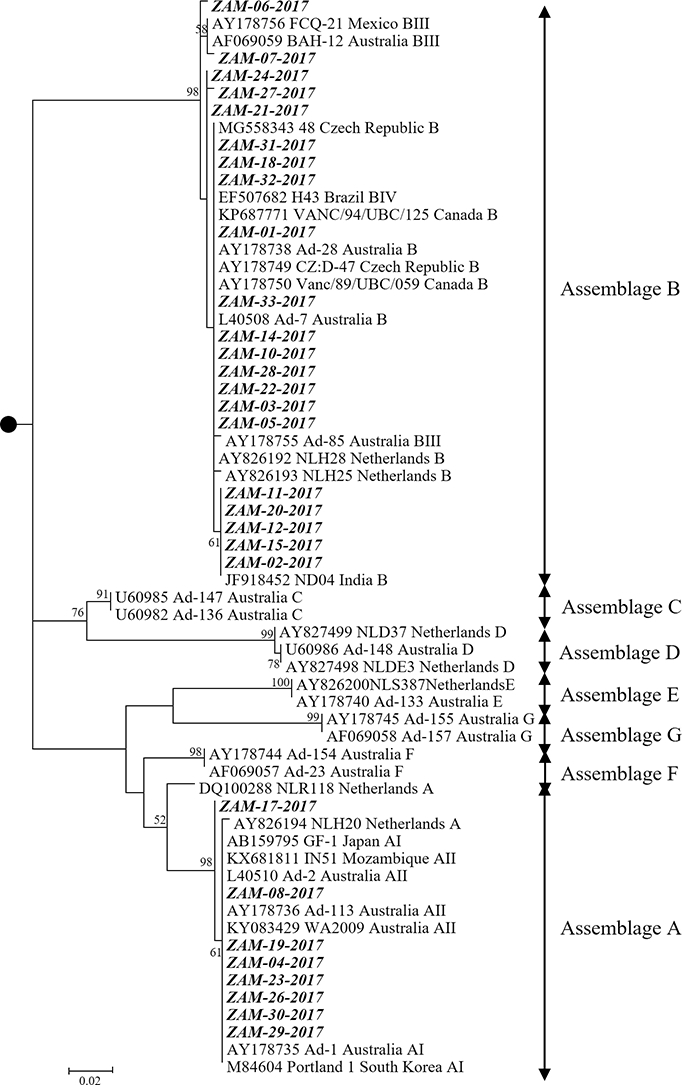
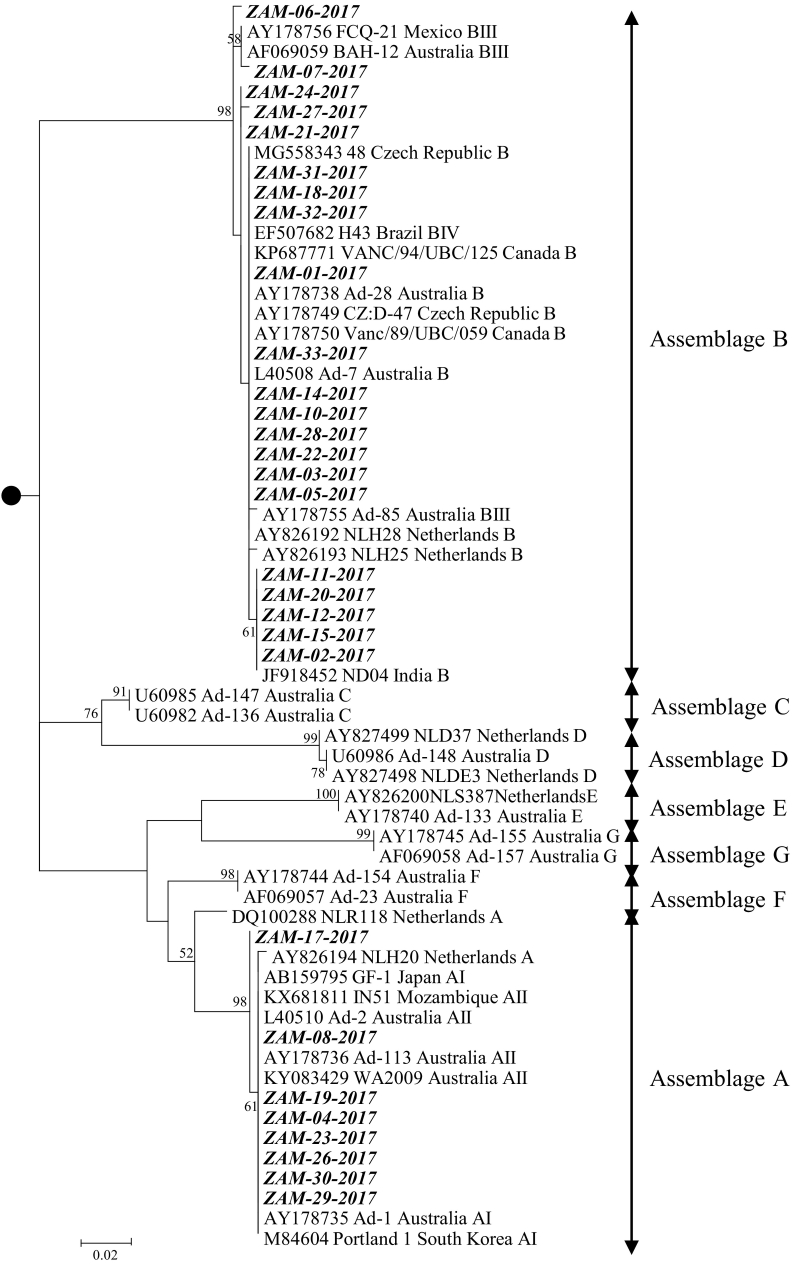
Giardia duodenalis is one of the most common causes of diarrhea in humans with about 250-300 million cases per year. It is considered to be a species complex comprising of eight genetic assemblages (A to H), with assemblages A and B being the major causes of human infections. In this study we carried out genotypic characterization of G. duodenalis isolates detected in asymptomatic school-going children aged 3-16 years. Between May and September 2017, a total of 329 fecal samples were collected from school-going children from Chawama compound of Lusaka City and were screened for Giardia by microscopic examination. All microscopically positive fecal samples were analyzed by semi-nested polymerase chain reaction (PCR) targeting the glutamate dehydrogenase (gdh) gene. Genotyping of amplified PCR products was conducted by restriction fragment length polymorphism (RFLP) and DNA sequence analysis. Microscopically, Giardia was found in 10% (33/329) of fecal samples. The PCR-RFLP analysis of the gdh gene revealed assemblages A and B in 27.3% (9/33) and 72.7% (24/33), respectively. Furthermore, analysis with restriction enzymes identified sub-assemblages AII (27.3%, 9/33), BIII (12.1%, 4/33), BIV (51.5%, 17/33) and mixed infections of BIII and BIV (9.1%, 3/33). Phylogenetic analysis showed the clustering of 27.6% (8/29) and 72.4% (21/29) of Zambian Giardia gdh gene sequences into assemblages A and B, respectively. This study has revealed the presence of both assemblage A and B and that spread of G. duodenalis in school-going children appears to be mostly through anthroponotic transmission. To our knowledge, this is the first report of genotypic characterization of G. duodenalis identified in Zambia.
Keywords: Genotyping; Giardia duodenalis; Giardiasis; Glutamate dehydrogenase; Phylogenetic analysis; Zambia.
© 2020 The Authors.
Conflict of interest statement
All the authors declare that there is no conflict of interest.
Figures
Similar articles
-
Prevalence of Giardia duodenalis assemblages and sub-assemblages in symptomatic patients from Damascus city and its suburbs.Infect Genet Evol. 2017 Jan;47:155-160. doi: 10.1016/j.meegid.2016.11.030. Epub 2016 Dec 3. Infect Genet Evol. 2017. PMID: 27919804
-
Molecular Characterization of Giardia duodenalis in Children in Kenya.BMC Infect Dis. 2016 Mar 22;16:135. doi: 10.1186/s12879-016-1436-z. BMC Infect Dis. 2016. PMID: 27005473 Free PMC article.
-
Molecular Genotyping of Giardia duodenalis Isolates from Symptomatic Individuals Attending Two Major Public Hospitals in Madrid, Spain.PLoS One. 2015 Dec 7;10(12):e0143981. doi: 10.1371/journal.pone.0143981. eCollection 2015. PLoS One. 2015. PMID: 26641082 Free PMC article.
-
Giardia duodenalis Virulence - "To Be, or Not To Be".Curr Trop Med Rep. 2021;8(4):246-256. doi: 10.1007/s40475-021-00248-z. Epub 2021 Oct 21. Curr Trop Med Rep. 2021. PMID: 34697581 Free PMC article. Review.
-
Burden and Epidemiology of Human Intestinal Giardia duodenalis Infection in Colombia: A Systematic Review.Trop Med Infect Dis. 2022 Oct 21;7(10):325. doi: 10.3390/tropicalmed7100325. Trop Med Infect Dis. 2022. PMID: 36288066 Free PMC article. Review.
Cited by
-
Asymptomatic carriage of intestinal protists is common in children in Lusaka Province, Zambia.PLoS Negl Trop Dis. 2024 Dec 13;18(12):e0012717. doi: 10.1371/journal.pntd.0012717. eCollection 2024 Dec. PLoS Negl Trop Dis. 2024. PMID: 39671429 Free PMC article.
-
Prevalence of intestinal protozoan parasites among school children in africa: A systematic review and meta-analysis.PLoS Negl Trop Dis. 2022 Feb 11;16(2):e0009971. doi: 10.1371/journal.pntd.0009971. eCollection 2022 Feb. PLoS Negl Trop Dis. 2022. PMID: 35148325 Free PMC article.
-
Genotyping and epidemiological distribution of diarrhea-causing isolates of Giardia duodenalis in southeastern part of West Bengal, India.Parasitol Res. 2023 Nov;122(11):2567-2584. doi: 10.1007/s00436-023-07956-7. Epub 2023 Sep 8. Parasitol Res. 2023. PMID: 37682345
-
Prevalence and molecular characterization of Giardia intestinalis isolated from children and calves in Babylon province, Iraq.Vet World. 2023 Sep;16(9):1781-1789. doi: 10.14202/vetworld.2023.1781-1789. Epub 2023 Sep 13. Vet World. 2023. PMID: 37859966 Free PMC article.
-
Assemblages and Subassemblages of Giardia duodenalis in Rural Western, Kenya: Association with Sources, Signs, and Symptoms.J Parasitol Res. 2024 Feb 5;2024:1180217. doi: 10.1155/2024/1180217. eCollection 2024. J Parasitol Res. 2024. PMID: 38348444 Free PMC article.
References
-
- Abdel-Moein K.A., Saeed H. The zoonotic potential of Giardia intestinalis assemblage E in rural settings. Parasitol. Res. 2016;115:3197–3202. - PubMed
-
- Almeida A.A., Delgado M.L., Soares S.C., Castro A.O., Moreira M.J., Mendonca C.M., Canada N.B., Da Costa J.M. Genotype analysis of Giardia isolated from asymptomatic children in northern Portugal. J. Eukaryot. Microbiol. 2006;53(Suppl. 1):S177–S178. - PubMed
-
- Al-Mekhlafi H.M. Giardia duodenalis infection among rural communities in Yemen: a community-based assessment of the prevalence and associated risk factors. Asian Pac J Trop Med. 2017;10:987–995. - PubMed
Grants and funding
LinkOut - more resources
Full Text Sources
