


A decision support system for multi-target disease diagnosis: A bioinformatics approach
- PMID: 32258494
- PMCID: PMC7113440
- DOI: 10.1016/j.heliyon.2020.e03657
A decision support system for multi-target disease diagnosis: A bioinformatics approach
Erratum in
-
Corrigendum to "A decision support system for multi-target disease diagnosis: A bioinformatics approach"[Heliyon 6 (3), (March 2020) Article e03657].Heliyon. 2022 Sep 27;8(10):e10754. doi: 10.1016/j.heliyon.2022.e10754. eCollection 2022 Oct. Heliyon. 2022. PMID: 36254296 Free PMC article.
-
Corrigendum to "A decision support system for multi-target disease diagnosis: A bioinformatics approach" [Heliyon Volume 6, Issue 3, March 2020, Article e03657].Heliyon. 2025 May 22;11(10):e43402. doi: 10.1016/j.heliyon.2025.e43402. eCollection 2025 May. Heliyon. 2025. PMID: 40535893 Free PMC article.
Abstract
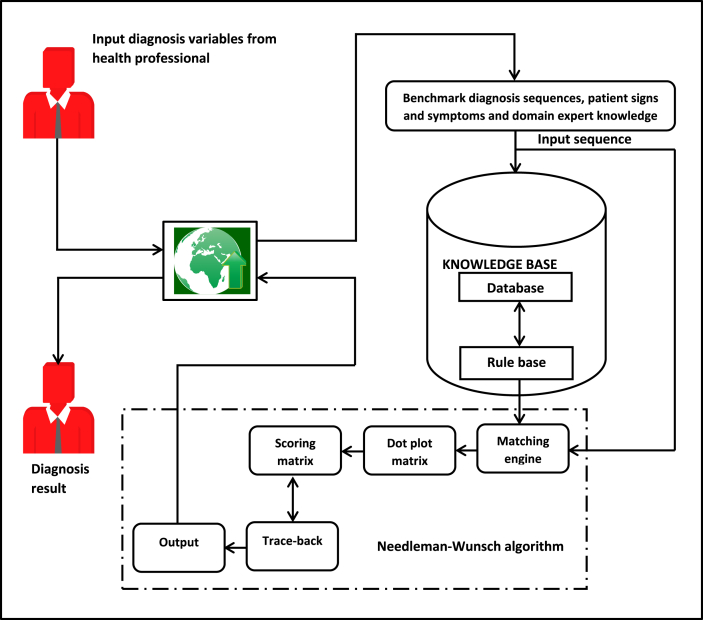
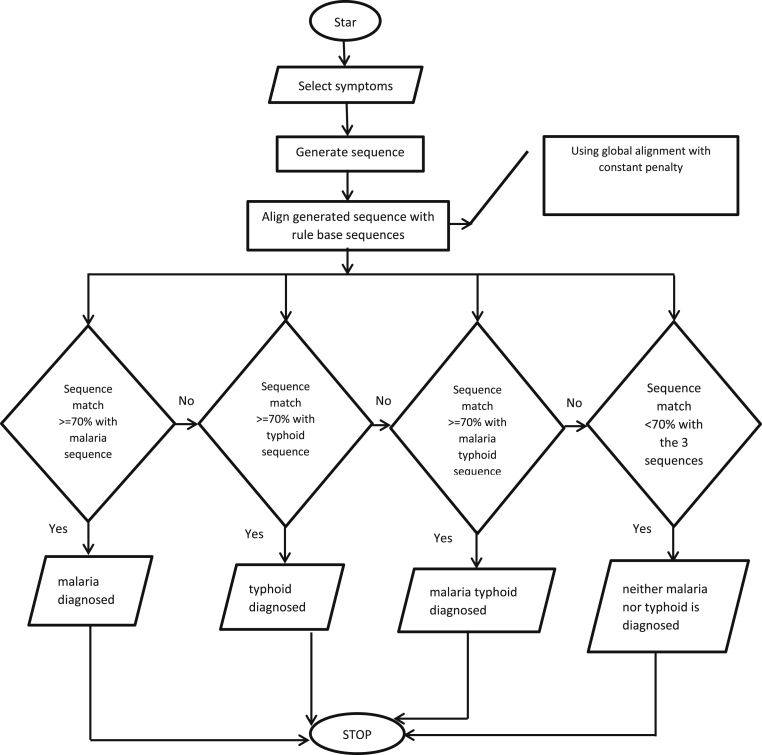
Malaria and typhoid fever are revered for their ability to individually or jointly cause high mortality rate. Both malaria and typhoid fever have similar symptoms and are famous for their co-existence in the human body, hence, causes problem of under-diagnosis when doctors tries to determine the exact disease out of the two diseases. This paper proposes a Bioinformatics Based Decision Support System (BBDSS) for malaria, typhoid and malaria typhoid diagnosis. The system is a hybrid of expert system and global alignment with constant penalty. The architecture of the proposed system takes input diagnosis sequence and benchmark diagnosis sequences through the browser, store these diagnosis sequences in the Knowledge base and set up the IF-THEN rules guiding the diagnosis decisions for malaria, typhoid and malaria typhoid respectively. The matching engine component of the system receives as input the input sequence and applies global alignment technique with constant penalty for the matching between the input sequence and the three benchmark sequences in turns. The global alignment technique with constant penalty applies its pre-defined process to generate optimal alignment and determine the disease condition of the patient through alignment scores comparison for the three benchmark diagnosis sequences. In order to evaluate the proposed system, ANOVA was used to compare the means of the three independent groups (malaria, typhoid and malaria typhoid) to determine whether there is statistical evidence that the associated values on the diagnosis variables means are significantly different. The ANOVA results indicated that the mean of the values on diagnosis variables is significantly different for at least one of the disease status groups. Similarly, multiple comparisons tests was further used to explicitly identify which means were different from one another. The multiple comparisons results showed that there is a statistically significant difference in the values on the diagnosis variables to diagnose the disease conditions between the groups of malaria and malaria typhoid. Conversely, there were no differences between the groups of malaria and typhoid fever as well as between the groups of typhoid fever and malaria typhoid. In order to show mean difference in the diagnosis scores between the orthodox and the proposed diagnosis system, t-test statistics was used. The results of the t-test statistics indicates that the mean values of diagnosis from the orthodox system differ from those of the proposed system. Finally, the evaluation of the proposed diagnosis system is most efficient at providing diagnosis for malaria and malaria typhoid at 97% accuracy.
Keywords: Bioinformatics; Computer science; Expert system; Malaria; Sequence alignment; Typhoid fever.
© 2020 The Author(s).
Figures
References
-
- Abatcha M.G., Effarizah M.E., Rusul G. Antibiotic susceptibility and molecular characterization of Salmonella enterica serovar Paratyphi B isolated from vegetables and processing environment in Malaysia. Int. J. Food Microbiol. 2019;290:180–183. Elsevier BV Netherlands. - PubMed
-
- Abduah S., Karunamoorthi K. Malaria and blood transfusion: major issues of blood safety in malaria-endemic countries and strategies for mitigating the risk of Plasmodium parasites. Parasitol. Res. 2016;115(1):35–47. Springer-Verlag GmbH Germany. - PubMed
-
- Adehor A.B., Burrell P.R. IFIP International Conference on Artificial Intelligence in Theory and Practice. Springer; Boston, MA: 2008. An intelligent decision support system for the prompt diagnosis of malaria and typhoid fever in the malaria belt of Africa; pp. 287–296.
-
- Alexopoulos E., Dounias G.D., Vemmos K. Machine Learning and Applications. 1999. Medical diagnosis of stroke using inductive machine learning; pp. 20–23. Chania, Greece.
-
- Amarathunga A.A.L.C., Ellawala E.P.W.C., Abeysekara G.N., Amalraj C.R.J. Expert system for diagnosis of skin diseases. Int. J. Sci. Technol. Res. 2015;4(1):174–178.
LinkOut - more resources
Full Text Sources
Miscellaneous
