


Metagenomic Analysis of Acquired Antibiotic Resistance Determinants in the Gut Microbiota of Wild Boars (Sus Scrofa) - Preliminary Results
- PMID: 32258807
- PMCID: PMC7105989
- DOI: 10.2478/jvetres-2020-0015
Metagenomic Analysis of Acquired Antibiotic Resistance Determinants in the Gut Microbiota of Wild Boars (Sus Scrofa) - Preliminary Results
Abstract
Introduction: Land application of manure that contains antibiotics and resistant bacteria may facilitate the establishment of an environmental reservoir of antibiotic-resistant microbes, promoting their dissemination into agricultural and natural habitats. The main objective of this study was to search for acquired antibiotic resistance determinants in the gut microbiota of wild boar populations living in natural habitats.
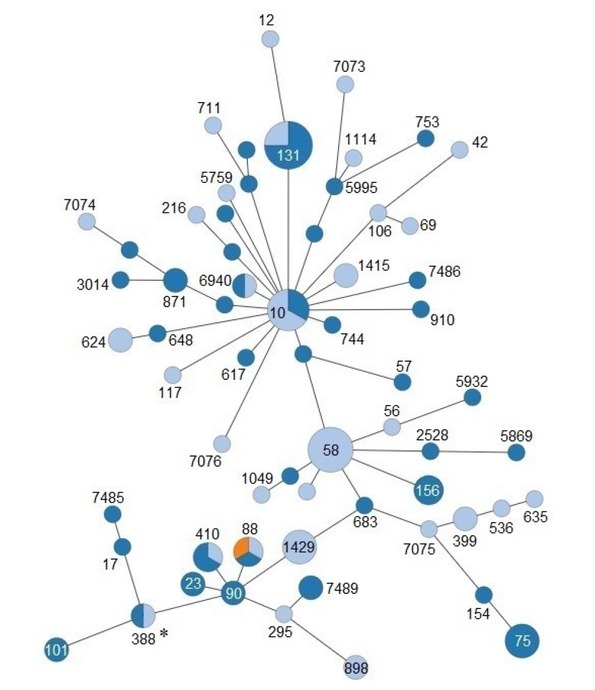
Material and methods: Gastrointestinal samples of free-living wild boars were collected in the Zemplén Mountains in Hungary and were characterised by culture-based, metagenomic, and molecular microbiological methods. Bioinformatic analysis of the faecal microbiome of a hunted wild boar from Japan was used for comparative studies. Also, shotgun metagenomic sequencing data of two untreated sewage wastewater samples from North Pest (Hungary) from 2016 were analysed by bioinformatic methods. Minimum spanning tree diagrams for seven-gene MLST profiles of 104 E. coli strains isolated in Europe from wild boars and domestic pigs were generated in Enterobase.
Results: In the ileum of a diarrhoeic boar, a dominant E. coli O112ab:H2 strain with intermediate resistance to gentamicin, tobramycin, and amikacin was identified, displaying sequence type ST388 and harbouring the EAST1 toxin astA gene. Metagenomic analyses of the colon and rectum digesta revealed the presence of the tetQ, tetW, tetO, and mefA antibiotic resistance genes that were also detected in the gut microbiome of four other wild boars from the mountains. Furthermore, the tetQ and cfxA genes were identified in the faecal microbiome of a hunted wild boar from Japan.
Conclusion: The gastrointestinal microbiota of the free-living wild boars examined in this study carried acquired antibiotic resistance determinants that are highly prevalent among domestic livestock populations.
Keywords: antibiotic resistance; intestinal microbiota; natural habitat; tetracycline; wild boar.
© 2020 B. Libisch et al. published by Sciendo.
Conflict of interest statement
Conflict of Interest Conflict of Interest Statement: The authors declare that there is no conflict of interests regarding the publication of this article.
Figures



References
-
- Alonso C.A., González-Barrio D., Ruiz-Fons F., Ruiz-Ripa L., Torres C.. High frequency of B2 phylogroup among non-clonally related fecal Escherichia coli isolates from wild boars, including the lineage ST131. FEMS Microbiol Ecol. 2017;93 - PubMed
-
- AMR One Health Surveillance Committee: Nippon AMR One Health Report (NAOR) 2017. Tokyo: Tuberculosis and Infectious Diseases Control Division, Health Service Bureau, Ministry of Health, Labour and Welfare; 2017.
-
- Clermont O., Gordon D., Denamur E.. Guide to the various phylogenetic classification schemes for Escherichia coli and the correspondence among schemes. Microbiology. 2015;161:980–988. - PubMed
LinkOut - more resources
Full Text Sources