


Platelet-rich plasma in the management of Asherman's syndrome: An RCT
- PMID: 32259005
- PMCID: PMC7097166
- DOI: 10.18502/ijrm.v18i2.6423
Platelet-rich plasma in the management of Asherman's syndrome: An RCT
Erratum in
-
Correction to "Platelet-rich plasma in the management of Asherman's syndrome: An RCT" [Int J Reprod BioMed 2020; 18: 113-12].Int J Reprod Biomed. 2021 Apr 22;19(4):392. doi: 10.18502/ijrm.v19i4.9068. eCollection 2021 Apr. Int J Reprod Biomed. 2021. PMID: 34056513 Free PMC article.
Abstract
Background: Asherman's syndrome (AS) is a rare reproductive abnormality, resulting in endometrial collapse due to aggressive or recurrent endometritis and/or curettage.
Objective: We aimed to assess the effectiveness of using platelet-rich plasma (PRP) to lower the recurrence rate of intrauterine adhesions (IUAs) following hysteroscopy.
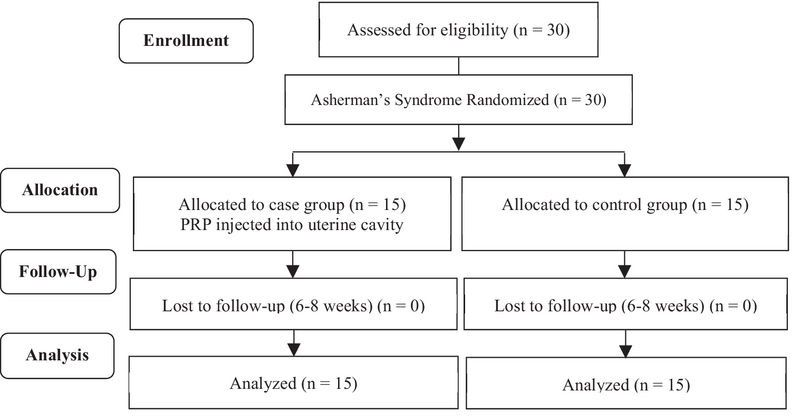
Materials and methods: In this non-randomized clinical trial, women aged 20-45 years with AS diagnosed by sonohysterography, 3D sonography, hysteroscopy, or uterosalpingography between May 2018 and September 2018 were included. Participants (n = 30) were divided into case and control groups. Following hysteroscopic adhesiolysis, a Foley catheter was placed into the uterine cavity in all women. After two days, the catheter was removed, and 1-mL PRP was injected into the uterine cavity of women in the PRP (case) group, while the control received no PRP. All controls and subjects underwent diagnostic hysteroscopy 8-10 weeks following the intervention to assess the IUAs according to the American Society for Reproductive Medicine scoring system.
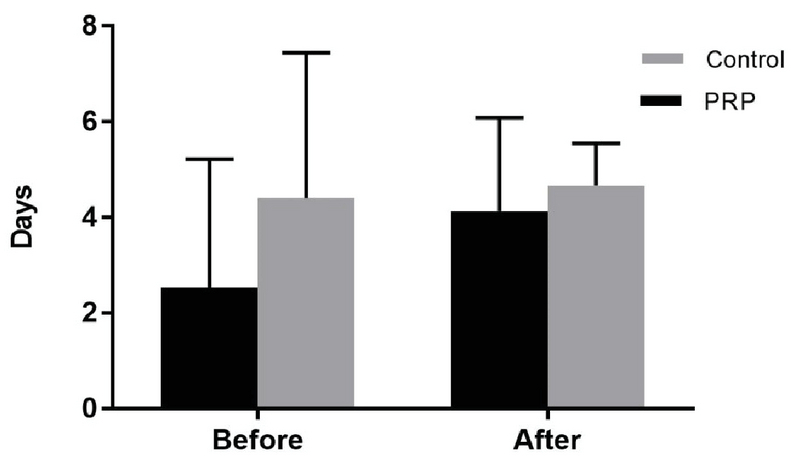
Results: Our results did not reveal any significant difference in the menstrual pattern of either the control or test groups before or after treatment (p = 0.2). Moreover, the IUA stage in both studied groups before and after treatment was similar (p = 0.2). The duration of menstrual bleeding in both studied groups before and after treatment was also similar.
Conclusion: PRP cannot change the menstrual pattern or development of postsurgical AS, as evaluated by follow-up hysteroscopy.
Keywords: Platelet-rich plasma; Pregnancy rate.; Asherman's syndrome.
Copyright © 2020 Javaheri et al.
Conflict of interest statement
The authors have no financial or nonfinancial conflicts of interest.
Figures
References
-
- Patterson Amanda L., Zhang Ling, Arango Nelson A., Teixeira Jose, Pru James K. Mesenchymal-to-Epithelial Transition Contributes to Endometrial Regeneration Following Natural and Artificial Decidualization. Stem Cells and Development. 2013;22(6):964–974. doi: 10.1089/scd.2012.0435. - DOI - PMC - PubMed
-
- Wp Dmowski, Rb Greenblatt. Asherman's syndrome and risk of placenta accreta. Obstet Gynecol 1969; 34: 288-299. - PubMed
-
- Da Silva Rogério T., Heidrich Fernando. Platelet-Rich Plasma. Springer Berlin Heidelberg; 2013. Oct, pp. 153–170. - DOI
LinkOut - more resources
Full Text Sources
Research Materials