Review
. 2020 Jan 13;3(1):29-42.
doi: 10.1021/acsptsci.9b00093. eCollection 2020 Feb 14.

The Emerging Role of Adhesion GPCRs in Cancer

Affiliations
Review

The Emerging Role of Adhesion GPCRs in Cancer

Abanoub A Gad et al. ACS Pharmacol Transl Sci. .

Abstract

Aberrant expression, function, and mutation of G protein-coupled receptors (GPCRs) and their signaling partners, G proteins, have been well documented in many forms of cancer. These cell surface receptors and their endogenous ligands are implicated in all aspects of cancer including proliferation, angiogenesis, invasion, and metastasis. Adhesion GPCRs (aGPCRs) form the second largest family of GPCRs, most of which are orphan receptors with unknown physiological functions. This is mainly due to our limited insight into their structure, natural ligands, signaling pathways, and tissue expression profiles. Nevertheless, recent studies show that aGPCRs play important roles in cell adhesion to the extracellular matrix and cell-cell communication, processes that are dysregulated in cancer. Emerging evidence suggests that aGPCRs are implicated in migration, proliferation, and survival of tumor cells. We here review the role of aGPCRs in the five most common types of cancer (lung, breast, colorectal, prostate, and gastric) and emphasize the importance of further translational studies in this field.


Conflict of interest statement

The authors declare no competing financial interest.

Figures
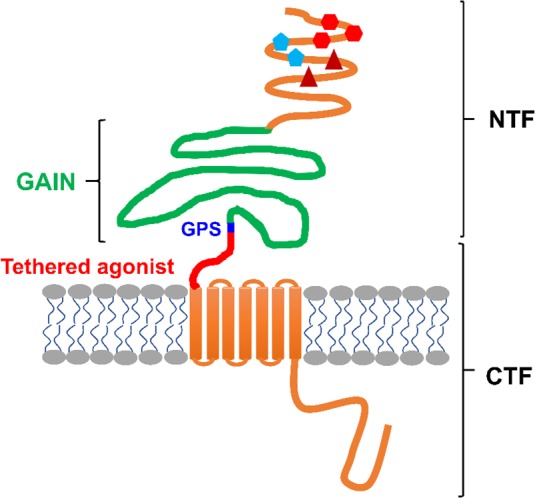
Figure 1
Figure 1
General structure of an aGPCR. All aGPCRs, except ADGRA1, contain a GPCR Autoproteolysis-Inducing domain (GAIN) that includes the GPCR proteolysis site (GPS) and a tethered agonist sequence. The cleavage at GPS results in a two-subunit molecule, including an N-terminal fragment (NTF) and a C-terminal fragment (CTF) that remain associated via noncovalent interactions. In some aGPCRs, NTF includes additional domains such as EGF-like, cadherin, pentraxin, and leucine-rich repeats. These domains interact with other cell adhesion molecules and extracellular matrices, by which they orchestrate the intracellular signaling.
Figure 2
Figure 2
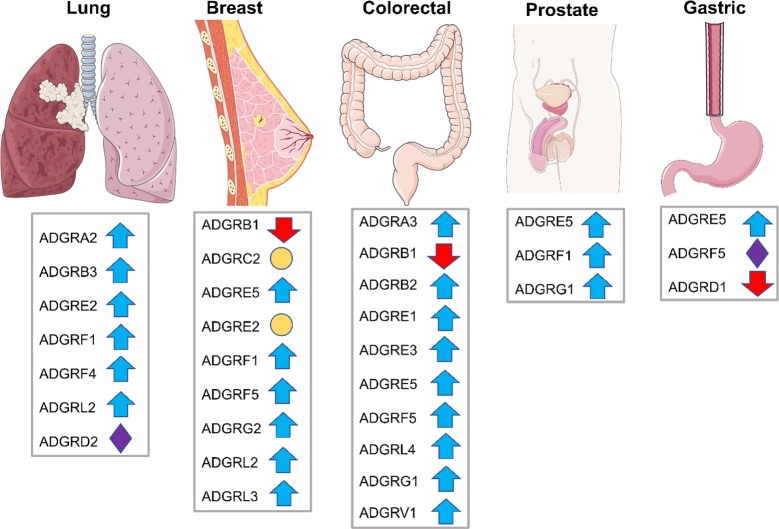
List of aGPCRs with altered expression (blue and red arrows), mutation (purple diamonds), or localization (orange circles) in the five most common cancers globally (organ images are taken from https://smart.servier.com).

References

    1. Hall R. A.; Premont R. T.; Lefkowitz R. J. (1999) Heptahelical receptor signaling: beyond the G protein paradigm. J. Cell Biol. 145, 927–932. 10.1083/jcb.145.5.927. - DOI - PMC - PubMed
    1. Rosenbaum D. M.; Rasmussen S. G.; Kobilka B. K. (2009) The structure and function of G-protein-coupled receptors. Nature 459, 356–363. 10.1038/nature08144. - DOI - PMC - PubMed
    1. Yim Y. Y.; Zurawski Z.; Hamm H. (2018) GPCR regulation of secretion. Pharmacol. Ther. 192, 124–140. 10.1016/j.pharmthera.2018.07.005. - DOI - PMC - PubMed
    1. De Francesco E. M.; Sotgia F.; Clarke R. B.; Lisanti M. P.; Maggiolini M. (2017) G Protein-Coupled Receptors at the Crossroad between Physiologic and Pathologic Angiogenesis: Old Paradigms and Emerging Concepts. Int. J. Mol. Sci. 18, 2713. 10.3390/ijms18122713. - DOI - PMC - PubMed
    1. Fredriksson R.; Lagerstrom M. C.; Lundin L. G.; Schioth H. B. (2003) The G-protein-coupled receptors in the human genome form five main families. Phylogenetic analysis, paralogon groups, and fingerprints. Mol. Pharmacol. 63, 1256–1272. 10.1124/mol.63.6.1256. - DOI - PubMed

LinkOut - more resources