


Reported Weight Change in Older Adults and Presence of Frailty
- PMID: 32259180
- PMCID: PMC7202674
- DOI: 10.14283/jfa.2019.44
Reported Weight Change in Older Adults and Presence of Frailty
Abstract
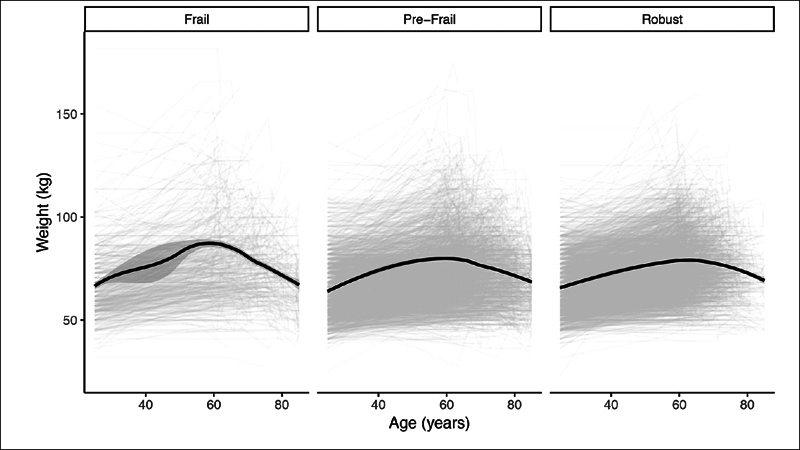
Objective: A 5% change in weight is a significant predictor for frailty and obesity. We ascertained how self-reported weight change over the lifespan impacts rates of frailty in older adults.
Methods: We identified 4,984 subjects ≥60 years with body composition measures from the National Health and Nutrition Examination Survey. An adapted version of Fried's frailty criteria was used as the primary outcome. Self-reported weight was assessed at time current,1 and 10 years earlier and at age 25. Weight changes between each time point were categorized as ≥ 5%, ≤5% or neutral. Logistic regression assessed the impact of weight change on the outcome of frailty.
Results: Among 4,984 participants, 56.5% were female, mean age was 71.1 years, and mean BMI was 28.2kg/m2. A weight loss of ≥ 5% had a higher association with frailty compared to current weight, age 25 (OR 2.94 [1.72,5.02]), 10 years ago (OR 1.68 [1.05,2.69]), and 1 year ago (OR 1.55 [1.02,2.36]). Weight gain in the last year was associated with increased rate of frailty (1.59 [1.09,2.32]).
Conclusion: There is an association between frailty and reported weight loss over time while only weight gain in the last year has an association with frailty.
Keywords: Obesity; frailty; pre-frailty; sarcopenia.
Conflict of interest statement
There are no conflicts of interest pertaining to this manuscript.
Figures
References
-
- Chong E, Ho E, Baldevarona-Llego J, Chan M, Wu L, Tay L. Frailty and Risk of Adverse Outcomes in Hospitalized Older Adults: A Comparison of Different Frailty Measures. J Am Med Dir Assoc. 2017;18(7):638.e7–638.e11. - PubMed
-
- Fried LP, Tangen CM, Walston J, Newman AB, Hirsch C, Gottdiener J, et al. Frailty in older adults: evidence for a phenotype. J Gerontol A Biol Sci Med Sci. 2001;56(3):M146–M156. - PubMed
MeSH terms
Grants and funding
LinkOut - more resources
Full Text Sources
