


Case Series: Unilateral Amygdala Ablation Ameliorates Post-Traumatic Stress Disorder Symptoms and Biomarkers
- PMID: 32259241
- PMCID: PMC7593359
- DOI: 10.1093/neuros/nyaa051
Case Series: Unilateral Amygdala Ablation Ameliorates Post-Traumatic Stress Disorder Symptoms and Biomarkers
Abstract
Background: Post-traumatic stress disorder is a severe psychobiological disorder associated with hyperactivity of the amygdala, particularly on the right side. Highly selective laser ablation of the amygdalohippocampal complex is an effective neurosurgical treatment for medically refractory medial temporal lobe epilepsy that minimizes neurocognitive deficits relative to traditional open surgery.
Objective: To examine the impact of amygdalohippocampotomy upon symptoms and biomarkers of post-traumatic stress disorder.
Methods: Two patients with well-documented chronic post-traumatic stress disorder who subsequently developed late-onset epilepsy underwent unilateral laser amygdalohippocampotomy. Prospective clinical and neuropsychological measurements were collected in patient 1. Additional prospective measurements of symptoms and biomarkers were collected pre- and post-surgery in patient 2.
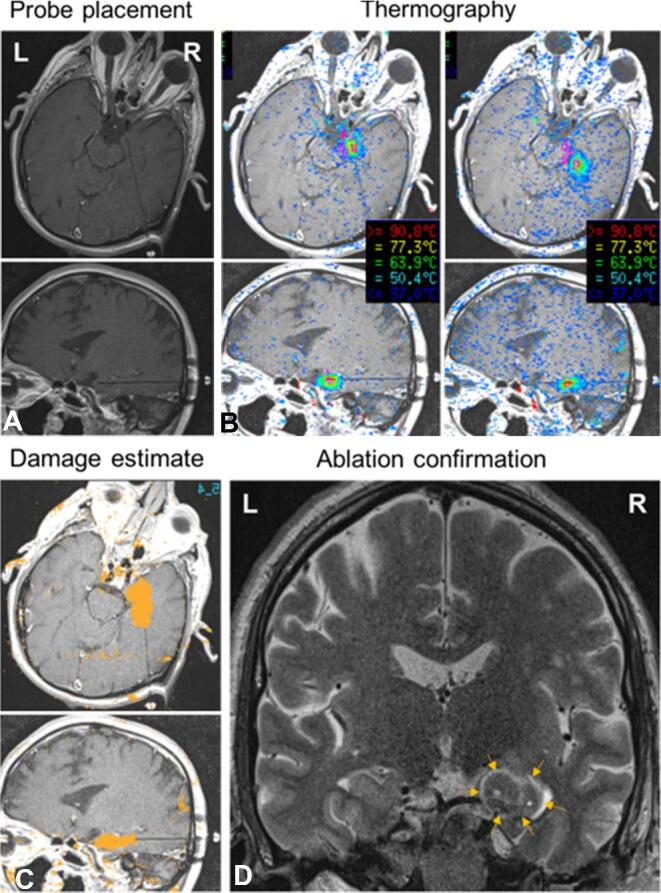
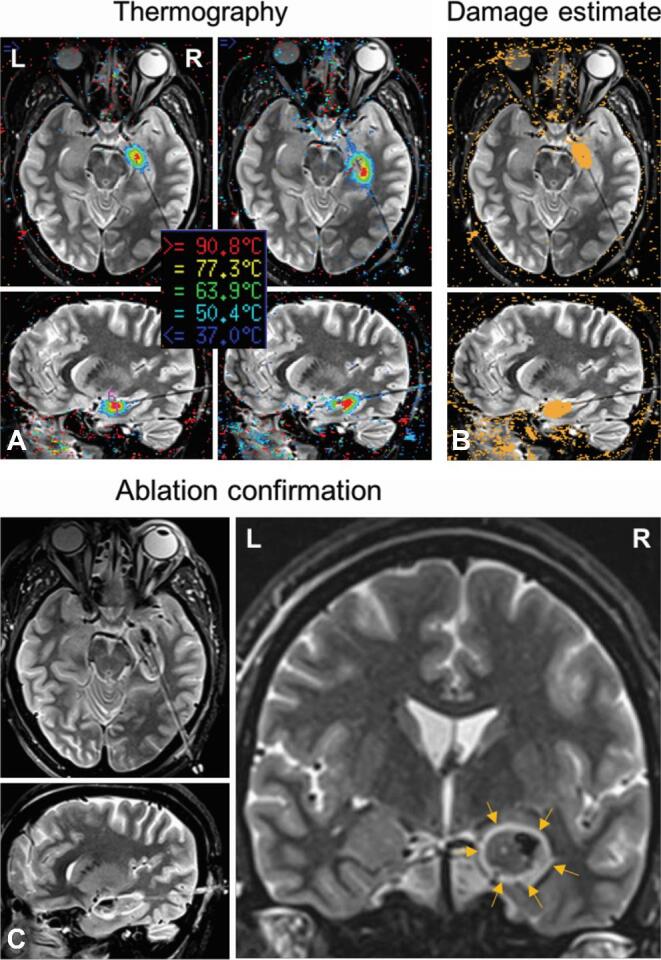
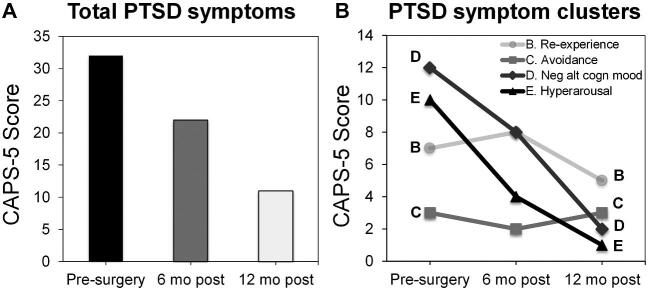
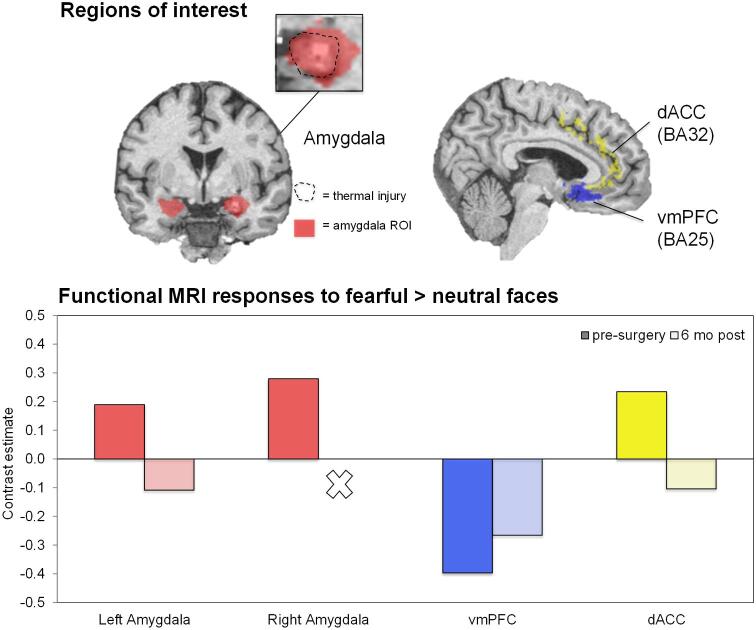
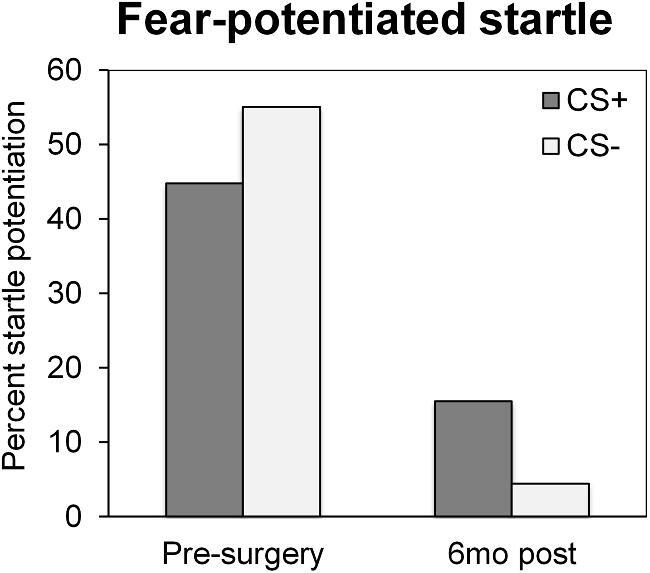
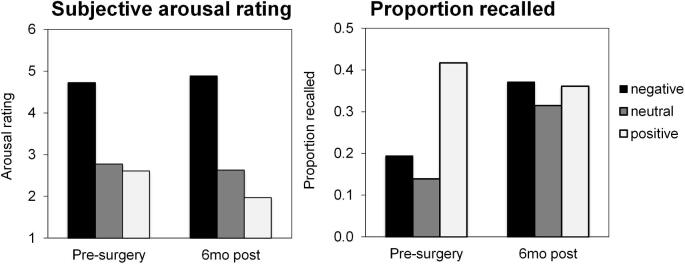
Results: After laser ablation targeting the nondominant (right) amygdala, both patients experienced not only reduced seizures, but also profoundly abated post-traumatic stress symptoms. Prospective evaluation of biomarkers in patient 2 showed robust improvements in hyperarousal symptoms, fear potentiation of the startle reflex, brain functional magnetic resonance imaging responses to fear-inducing stimuli, and emotional declarative memory.
Conclusion: These observations support the emerging hypothesis that the right amygdala particularly perpetuates the signs and symptoms of post-traumatic stress disorder and suggests that focal unilateral amydalohippocampotomy can provide therapeutic benefit.
Keywords: Ablation; Amygdala; Anxiety; Epilepsy; Hippocampus; Lesion; Post-traumatic stress disorder; Resection.
Copyright © 2020 by the Congress of Neurological Surgeons.
Figures
Comment in
-
Letter: Case Series: Unilateral Amygdala Ablation Ameliorates Post-Traumatic Stress Disorder Symptoms and Biomarkers.Neurosurgery. 2021 Apr 15;88(5):E478-E479. doi: 10.1093/neuros/nyab025. Neurosurgery. 2021. PMID: 33582763 No abstract available.
-
In Reply: Case Series: Unilateral Amygdala Ablation Ameliorates Post-Traumatic Stress Disorder Symptoms and Biomarkers.Neurosurgery. 2021 Apr 15;88(5):E480-E481. doi: 10.1093/neuros/nyab028. Neurosurgery. 2021. PMID: 33611569 Free PMC article. No abstract available.
References
-
- Kessler RC, Berglund P, Demler O, Jin R, Merikangas KR, Walters EE. Lifetime prevalence and age-of-onset distributions of DSM-IV disorders in the national comorbidity survey replication. Arch Gen Psychiatry. 2005;62(6):593-602. - PubMed
-
- Association AP. Diagnostic and statistical manual of mental disorders. 5th ed.Arlington, VA: American Psychiatric Publishing; 2013.
-
- Bradley RG, Greene J, Russ E, Dutra L, Westen D. A multidimensional meta-analysis of psychotherapy for PTSD. Am J Psychiatr. 2005;162(2):214-227. - PubMed
Publication types
MeSH terms
Grants and funding
LinkOut - more resources
Full Text Sources
Medical
