Comparative Study
. 2020 Aug 1;37(8):2341-2356.
doi: 10.1093/molbev/msaa090.

Extraordinary Sequence Diversity and Promiscuity of Centromeric Satellites in the Legume Tribe Fabeae

Affiliations
Comparative Study

Extraordinary Sequence Diversity and Promiscuity of Centromeric Satellites in the Legume Tribe Fabeae

Laura Ávila Robledillo et al. Mol Biol Evol. .

Abstract

Satellite repeats are major sequence constituents of centromeres in many plant and animal species. Within a species, a single family of satellite sequences typically occupies centromeres of all chromosomes and is absent from other parts of the genome. Due to their common origin, sequence similarities exist among the centromere-specific satellites in related species. Here, we report a remarkably different pattern of centromere evolution in the plant tribe Fabeae, which includes genera Pisum, Lathyrus, Vicia, and Lens. By immunoprecipitation of centromeric chromatin with CENH3 antibodies, we identified and characterized a large and diverse set of 64 families of centromeric satellites in 14 species. These families differed in their nucleotide sequence, monomer length (33-2,979 bp), and abundance in individual species. Most families were species-specific, and most species possessed multiple (2-12) satellites in their centromeres. Some of the repeats that were shared by several species exhibited promiscuous patterns of centromere association, being located within CENH3 chromatin in some species, but apart from the centromeres in others. Moreover, FISH experiments revealed that the same family could assume centromeric and noncentromeric positions even within a single species. Taken together, these findings suggest that Fabeae centromeres are not shaped by the coevolution of a single centromeric satellite with its interacting CENH3 proteins, as proposed by the centromere drive model. This conclusion is also supported by the absence of pervasive adaptive evolution of CENH3 sequences retrieved from Fabeae species.

Keywords: CENH3; ChIP-seq; centromere evolution; plant chromosomes; satellite DNA.


Figures

<sc>Fig</sc>. 1.
Fig. 1.
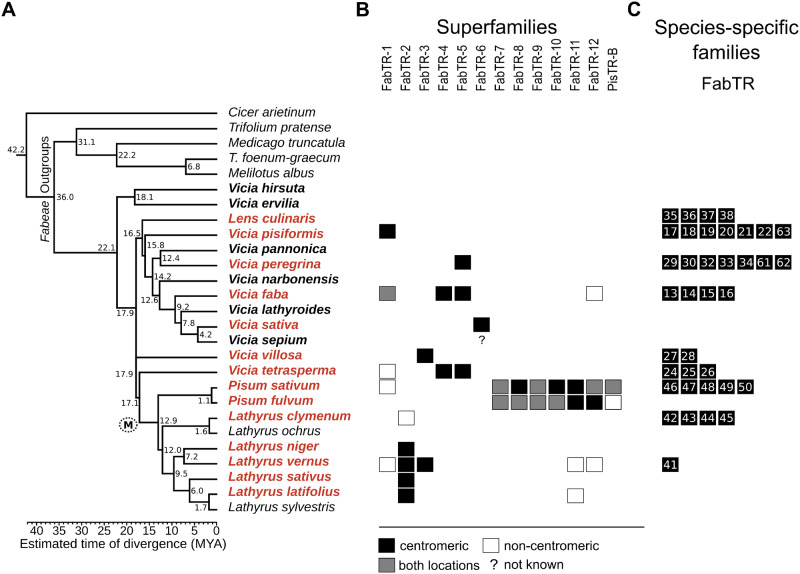
Overview of centromeric satellite families identified in Fabeae. Species are arranged based on their phylogenetic distances inferred from a comparison of matK–rbcL sequences using the maximum likelihood algorithm (A). The tree was rooted using five species representing related legume genera as outgroups. Numbers represent estimated node ages in million years ago (MYA), and correspond to the divergence time scale below the tree. The branch leading to the species with meta-polycentric chromosomes is marked with (M). Names of Fabeae species in which satellite repeats were identified using CENH3 ChIP-seq are printed in red, whereas species not analyzed by ChIP but included in the similarity searches are printed in bold. (B and C) The presence of individual satellite families in analyzed species is indicated by squares. Black squares indicate families associated with centromeric chromatin, as revealed by their enrichment in the CENH3 ChIP-seq experiments. The centromeric satellites that simultaneously occur in the genome as additional, noncentromeric loci (revealed by FISH) are marked with gray squares, whereas those present in the respective species but not enriched in ChIP-seq experiments are marked with empty squares. The question mark in FabTR-6 column indicates that this repeat is present in Vicia sepium genome but was not investigated by ChIP-seq in this species. (B) The satellite families from different species displaying sequence similarities are grouped into superfamilies and arranged in columns labeled with the superfamily name. (C) Numbers of species-specific families are symbolized by squares in each row, ranging from one in Lathyrus vernus to seven in V. pisiformis and V. peregrina. Numbers within the squares refer to the family names (FabTR-numbers) listed in table 1.
<sc>Fig</sc>. 2.
Fig. 2.
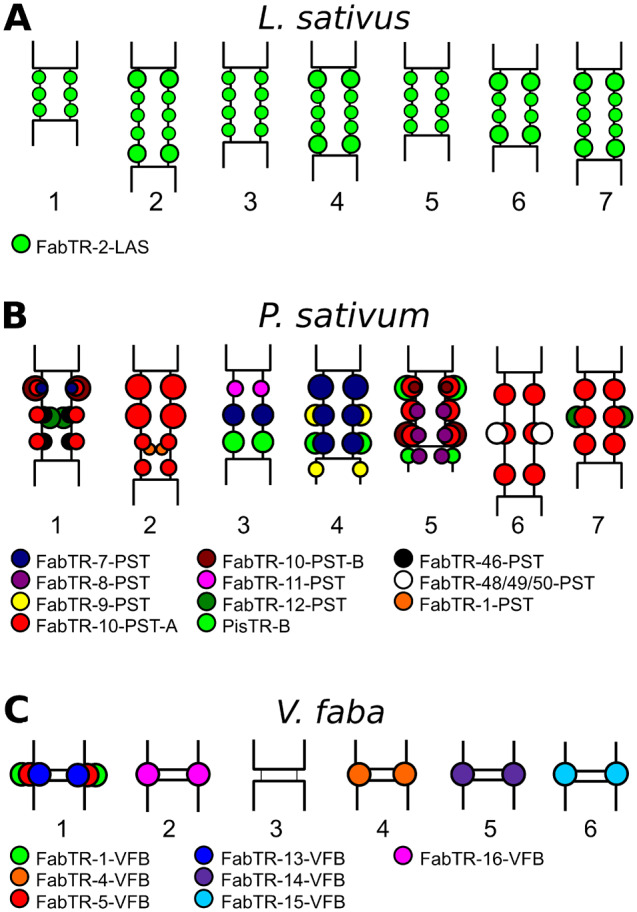
Schematic representation of the satellite repeat distribution in centromeric regions of (A) Lathyrus sativus (n = 7), (B) Pisum sativum (n = 7), and (C) Vicia faba (n = 6) chromosomes. Different families of satellite repeats are distinguished by colors according to the legend provided for each species. In meta-polycentric chromosomes (A and B), the satellite loci associated with CENH3 chromatin are located at the outer periphery of the primary constrictions, whereas those located within the inner regions of P. sativum constrictions lack CENH3.
<sc>Fig</sc>. 3.
Fig. 3.
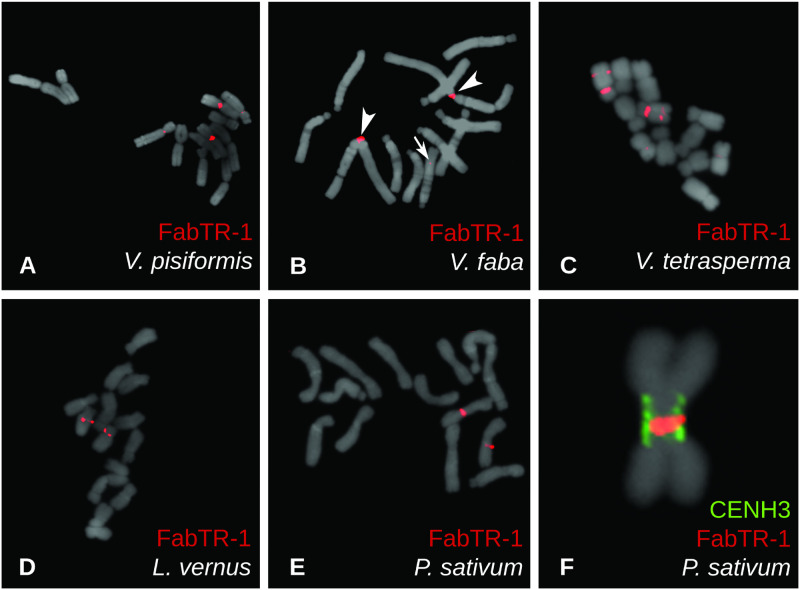
Localization of FabTR-1 repeats on metaphase chromosomes of five Fabeae species. Repeats were detected using FISH (red signals), showing signals within centromeres of two chromosome pairs in Vicia pisiformis (A) and one pair in V. faba (B). A minor noncentromeric signal on V. faba chromosome 6 is marked with an arrow. Two pericentromeric and one interstitial signal were detected in V. tetrasperma (C), whereas Lathyrus vernus (D) and Pisum sativum (E) exhibited signals adjacent to or within primary constrictions of one pair of chromosomes. Closer examination of P. sativum chromosomes using a combination of FISH (red) with immunolabeling of CENH3 proteins (green) revealed that FabTR-1 is located within the inner part of the primary constriction, apart from the CENH3 chromatin located along the constriction periphery (F). Chromosomes counterstained with DAPI are shown in gray.
<sc>Fig</sc>. 4.
Fig. 4.
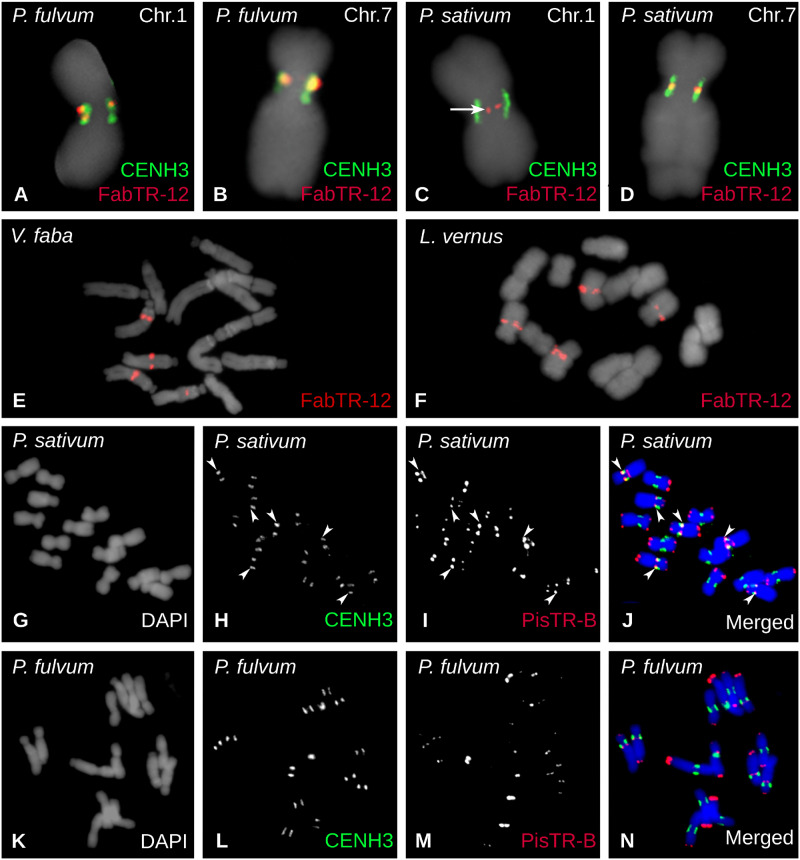
Localization of FabTR-12 and PisTR-B repeats on metaphase chromosomes. Repeats were detected using FISH (red) alone or in combination with immunolabeling of CENH3 (green signals). (AD) FISH detection of FabTR-12 showing signals overlapping with CENH3 loci on chromosomes 1 and 7 of Pisum fulvum and on chromosome 7 of P. sativum. On the contrary, FabTR-12 signals were located apart from the CENH3 chromatin on P. sativum chromosome 1 (arrow). In Vicia faba (E) and Lathyrus vernus (F), the repeat was also present on two chromosome pairs, but the signals were not centromeric and were instead located within the long chromosome arms. (G–N) Distribution of PisTR-B repeats on chromosomes of the two Pisum species. There are three centromeric PisTR-B loci (arrowheads) that colocalize with CENH3 in P. sativum (G–J); however, this satellite is not associated with the centromeric chromatin in P. fulvum (KN).
<sc>Fig</sc>. 5.
Fig. 5.
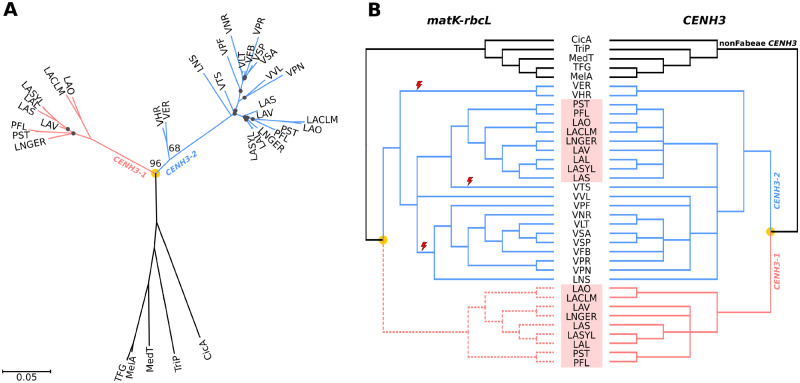
Phylogenetic trees of CENH3 sequences. (A) Phylogenetic tree inferred from the alignment of CENH3-coding sequences using the maximum likelihood method, excluding the INDEL region near the 5′ end (see supplementary fig. 5, Supplementary Material online). Bootstrap values are shown only for key nodes. Black dots indicate nodes with low bootstrap support (<50). The scale bar shows genetic distance. (B) Tanglegram showing comparison of the CENH3 tree from the panel (A) with the species tree inferred from matKrbcL shown in figure 1A. Nodes with low bootstrap support (<50) were collapsed in both trees. The part of the matKrbcL tree depicted by dashed lines was manually added to the tree to show comparison of phylogenies inferred from matKrbcL and CENH3-1, and to allow the use of the matKrbcL tree for analysis of positive selection in CENH3 genes. Red lightning symbols mark three independent losses of CENH3-1 genes. Pisum and Lathyrus species are highlighted by red rectangles. Orange dots indicate CENH3 duplication events.

References

    1. Akera T, Chmátal L, Trimm E, Yang K, Aonbangkhen C, Chenoweth DM, Janke C, Schultz RM, Lampson MA.. 2017. Spindle asymmetry drives non-Mendelian chromosome segregation. Science 358(6363):668–672. - PMC - PubMed
    1. Altschul SF, Madden TL, Schäffer AA, Zhang J, Zhang Z, Miller W, Lipman DJ.. 1997. Gapped BLAST and PSI-BLAST: a new generation of protein database search programs. Nucleic Acids Res. 25(17):3389–3402. - PMC - PubMed
    1. Ávila Robledillo L, Koblížková A, Novák P, Böttinger K, Vrbová I, Neumann P, Schubert I, Macas J.. 2018. Satellite DNA in Vicia faba is characterized by remarkable diversity in its sequence composition, association with centromeres, and replication timing. Sci Rep. 8(1):5838. - PMC - PubMed
    1. Badr SF. 2006. Karyotype analysis and chromosome evolution in species of Lathyrus (Fabaceae). Cytologia 71(4):447–455. - PubMed
    1. Bilinski P, Distor K, Gutierrez-Lopez J, Mendoza Mendoza G, Shi J, Dawe RK, Ross-Ibarra J.. 2015. Diversity and evolution of centromere repeats in the maize genome. Chromosoma 124(1):57–65. - PubMed

Publication types