


A Systematic Review of Estimating Breast Cancer Recurrence at the Population Level With Administrative Data
- PMID: 32259259
- PMCID: PMC7566328
- DOI: 10.1093/jnci/djaa050
A Systematic Review of Estimating Breast Cancer Recurrence at the Population Level With Administrative Data
Abstract
Background: Exact numbers of breast cancer recurrences are currently unknown at the population level, because they are challenging to actively collect. Previously, real-world data such as administrative claims have been used within expert- or data-driven (machine learning) algorithms for estimating cancer recurrence. We present the first systematic review and meta-analysis, to our knowledge, of publications estimating breast cancer recurrence at the population level using algorithms based on administrative data.
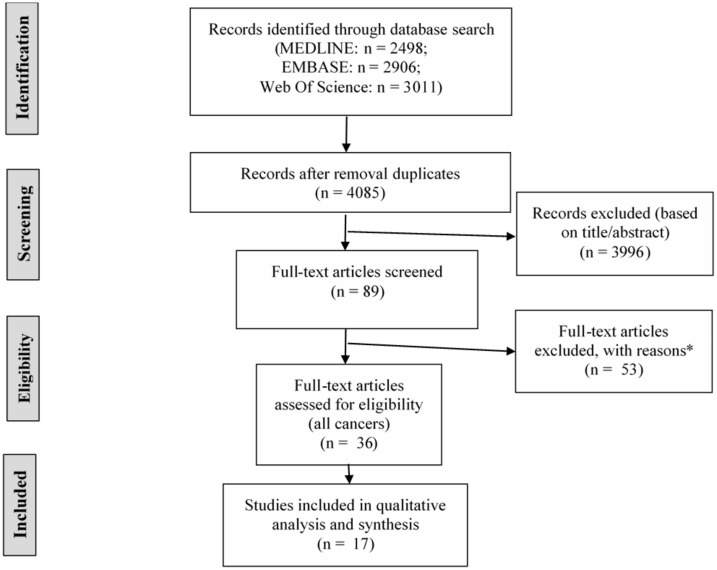
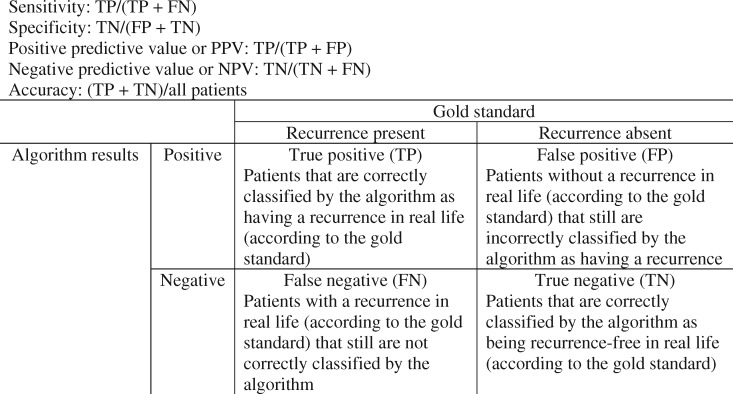
Methods: The systematic literature search followed Preferred Reporting Items for Systematic Reviews and Meta-Analysis guidelines. We evaluated and compared sensitivity, specificity, positive predictive value, negative predictive value, and overall accuracy of algorithms. A random-effects meta-analysis was performed using a generalized linear mixed model to obtain a pooled estimate of accuracy.
Results: Seventeen articles met the inclusion criteria. Most articles used information from medical files as the gold standard, defined as any recurrence. Two studies included bone metastases only in the definition of recurrence. Fewer studies used a model-based approach (decision trees or logistic regression) (41.2%) compared with studies using detection rules without specified model (58.8%). The generalized linear mixed model for all recurrence types reported an accuracy of 92.2% (95% confidence interval = 88.4% to 94.8%).
Conclusions: Publications reporting algorithms for detecting breast cancer recurrence are limited in number and heterogeneous. A thorough analysis of the existing algorithms demonstrated the need for more standardization and validation. The meta-analysis reported a high accuracy overall, which indicates algorithms as promising tools to identify breast cancer recurrence at the population level. The rule-based approach combined with emerging machine learning algorithms could be interesting to explore in the future.
© The Author(s) 2020. Published by Oxford University Press. All rights reserved. For permissions, please email: journals.permissions@oup.com.
Figures
References
-
- IARC. Cancer fact sheets. Global Cancer Observatory - IARC. https://gco.iarc.fr/today/fact-sheets-cancers. Accessed September 5, 2019.
-
- In H, Bilimoria KY, Stewart AK, et al. Cancer recurrence: an important but missing variable in national cancer registries. Ann Surg Oncol. 2014;21(5):1520–1529. doi: 10.1245/s10434-014-3516-x. - PubMed
Publication types
MeSH terms
LinkOut - more resources
Full Text Sources
Medical
Miscellaneous
