. 2020 Jul 22;26(41):9005-9011.
doi: 10.1002/chem.202001494. Epub 2020 Jul 1.

Photoinduced and Thermal Single-Electron Transfer to Generate Radicals from Frustrated Lewis Pairs

Affiliations

Photoinduced and Thermal Single-Electron Transfer to Generate Radicals from Frustrated Lewis Pairs

Flip Holtrop et al. Chemistry. .

Abstract

Archetypal phosphine/borane frustrated Lewis pairs (FLPs) are famed for their ability to activate small molecules. The mechanism is generally believed to involve two-electron processes. However, the detection of radical intermediates indicates that single-electron transfer (SET) generating frustrated radical pairs could also play an important role. These highly reactive radical species typically have significantly higher energy than the FLP, which prompted this investigation into their formation. Herein, we provide evidence that the classical phosphine/borane combinations PMes3 /B(C6 F5 )3 and PtBu3 /B(C6 F5 )3 both form an electron donor-acceptor (charge-transfer) complex that undergoes visible-light-induced SET to form the corresponding highly reactive radical-ion pairs. Subsequently, we show that by tuning the properties of the Lewis acid/base pair, the energy required for SET can be reduced to become thermally accessible.

Keywords: Lewis pairs; charge transfer; electron transfer; photochemistry; radicals.


Conflict of interest statement

The authors declare no conflict of interest.

Figures

Scheme 1
Scheme 1
Literature examples of detected radicals (highlighted in boxes) in cooperative main‐group Lewis acid/base chemistry.2c, 4b, 7 R=Mes, Tipp, C6F5, C6Me5, tBu (only in the case of CPh3 +); SiR′3 +=SiiPr3 +, Si(C6Me5)3 +, SitBuMe2 +, SiEt3 +.
Scheme 2
Scheme 2
Electron donor–acceptor complex formation and subsequent SET to generate the corresponding radical‐ion pair.
Figure 1
Figure 1
DFT‐calculated energy needed to access the radical‐ion pairs from the FLP systems PtBu3/PMes3 and BCF.7
Figure 2
Figure 2
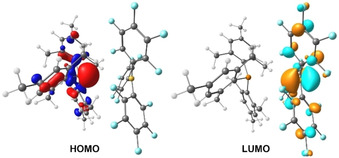
Frontier molecular orbitals of the PMes3/BCF encounter complex, calculated at the ωB97X‐D/6‐311G(d,p) level of theory. Isovalue=0.05.
Figure 3
Figure 3
a) UV/Vis spectrum of PMes3/BCF (both components: 1.5×10⁻²m in toluene) compared with the spectra of the separate components (1.5×10⁻²m). b) Experimental EPR spectrum of PMes3/BCF in toluene measured at 30 K during irradiation with visible light (390–500 nm) and simulated EPR spectra of PMes3 ⋅+ and BCF⋅−. c) Transient absorption spectra measured after pulsed excitation of PMes3/BCF with 530 nm light.
Figure 4
Figure 4
a) UV/Vis spectrum of PtBu3/BCF (both components: 1.5×10⁻²m in toluene) compared with the spectra of the separate components (1.5×10⁻²m). Inset shows the colour of the solution. b) Experimental EPR spectrum of PtBu3/BCF in toluene measured at 30 K during irradiation with visible light (390–500 nm) and simulated EPR spectra of PtBu3 ⋅+ and BCF⋅−. c) Transient absorption spectra measured after pulsed excitation of PtBu3/BCF with 530 nm light.
Scheme 3
Scheme 3
SET to afford the high‐energy radical‐ion pair, which, by decomposition of either the radical cation or radical anion, forms the stable complementary radical ion selectively.
Figure 5
Figure 5
Ionisation energies (IED, top) and electron affinities (EAA, bottom) of donors and acceptors typical in FLP chemistry calculated at the SCRF/ωB97X‐D/6‐311+G(d,p) level of theory (solvent=toluene).
Figure 6
Figure 6
Energy diagram showing the thermal SET equilibrium for the NpTol3/+CPh3 EDA pair. For computational details, see Figure 5.

References

    1. None
    1. Welch G. C., San Juan R. R., Masuda J. D., Stephan D. W., Science 2006, 314, 1124–1126; - PubMed
    1. Paradies J., Coord. Chem. Rev. 2019, 380, 170–183;
    1. Skara G., De Vleeschouwer F., Geerlings P., De Proft F., Pinter B., Sci. Rep. 2017, 7, 1–15; - PMC - PubMed
    1. Stephan D. W., Science 2016, 354, aaf7229; - PubMed

LinkOut - more resources