


Microstructure Simulation and Constitutive Modelling of Magnetorheological Fluids Based on the Hexagonal Close-packed Structure
- PMID: 32260188
- PMCID: PMC7178291
- DOI: 10.3390/ma13071674
Microstructure Simulation and Constitutive Modelling of Magnetorheological Fluids Based on the Hexagonal Close-packed Structure
Abstract
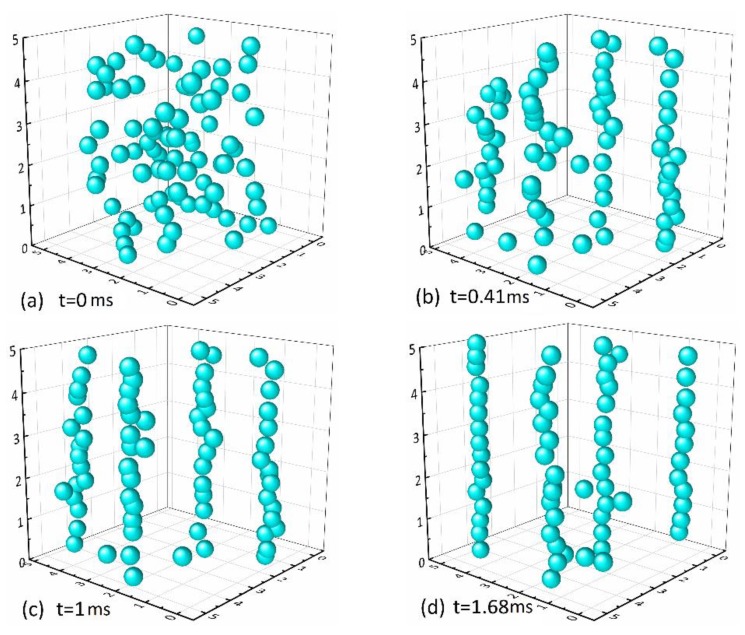
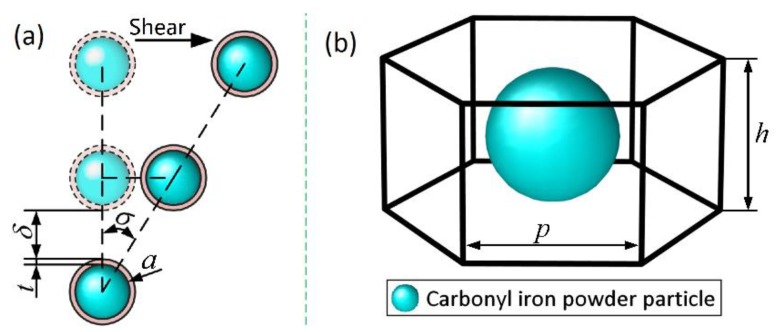
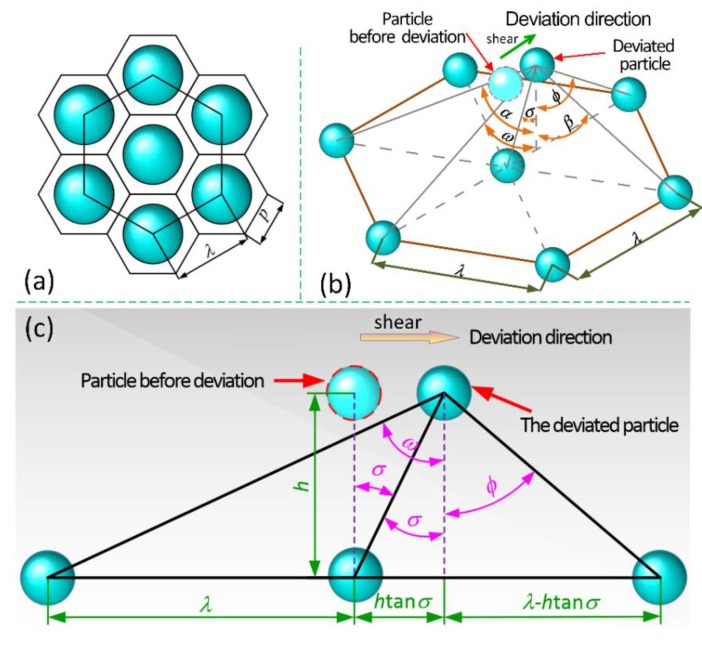
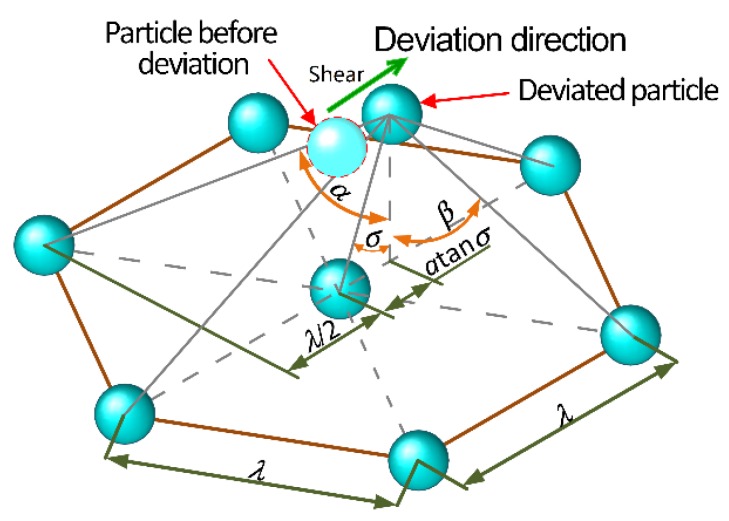
This paper presents a new constitutive model of high particles concentrated magnetorheological fluids (MRFs) that is based on the hexagonal close-packed structure, which can reflect the micro-structures of the particles under the magnetic field. Firstly, the particle dynamic simulations for the forces sustained by carbonyl iron powder (CIP) particles of MRFs are performed in order to investigate the particles chain-forming process at different time nodes. Subsequently, according to the force analyses, a hexagonal close-packed structure, which differs from the existing single-chain structure and body-cantered cubic structure, is adopted to formulate a constitutive model of MRFs with high concentration of the magnetic-responsive particles. Several experiments are performed while considering crucial factors that influence on the chain-forming mechanism and, hence, change the field-dependent shear yield stress in order to validate the proposed model. These factors include the magnetic induction intensity, volume fraction and radius of CIP particles, and surfactant coating thickness. It is shown that the proposed modeling approach can predict the field-dependent shear yield stress much better than the single-chain model. In addition, it is identified that the shear yield stress is increased as the particle volume fraction increases and surfactant coating thickness decreases. It is believed that the proposed constitutive model can be effectively used to estimate the field-dependent shear yield stress of MRFs with a high concentration of iron particles.
Keywords: constitutive modeling; hexagonal close-packed structure; magnetorheological fluids; microstructure; particle dynamics analysis.
Conflict of interest statement
The authors declare no conflict of interest.
Figures

References
-
- Wang S.Y., Song W.L., Li H.L., Wang N. Modeling and multi-field simulation annlysis of a multi-cylindrical magneto-rheological brake. Int. J. Appl. Electrom. 2018;57:399–414. doi: 10.3233/JAE-170149. - DOI
-
- Zhang J.Q., Zhang J., Kong Y.N., Gao Y.Q., Jia J.F., Wang H.T. Summarization of magnetorheological fluid and its application. J. Acad. Armored Force Eng. 2010;24:5–10. doi: 10.1016/j.jmaa.2010.03.038. - DOI
-
- Fu J., Bai J.F., Lai J.J., Li P.D., Yu M., Lam H.K. Adaptive fuzzy control of a magnetorheological elastomer vibration isolation system with time-varying sinusoidal excitations. J. Sound Vib. 2019;456:386–406. doi: 10.1016/j.jsv.2019.05.046. - DOI
-
- Brigadnov I.A., Dorfmann A. Mathematical modeling of magnetorheological fluids. Continuum Mech. Thermodyn. 2005;17:29–42. doi: 10.1007/s00161-004-0185-1. - DOI
Grants and funding
LinkOut - more resources
Full Text Sources
