Review
. 2020 Apr 7;19(1):86.
doi: 10.1186/s12934-020-01342-z.

Current developments on polyhydroxyalkanoates synthesis by using halophiles as a promising cell factory

Affiliations
Review

Current developments on polyhydroxyalkanoates synthesis by using halophiles as a promising cell factory

Ruchira Mitra et al. Microb Cell Fact. .

Abstract

Plastic pollution is a severe threat to our environment which necessitates implementation of bioplastics to realize sustainable development for a green world. Polyhydroxyalkanoates (PHA) represent one of the potential candidates for these bioplastics. However, a major challenge faced by PHA is the high production cost which limits its commercial application. Halophiles are considered to be a promising cell factory for PHA synthesis due to its several unique characteristics including high salinity requirement preventing microbial contamination, high intracellular osmotic pressure allowing easy cell lysis for PHA recovery, and capability to utilize wide spectrum of low-cost substrates. Optimization of fermentation parameters has made it plausible to achieve large-scale production at low cost by using halophiles. Further deeper insights into halophiles have revealed the existence of diversified and even novel PHA synthetic pathways within different halophilic species that greatly affects PHA type. Thus, precise metabolic engineering of halophiles with the help of advanced tools and strategies have led to more efficient microbial cell factory for PHA production. This review is an endeavour to summarize the various research achievements in these areas which will help the readers to understand the current developments as well as the future efforts in PHA research.

Keywords: Cost reduction; Halophiles; Metabolic engineering; Novel PHA biosynthesis; Polyhydroxyalkanoates; Production improvement.


Conflict of interest statement

The authors declare that they have no competing interests.

Figures
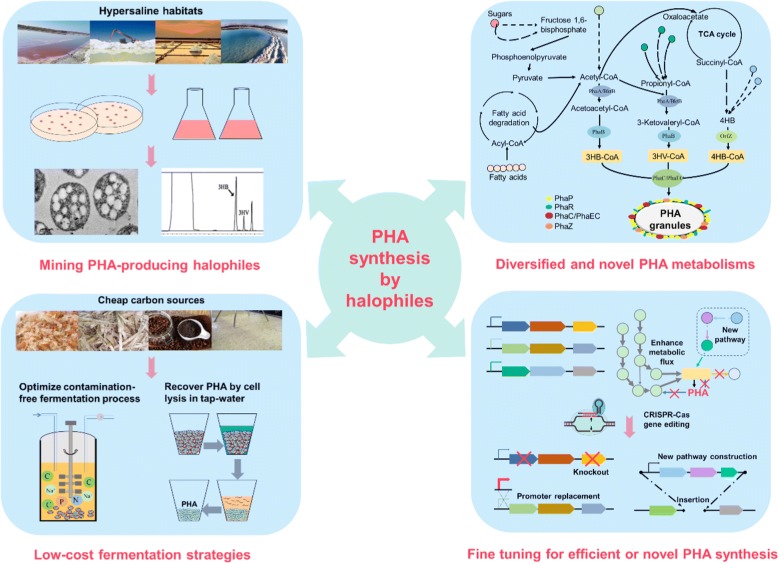
Fig. 1
Fig. 1
Summary of the PHA research achievements in Haloarchaea and Halophilic bacteria. Halophiles with strong PHA-accumulation ability are mined from various hypersaline habitats. PHA production cost is closely related with substrate usage, fermentation process, and PHA recovery. Halophiles are able to utilize a wide-range of low-cost substrates. PHA recovery from halophiles can be easily done by cell lysis using tap-water. The physicochemical parameters and fermentation modes have been optimized to enhance PHA production in halophiles. With the aim of genome sequencing technology and genetic manipulation tools, various PHA related genes, enzymes and pathways have been identified. With the help of advanced metabolic engineering tools and strategies, more efficient microbial cell factory has been developed for PHA production using halophiles
Fig. 2
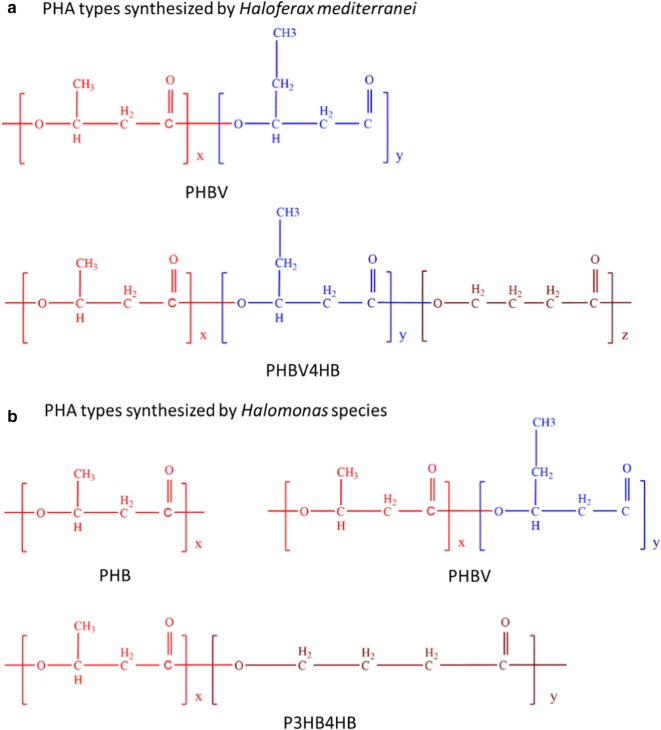
Fig. 2
The PHA types synthesized by Haloferax mediterranei and Halomonas species. Hfx. mediterranei can synthesize PHBV and PHBV4HB. Halomonas species are able to accumulate PHB, PHBV, and P3HB4HB

References

    1. Chae Y, An YJ. Current research trends on plastic pollution and ecological impacts on the soil ecosystem: a review. Environ Pollut. 2018;240:387–395. doi: 10.1016/j.envpol.2018.05.008. - DOI - PubMed
    1. Sharma S, Chatterjee S. Microplastic pollution, a threat to marine ecosystem and human health: a short review. Environ Sci Pollut Res. 2017;24:21530–21547. doi: 10.1007/s11356-017-9910-8. - DOI - PubMed
    1. Jendrossek D. Polyhydroxyalkanoate granules are complex subcellular organelles (carbonosomes) J Bacteriol. 2009;191(10):3195–3202. doi: 10.1128/JB.01723-08. - DOI - PMC - PubMed
    1. Han J, Wu LP, Hou J, Zhao D, Xiang H. Biosynthesis, characterization, and hemostasis potential of tailor-made poly(3-hydroxybutyrate-co-3-hydroxyvalerate) produced by Haloferax mediterranei. Biomacromol. 2015;16:578–588. doi: 10.1021/bm5016267. - DOI - PubMed
    1. Han J, Wu LP, Liu XB, Hou J, Zhao LL, Chen JY, Zhao DH, Xiang H. Biodegradation and biocompatibility of haloarchaea-produced poly (3-hydroxybutyrate-co-3-hydroxyvalerate) copolymers. Biomaterials. 2017;139:172–186. doi: 10.1016/j.biomaterials.2017.06.006. - DOI - PubMed

MeSH terms

Substances

LinkOut - more resources