


doi: 10.1186/s12915-020-0756-z.
Improving the usability and comprehensiveness of microbial databases
Affiliations
- PMID: 32264902
- PMCID: PMC7140547
- DOI: 10.1186/s12915-020-0756-z
Item in Clipboard
Improving the usability and comprehensiveness of microbial databases
BMC Biol.
.
Erratum in
-
Correction to: Improving the usability and comprehensiveness of microbial databases.BMC Biol. 2020 Jul 28;18(1):92. doi: 10.1186/s12915-020-00831-2. BMC Biol. 2020. PMID: 32723395 Free PMC article.
Abstract
Metagenomics studies leverage genomic reference databases to generate discoveries in basic science and translational research. However, current microbial studies use disparate reference databases that lack consistent standards of specimen inclusion, data preparation, taxon labelling and accessibility, hindering their quality and comprehensiveness, and calling for the establishment of recommendations for reference genome database assembly. Here, we analyze existing fungal and bacterial databases and discuss guidelines for the development of a master reference database that promises to improve the quality and quantity of omics research.
Conflict of interest statement
The authors declare that they have no competing interests.
Figures
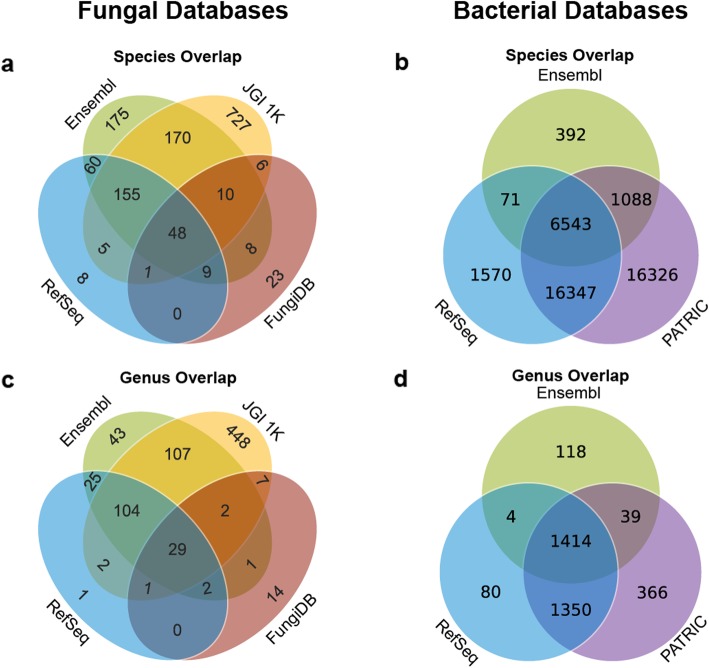
Consensus of fungal and bacterial genome representation across multiple reference databases. a In total, there are 1405 unique species represented across the four fungal databases. Of these, 48 species are represented in all four databases. There are a total of 175 species found where strictly three databases overlap and 189 species where strictly two databases overlap. A total of 993 unique fungal species cannot be found in any overlaps. b In total, there are 42,337 unique species represented across the three bacterial databases. Of these, 6543 species are represented in all three databases, and 17,506 total species are found where strictly two databases overlap. A total of 18,288 unique bacterial species cannot be found in any overlaps. c In total, there are 786 unique genera represented across the four fungal databases. Of these, 29 genera are represented in all four databases. There are a total of 109 genera found where strictly three databases overlap and 142 genera where strictly two databases overlap. A total of 506 unique fungal genera cannot be found in any overlaps. d In total, there are 2214 unique genera represented across the three bacterial databases. Of these, 76 genera are represented in all three databases, and 1149 total genera are found where strictly two databases overlap. A total of 989 unique bacterial genera cannot be found in any overlaps
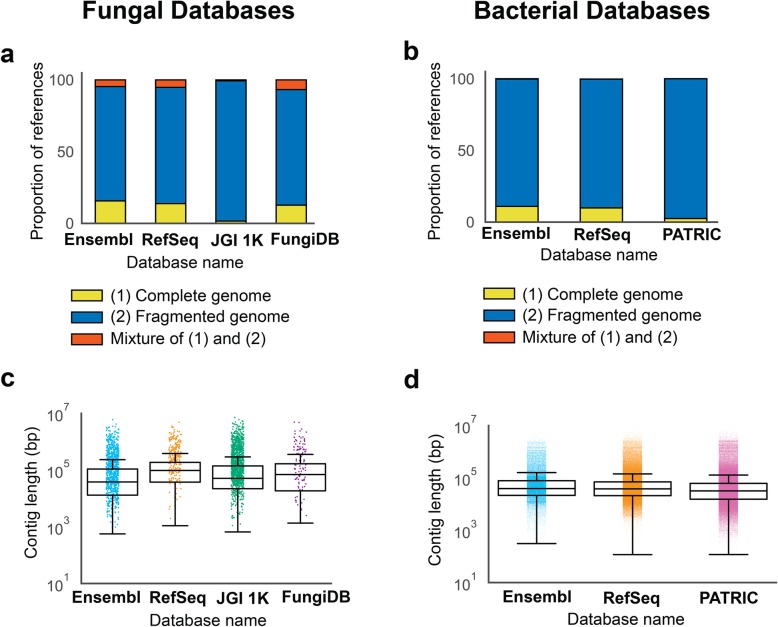
Fungal and bacterial genome composition across multiple reference databases. a Percentage of references per fungal database available as complete genomes (yellow), fragmented genomes (i.e., set of contigs) (blue), and a mixture of full chromosomes and contigs (red). b Percentage of species per bacterial database available as complete genomes (yellow), fragmented genomes (i.e., set of contigs) (blue), and a mixture of full chromosomes and contigs (red). c Length distribution of the fungal genomes (contigs) across the databases. The contig mean lengths for each fungal database are 322 thousand bp (Ensembl), 513 thousand bp (RefSeq), 426 thousand bp (JGI 1 K), and 548 thousand bp (FungiDB). d Length distribution of the bacterial genomes (contigs) across the databases. The contig mean lengths for each bacterial database are 149 thousand bp (Ensembl), 119 thousand bp (RefSeq), and 107 thousand bp (PATRIC)
References
-
- O'Leary NA, Wright MW, Brister JR, Ciufo S, Haddad D, McVeigh R, Rajput B, Robbertse B, Smith-White B, Ako-Adjei D, Astashyn A. Reference sequence (RefSeq) database at NCBI: current status, taxonomic expansion, and functional annotation. Nucleic Acids Res. 2016;44(D1):D733–D745. doi: 10.1093/nar/gkv1189. - DOI - PMC - PubMed
MeSH terms
LinkOut - more resources
Full Text Sources
Medical
