


Clinical Application of 3-Dimensional Printed Navigation Templates in Treating Femoral Head Osteonecrosis With Pedicled Iliac Bone Graft
- PMID: 32265360
- PMCID: PMC7170442
- DOI: 10.1097/SAP.0000000000002362
Clinical Application of 3-Dimensional Printed Navigation Templates in Treating Femoral Head Osteonecrosis With Pedicled Iliac Bone Graft
Abstract
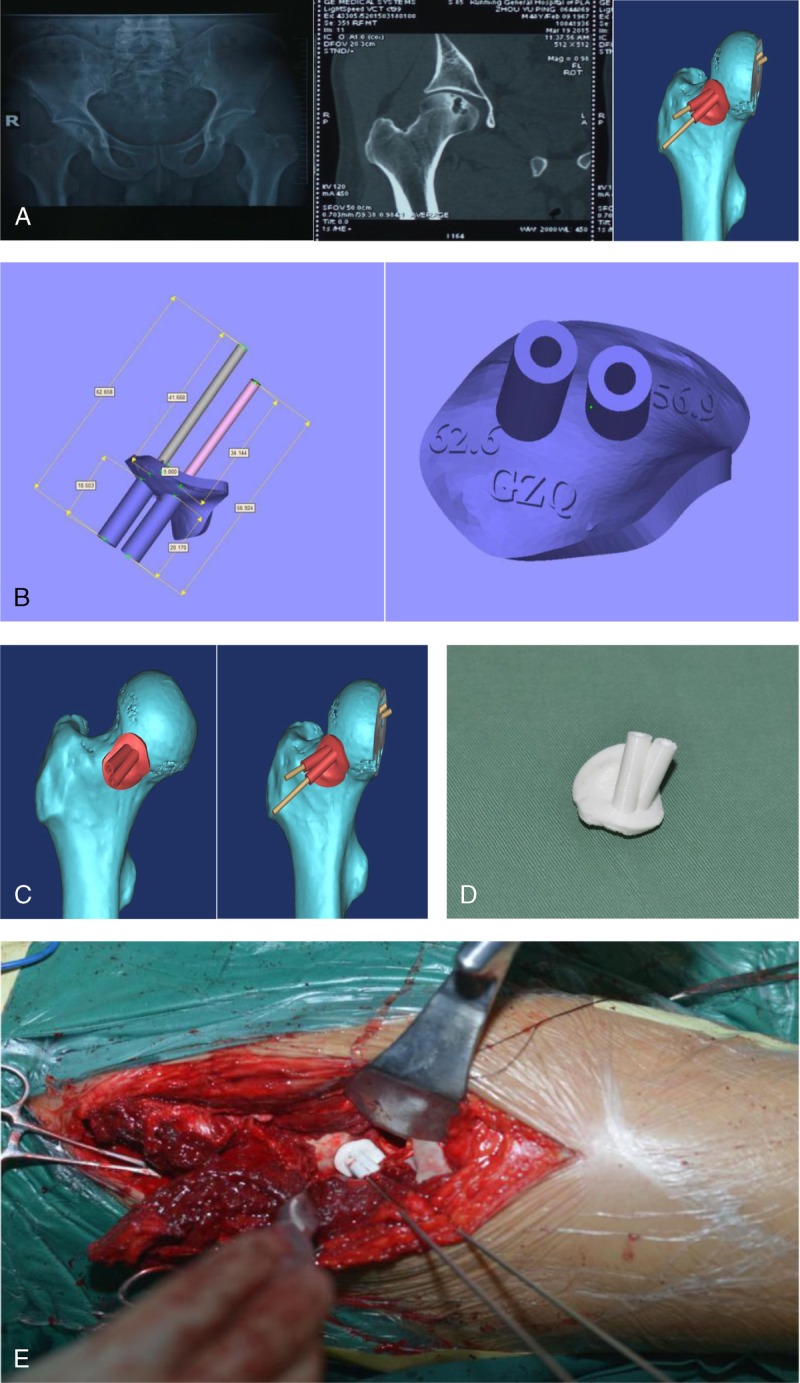
Objective: The aim of the study was to explore the feasibility and early effect of digital design combined with 3-dimensional (3D) printing technique in the transplantation of vascular pedicled iliac bone flap in the treatment of avascular necrosis of the femoral head.
Methods: The navigation template was designed according to computed tomography scan and printed in 3D printing technique before operation, which was used to guide the localization and clearance of osteonecrosis of the femoral head in vascular pedicled iliac bone flap transplantation. In blank control group, 28 cases (32 hips) of osteonecrosis of the femoral head were treated with vascular pedicled iliac bone flap without the assistance of 3D navigation template from February 2002 to February 2009, including 19 males (21 hips) and 9 females (11 hips), with an average age of 37 years (range, 20-61 years). There were 12 cases of left hip, 16 cases of right hip, and 4 cases of double hip. According to the International Association of Bone Circulation staging, there were 8 hips in stage II B, 9 hips in stage II C, 8 hips in stage III B, and 7 hips in stage III C. In the experimental group, from February 2014 to June 2014, 15 patients (24 hips) with avascular necrosis of the femoral head were treated with vascular pedicled iliac bone flap with the aid of 3D navigation template. There were 11 males (17 hips) and 4 females (7 hips) with an average age of 38 years (range, 18-56 years). There were 2 cases of left hip, 4 cases of right hip, and 9 cases of double hip. According to the International Association of Bone Circulation staging, there were 5 hips in stage II B, 8 hips in stage II C, 6 hips in stage III B, and 5 hips in stage III C. The operation time, bleeding volume, and postoperative Harris score of the experimental group and the control group were statistically analyzed.
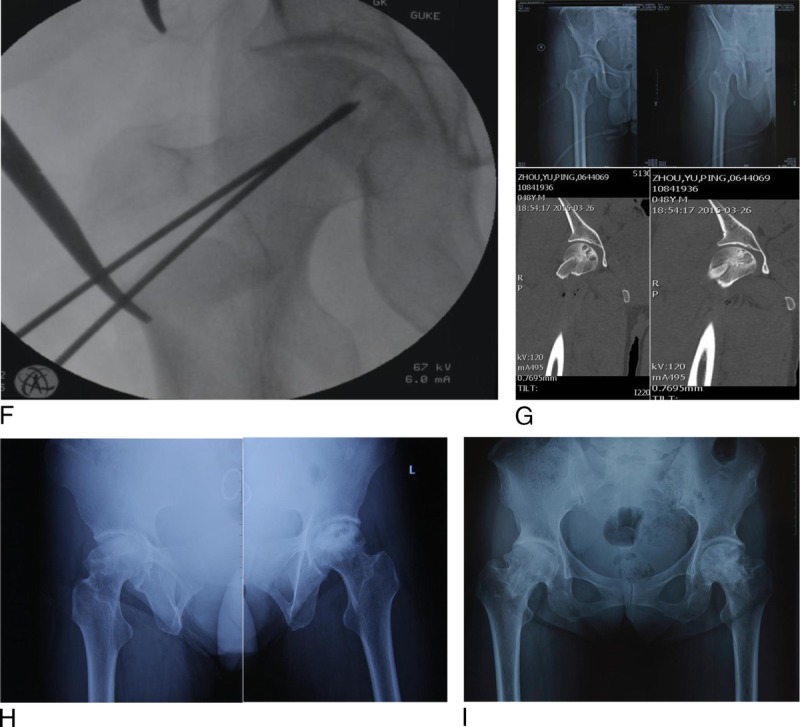
Results: The incisions in both groups healed in the first stage, and there were no operation-related complications such as deep venous thrombosis and infection of lower extremities. All patients were followed up for 12 to 16 months (with an average of 14 months). On the second day after operation, X-ray and computed tomography showed that the necrotic focus of the femoral head and the surrounding sclerotic bone was completely removed, and the position of the vascular pedicled iliac bone flap was satisfactory and did not penetrate the articular surface. The iliac bone flap and bone graft achieved bony fusion. In the navigation template group, the mean ± SD operation time was 135.38 ± 9.49 minutes, the mean ± SD blood loss was 225.13 ± 13.41 mL, the mean ± SD postoperative Harris score was 89.53 ± 5.83, 12 hips were excellent, 10 hips were good, and 2 hips were moderate, whereas in the group without navigation template, the mean ± SD operation time was 151.00 ± 15.28 minutes, the mean ± SD blood loss was 283.56 ± 30.60 mL, the mean ± SD postoperative Harris score was 83.32 ± 3.75, 15 hips were excellent, 14 hips were good, and 3 hips were fair. By independent sample t test, there were significant differences in average operation time, average blood loss, and postoperative Harris score between the 2 groups (P < 0.05).
Conclusions: Compared with not using navigation template, vascular pedicled iliac bone flap combined with navigation template in the treatment of osteonecrosis of femoral head could locate the area of osteonecrosis of femoral head more accurately, shorten the time of operation, and reduce the amount of bleeding during operation. Postoperative hip joint function recovery was better, and the early effect was satisfactory.
Conflict of interest statement
Conflicts of interest and sources of funding: none declared.
Figures
References
-
- Marker DR, Seyler TM, McGrath MS, et al. Treatment of early stage osteonecrosis of the femoral head. J Bone Joint Surg Am. 2008;90(suppl 4):175–187. - PubMed
-
- Mont MA, Hungerford DS. Non-traumatic avascular necrosis of the femoral head. J Bone Joint Surg Am. 1995;77:459–474. - PubMed
-
- Nakamura Y, Kumazawa Y, Mitsui H, et al. Combined rotational osteotomy and vascularized iliac bone graft for advanced osteonecrosis of the femoral head. J Reconstr Microsurg. 2005;21:101–105. - PubMed
-
- Zhao D, Zhang Y, Wang W, et al. Tantalum rod implantation and vascularized iliac grafting for osteonecrosis of the femoral head. Orthopedics. 2013;36:789–795. - PubMed
-
- Elmali N, Ertem K, Karakaplan M, et al. Vascular pedicled iliac bone grafting is effective in patients with an early stage of femoral head avascular necrosis. Eklem Hastalik Cerrahisi. 2014;25:2–7. - PubMed
Publication types
MeSH terms
LinkOut - more resources
Full Text Sources
