Review
. 2020 Mar 20:11:343.
doi: 10.3389/fphar.2020.00343. eCollection 2020.

The Drug-Resistance Mechanisms of Five Platinum-Based Antitumor Agents

Affiliations
Review

The Drug-Resistance Mechanisms of Five Platinum-Based Antitumor Agents

Jiabei Zhou et al. Front Pharmacol. .

Abstract

Platinum-based anticancer drugs, including cisplatin, carboplatin, oxaliplatin, nedaplatin, and lobaplatin, are heavily applied in chemotherapy regimens. However, the intrinsic or acquired resistance severely limit the clinical application of platinum-based treatment. The underlying mechanisms are incredibly complicated. Multiple transporters participate in the active transport of platinum-based antitumor agents, and the altered expression level, localization, or activity may severely decrease the cellular platinum accumulation. Detoxification components, which are commonly increasing in resistant tumor cells, can efficiently bind to platinum agents and prevent the formation of platinum-DNA adducts, but the adducts production is the determinant step for the cytotoxicity of platinum-based antitumor agents. Even if adequate adducts have formed, tumor cells still manage to survive through increased DNA repair processes or elevated apoptosis threshold. In addition, autophagy has a profound influence on platinum resistance. This review summarizes the critical participators of platinum resistance mechanisms mentioned above and highlights the most potential therapeutic targets or predicted markers. With a deeper understanding of the underlying resistance mechanisms, new solutions would be produced to extend the clinical application of platinum-based antitumor agents largely.

Keywords: DNA repair; apoptosis; autophagy; platinum-based anticancer drugs; resistance; transporter.


Figures

Figure 1
Figure 1
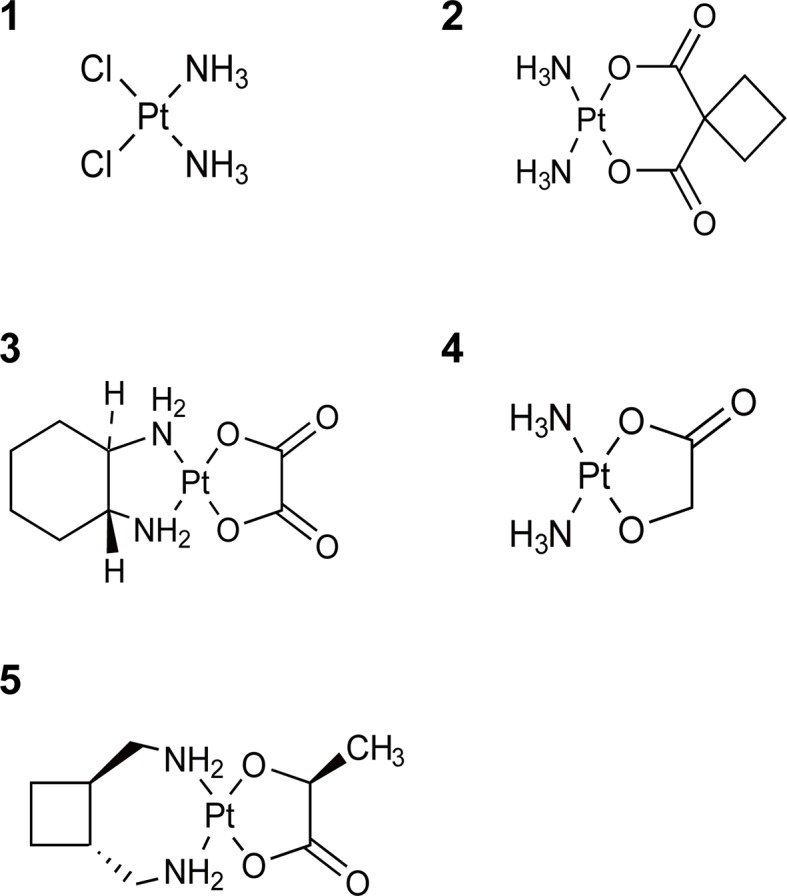
Chemical structures of platinum complexes. 1: Cisplatin; 2: Carboplatin; 3: Oxaliplatin; 4: Nedaplatin; 5: Lobaplatin.
Figure 2
Figure 2
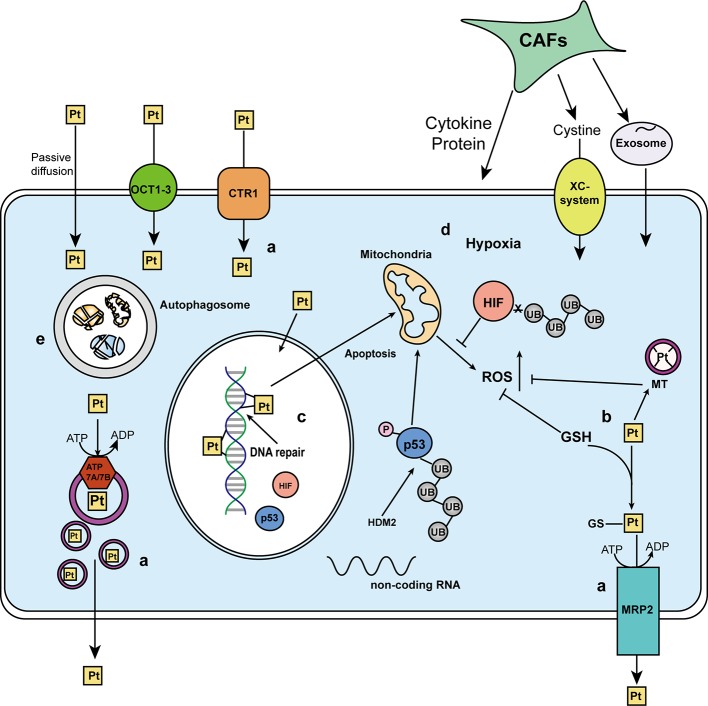
A schematic of the mechanisms affecting platinum response. The response toward platinum-based antitumor agents can result from (a) cellular drug accumulation. Besides passive diffusion, the uptake of platinum agents is mediated by multiple transporters. Organic cation transporters (OCT1-3) and CTR1 mediated the influx, while ATP7A/7B and MRP2 participate in the isolation and efflux of platinum agents or GS-platinum complex. (b) Detoxification system. Platinum agents can be deactivated by binding to detoxification components, glutathione (GSH) and metallothionein (MT). (c) DNA repair process. The platinum atom can covalently bound to the N7 positions of purine bases to form the platinum-DNA adducts and induce cytotoxicity, but the DNA repair process could repair the damaged DNA lesion. (d) Apoptosis. Once the DNA repair fails or is overwhelmed by too many DNA lesions, apoptosis will be triggered. Mitochondria will generate excessed reactive oxygen species (ROS) to kill the cells, which might be neutralized by GSH and MT. p53 and tumor microenvironment [including hypoxia-induced hypoxia-inducible factor (HIF) and cancer-associated fibroblasts (CAFs)] play key regulatory roles in apoptosis. (e) Autophagy, a self-digestion process, has two sides in affecting platinum response.

References

    1. Aguilar A. (2016). Kidney cancer: OCT2 demethylation cracks open oxaliplatin resistance. Nat. Rev. Nephrol. 12 (10), 581. 10.1038/nrneph.2016.122 - DOI - PubMed
    1. Ahmed A. A., Etemadmoghadam D., Temple J., Lynch A. G., Riad M., Sharma R., et al. (2010). Driver mutations in TP53 are ubiquitous in high grade serous carcinoma of the ovary. J. Pathol. 221 (1), 49–56. 10.1002/path.2696 - DOI - PMC - PubMed
    1. Ahmed E. M., Bandopadhyay G., Coyle B., Grabowska A. (2018). A HIF-independent, CD133-mediated mechanism of cisplatin resistance in glioblastoma cells. Cell Oncol. (Dordr.) 41 (3), 319–328. 10.1007/s13402-018-0374-8 - DOI - PMC - PubMed
    1. Ai Z., Lu Y., Qiu S., Fan Z. (2016). Overcoming cisplatin resistance of ovarian cancer cells by targeting HIF-1-regulated cancer metabolism. Cancer Lett. 373 (1), 36–44. 10.1016/j.canlet.2016.01.009 - DOI - PMC - PubMed
    1. Akerfeldt M. C., Tran C. M., Shen C., Hambley T. W., New E. J. (2017). Interactions of cisplatin and the copper transporter CTR1 in human colon cancer cells. J. Biol. Inorg. Chem. 22 (5), 765–774. 10.1007/s00775-017-1467-y - DOI - PubMed

LinkOut - more resources