


Systematic Review of Safety and Efficacy of Atacicept in Treating Immune-Mediated Disorders
- PMID: 32265917
- PMCID: PMC7105675
- DOI: 10.3389/fimmu.2020.00433
Systematic Review of Safety and Efficacy of Atacicept in Treating Immune-Mediated Disorders
Abstract
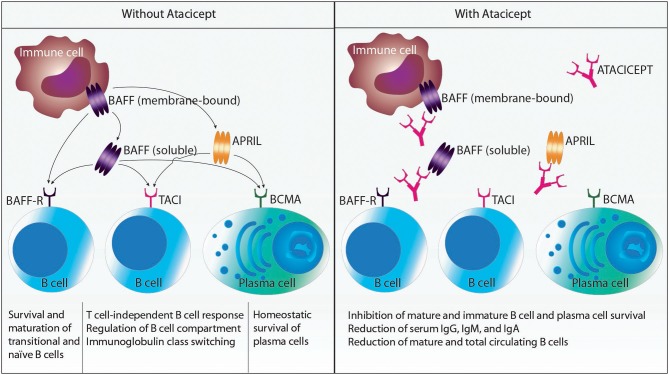
Background: Biological agents (also termed biologics or biologicals) play a growingly central role in the treatment of immunological diseases. However, the numerous studies published on biologics complicate the decision on the most appropriate biologic for a given disease. We aim to address this problem by publishing a series of systematic reviews evaluating the safety and efficacy of B cell-targeting biologics for the treatment of immune-mediated diseases. This article assesses the safety and efficacy of atacicept, a recombinant fusion protein consisting of the binding portion of transmembrane activator and CAML interactor (TACI; also known as tumor necrosis factor receptor superfamily member 13B), which is able to bind the cytokines B cell-activating factor (BAFF) and a proliferation-inducing ligand (APRIL). Objective: To evaluate atacicept's safety and efficacy for the treatment of immune-mediated disorders compared to placebo, conventional treatment or other biologics. Methods: The PRISMA checklist guided the reporting of the data. We searched the PubMed database between 4 October 2016 and 26 July 2018 concentrating on immune-mediated disorders. Results: The literature search identified 118 articles. After screening titles and abstracts against the inclusion and exclusion criteria and assessing full texts, ten articles were finally included in a narrative synthesis. Conclusions: Atacicept failed to show an effect in multiple sclerosis, optic neuritis, rheumatoid arthritis, and systemic lupus erythematosus. In patients with systemic lupus erythematosus, atacicept led to increased infection rates, but this adverse effect was not seen in the other treated diseases.
Keywords: APRIL; B cell; BAFF; TACI; monoclonal antibody; multiple sclerosis; rheumatoid arthritis; systemic lupus erythematosus.
Copyright © 2020 Kaegi, Steiner, Wuest, Crowley and Boyman.
Figures

Comment in
-
Commentary: Systematic Review of Safety and Efficacy of Atacicept in Treating Immune-Mediated Disorders.Front Immunol. 2020 Nov 11;11:592639. doi: 10.3389/fimmu.2020.592639. eCollection 2020. Front Immunol. 2020. PMID: 33262771 Free PMC article. No abstract available.
References
-
- Isenberg D, Gordon C, Licu D, Copt S, Rossi CP, Wofsy D. Efficacy and safety of atacicept for prevention of flares in patients with moderate-to-severe systemic lupus erythematosus (SLE): 52-week data (APRIL-SLE randomised trial). Ann Rheum Dis. (2015) 74:2006–15. 10.1136/annrheumdis-2013-205067 - DOI - PMC - PubMed
Publication types
MeSH terms
Substances
LinkOut - more resources
Full Text Sources
Other Literature Sources
Medical
Miscellaneous
