Review
. 2020 Apr 2:40:5.
doi: 10.1186/s41232-020-00114-x. eCollection 2020.

Calpain proteolytic systems counteract endothelial cell adaptation to inflammatory environments

Affiliations
Review

Calpain proteolytic systems counteract endothelial cell adaptation to inflammatory environments

Takuro Miyazaki et al. Inflamm Regen. .

Abstract

Vascular endothelial cells (ECs) make up the innermost surface of arteries, veins, and capillaries, separating the remaining layers of the vessel wall from circulating blood. Under non-inflammatory conditions, ECs are quiescent and form a robust barrier structure; however, exposure to inflammatory stimuli induces changes in the expression of EC proteins that control transcellular permeability and facilitate angiogenic tube formation. Increasing evidence suggests that dysfunction in intracellular proteolytic systems disturbs EC adaptation to the inflammatory environment, leading to vascular disorders such as atherosclerosis and pathological angiogenesis. Recent work has highlighted the contribution of the calpain-calpastatin stress-responsive intracellular proteolytic system to adaptation failure in ECs. In this review, we summarize our current knowledge of calpain-calpastatin-mediated physiologic and pathogenic regulation in ECs and discuss the molecular basis by which disruption of this system perturbs EC adaptation to the inflammatory environment.

Keywords: Adherens junctions; Adhesion molecules; Atherosclerosis; Proteostasis; Retinopathy; Tumor angiogenesis; Vascular remodeling; Wound repair.


Conflict of interest statement

Competing interestsNone.

Figures
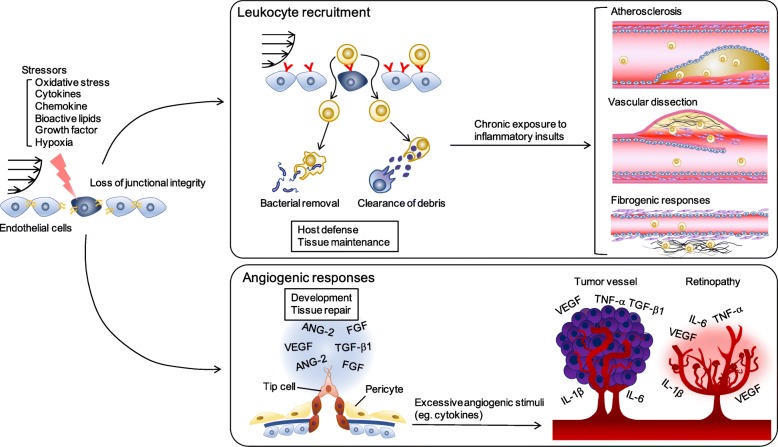
Fig. 1
Fig. 1
Endothelial adaptation to the inflammatory environment and related vascular disorders. Variety of stressors can elicit shedding of intercellular junctions in ECs (left). Loss of junctional integrity leads to recruitment of the leukocytes into the subendothelial spaces. While this adaptive event is required for the host defense and tissue maintenance, prolonged and excessive inflammatory responses cause failure of adaptation, thereby inducing fibrogenic responses in adjacent microenvironment as well as atherosclerosis and vascular dissection in large blood vessels (upper right). When ECs are subjected to the angiogenic stimuli, they migrate toward the interstitinal spaces to form new blood vessel network. Such angiogenic responses are indispensable for the tissue development and repair. However, excessive and redundant angiogenic stimuli, such as combination of growth factors and inflammatory cytokines, lead to aberrant angiogenic regulations, leading to the pathological angiogenesis, such as tumor angiogenesis and retinopathy (lower right). ANG-2: angiopoietin-2; EC: endothelial cell; FGF: fibroblast growth factor; IL-1β: interleukin-1β; IL-6: interleukin-6; TGF-β1: transforming growth factor-β1; TNF-α: tumor necrosis factor-α; VEGF: vascular endothelial growth factor
Fig. 2
Fig. 2
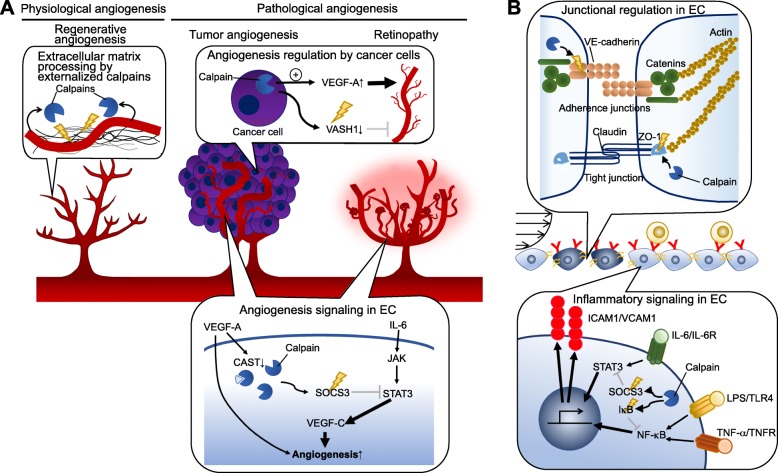
Calpain systems disturb EC adaptation to the inflammatory environment. a Conventional calpains can accelerate angiogenic responses in ECs. While conventional calpains externalized by ECs exert processing of extracellular matrix thereby accelerating regenerative angiogenesis, those in ECs can potentiate pathological angiogenesis, such as tumor angiogenesis and retinopathy. Mechanistically, calpain-induced proteolysis of SOCS3 accelerates cytokine-driven production of VEGF-C. VEGF-C can synergize with VEGF-A; thus, angiogenic responses in ECs can be excessive in the presence of redundant cytokine stimuli. Furthermore, conventional calpains in cancer cells degrade VASH1, an angiogenesis inhibitor, and potentiate the production of VEGF-A. Accordingly, calpains in cancer cells positively regulate tumor angiogenesis. b Conventional calpains can proteolyze the juxtamembrane domain of VE-cadherin, leading to the disorganization of adherence junctions in ECs. Furthermore, tight junction-associated protein ZO-1 can be degraded by calpain. As a result, overactivation of conventional calpains can disrupt junctional integrity in ECs. Concomitantly, calpain proteolyzes intracellular negative regulators of inflammatory signaling, such as IκB and SOCS3, in the cells. This amplifies cytokine responses in ECs, when the cells are subjected to the additional inflammatory stimuli. CAST: calpastatin; EC: endothelial cell; ICAM-1: intercellular adhesion molecule-1; IL-6: interleukin-6; IL-6R: interleukin-6 receptor; IκB: inhibitor κB; JAK: Janus kinase; LPS: lipopolysaccaride; NF-κB: nuclear factor-κB; STAT3: signal transducer and activator of transcription 3; SOCS3: suppressor of cytokine signaling 3; TLR4: toll-like receptor 4; TNF-α: tumor necrosis factor-α; TNFR: tumor necrosis factor receptor; VASH1: vasohibin-1; VCAM-1: vascular cell adhesion molecule-1; VE-cadherin: vascular endothelial-cadherin; VEGF: vascular endothelial growth factor; ZO-1; zonula occludens-1

References

    1. Rahimi N. Defenders and challengers of endothelial barrier function. Front Immunol. 2017;8:1847. doi: 10.3389/fimmu.2017.01847. - DOI - PMC - PubMed
    1. Boulanger CM. Highlight on endothelial activation and beyond. Arterioscler Thromb Vasc Biol. 2018;38(12):e198–e201. doi: 10.1161/ATVBAHA.118.312054. - DOI - PubMed
    1. Marcos-Ramiro B, García-Weber D, Millán J. TNF-induced endothelial barrier disruption: beyond actin and Rho. Thromb Haemost. 2014;112(6):1088–1102. - PubMed
    1. Reglero-Real N, Colom B, Bodkin JV, et al. Endothelial cell junctional adhesion molecules: role and regulation of expression in inflammation. Arterioscler Thromb Vasc Biol. 2016;36(10):2048–2057. doi: 10.1161/ATVBAHA.116.307610. - DOI - PMC - PubMed
    1. Dejana E, Tournier-Lasserve E, Weinstein BM. The control of vascular integrity by endothelial cell junctions: molecular basis and pathological implications. Dev Cell. 2009;16(2):209–221. doi: 10.1016/j.devcel.2009.01.004. - DOI - PubMed

LinkOut - more resources