Review
. 2020 Apr 29;48(2):645-656.
doi: 10.1042/BST20191046.

Small nucleolar RNAs: continuing identification of novel members and increasing diversity of their molecular mechanisms of action

Affiliations
Review

Small nucleolar RNAs: continuing identification of novel members and increasing diversity of their molecular mechanisms of action

Danny Bergeron et al. Biochem Soc Trans. .

Abstract

Identified five decades ago amongst the most abundant cellular RNAs, small nucleolar RNAs (snoRNAs) were initially described as serving as guides for the methylation and pseudouridylation of ribosomal RNA through direct base pairing. In recent years, however, increasingly powerful high-throughput genomic approaches and strategies have led to the discovery of many new members of the family and surprising diversity in snoRNA functionality and mechanisms of action. SnoRNAs are now known to target RNAs of many biotypes for a wider range of modifications, interact with diverse binding partners, compete with other binders for functional interactions, recruit diverse players to targets and affect protein function and accessibility through direct interaction. This mini-review presents the continuing characterization of the snoRNome through the identification of new snoRNA members and the discovery of their mechanisms of action, revealing a highly versatile noncoding family playing central regulatory roles and connecting the main cellular processes.

Keywords: RNA modification; RNA–RNA binding; RNA–protein binding; gene annotation; gene expression regulation; snoRNAs.


Conflict of interest statement

The authors declare that there are no competing interests associated with the manuscript.

Figures
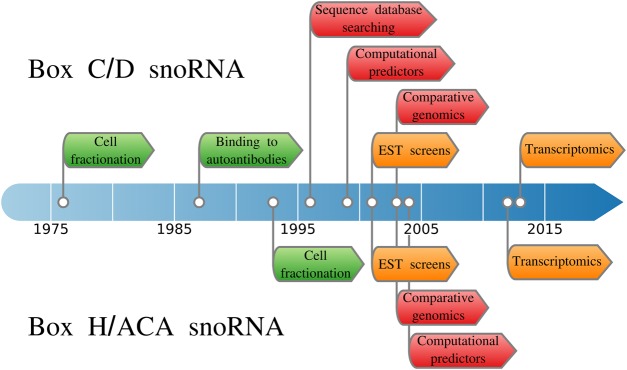
Figure 1.
Figure 1.. Timeline of the usage of different snoRNA identification strategies.
The identification strategies are grouped into three categories: biochemical approaches in green, high-throughput strategies in orange and computational approaches in red. Box C/D and box H/ACA discoveries are described respectively above and below the timeline.
Figure 2.
Figure 2.. Canonical features of snoRNAs.
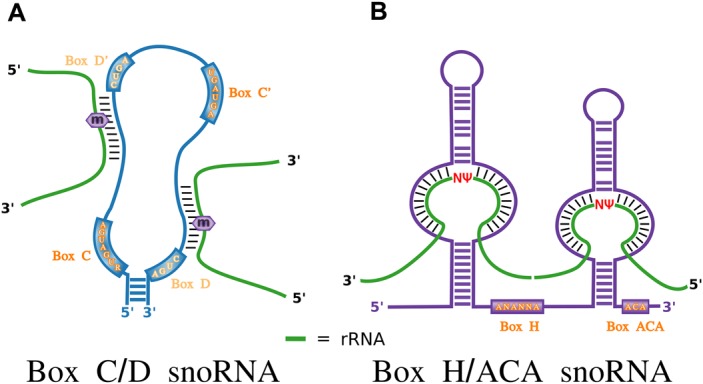
(A) Canonical box C/D snoRNAs are characterized by the presence of a terminal stem, sequence motifs (boxes C, C′, D′ and D) and guide regions with complementarity to target sequences in rRNA. The target residue base pairing with the fifth nucleotide upstream of the box D′ or D is methylated (shown by the m in a purple hexagon). (B) Canonical H/ACA snoRNAs consist of two tight hairpins separated by a hinge region (box H) and terminated by an ACA box found 3 nucleotides before the 3′ end. The hairpins typically have a bulge which is where the region of complementarity to the rRNA target is located. The uridine residue that is pseudouridylated is represented by a red Ψ.
Figure 3.
Figure 3.. Computational approaches to identify snoRNAs.
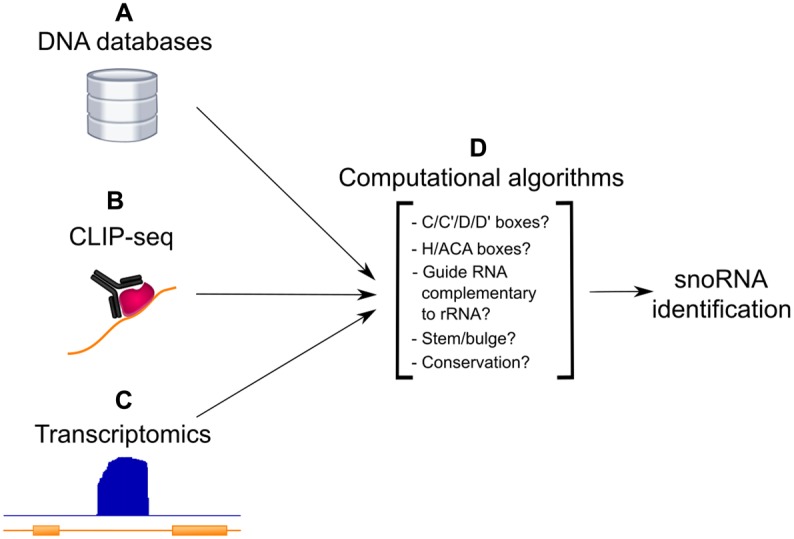
Starting from either sequence databases (A), the transcripts bound to specific proteins as detected by CLIP-seq experiments (B) or non-annotated genomic regions displaying strong levels of expression in RNA-seq datasets (C), computational algorithms consider several different features including, but not limited to, the presence of sequence motifs, complementarity to rRNA, secondary structure features and conservation to predict snoRNAs (D).
Figure 4.
Figure 4.. Overview of non-canonical mechanisms of action described for snoRNAs.
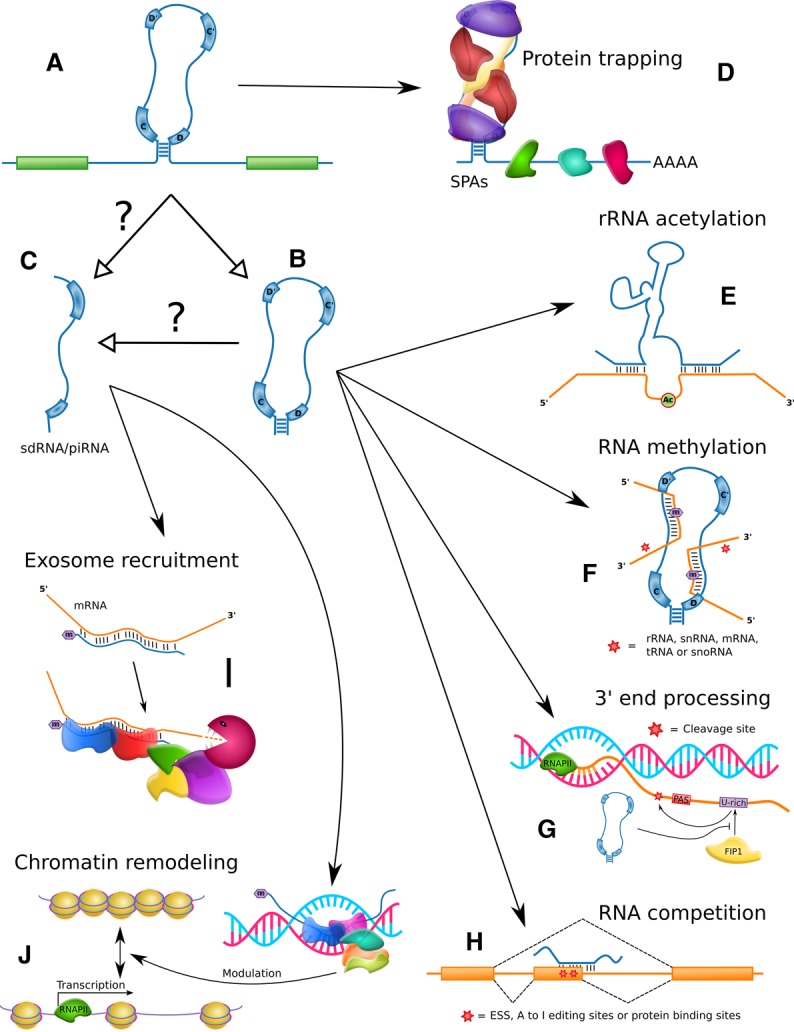
(A) Mammalian snoRNAs are typically embedded in an intron of another gene. (B) Following splicing, intron debranching, protein binding and exonucleolytic degradation, the mature snoRNA is formed. (C) Stable fragments of snoRNAs referred to as sdRNAs for snoRNA-derived RNAs have been detected and could be processed from the mature snoRNA or its precursors. Some sdRNAs have been characterized as piRNAs. (D) Longer noncoding transcripts containing snoRNAs have been found to sequester specific proteins. (E) Some snoRNAs can acetylate rRNA. (F) SnoRNAs can methylate diverse non-canonical substrates including tRNA and mRNA. (G) Specific snoRNAs can bind 3′ end processing protein factors, affecting the choice of polyadenylation sites. (H) SnoRNAs can interact with other RNA, competing for functional binding sites. (I) SdRNAs can regulate pre-mRNA stability through direct binding and recruitment of the nuclear exosome. (J) SdRNAs can also recruit chromatin-modifying complexes to promoters by direct binding. Throughout the figure, white arrowheads indicate processing relationships whereas black arrowheads depict regulatory relationships.

References

    1. Boivin V., Faucher-Giguere L., Scott M. and Abou-Elela S. (2019) The cellular landscape of mid-size noncoding RNA. Wiley Interdiscip. Rev. RNA 10, e1530. 10.1002/wrna.1530 - DOI - PMC - PubMed
    1. Dieci G., Preti M. and Montanini B. (2009) Eukaryotic snoRNAs: a paradigm for gene expression flexibility. Genomics 94, 83–88 10.1016/j.ygeno.2009.05.002 - DOI - PubMed
    1. Bachellerie J.P., Cavaille J. and Huttenhofer A. (2002) The expanding snoRNA world. Biochimie 84, 775–790 10.1016/S0300-9084(02)01402-5 - DOI - PubMed
    1. Bouchard-Bourelle P., Desjardins-Henri C., Mathurin-St-Pierre D., Deschamps-Francoeur G., Fafard-Couture E., Garant J.M. et al. (2020) snoDB: an interactive database of human snoRNA sequences, abundance and interactions. Nucleic Acids Res. 48, D220–D225 10.1093/nar/gkz884 - DOI - PMC - PubMed
    1. Schmitz J., Zemann A., Churakov G., Kuhl H., Grutzner F., Reinhardt R. et al. (2008) Retroposed SNOfall–a mammalian-wide comparison of platypus snoRNAs. Genome Res. 18, 1005–1010 10.1101/gr.7177908 - DOI - PMC - PubMed

Publication types