


"This Is How Hard It Is". Family Experience of Hospital-to-Home Transition with a Tracheostomy
- PMID: 32267725
- PMCID: PMC7328176
- DOI: 10.1513/AnnalsATS.201910-780OC
"This Is How Hard It Is". Family Experience of Hospital-to-Home Transition with a Tracheostomy
Abstract
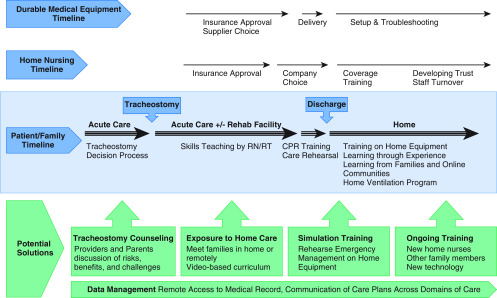
Rationale: Expansion of chronic ventilation options and shared decision-making have contributed to an increasing population of technology-dependent children. One particularly vulnerable group is children with tracheostomy who depend on technology for basic respiratory functions. Chronic critical care is now provided in the homecare setting with implications for family caregivers.Objectives: This study explores the experience of family caregivers of children and young adults with a tracheostomy during the transition from hospital to home care. We sought to identify the specific unmet needs of families to direct future interventions.Methods: We recruited a convenience sample of families from an established home ventilation program to participate in semistructured interviews. Sessions were conducted in person or via teleconference. A grounded-theory qualitative analysis was performed.Results: Between March 2017 and October 2018, we interviewed 13 individuals representing 12 families of children and/or young adults with tracheostomy. Patients ranged in age from 9 months to 28 years, had a tracheostomy for 8 months to 18 years, and represented a variety of underlying diagnoses. Five key themes emerged: 1) navigating home nursing; 2) care coordination and durable medical equipment (DME) impediments; 3) learning as a process; 4) managing emergencies; and 5) setting expectations.Conclusions: Our findings support the need for family-centered discharge processes including coordination of care and teaching focused on emergency preparedness.
Keywords: experience; family; home care; qualitative; tracheostomy.
Figures
Comment in
-
Take Me Home to the Place I Belong: Discharging the Tracheostomy-Dependent Child.Ann Am Thorac Soc. 2020 Jul;17(7):809-810. doi: 10.1513/AnnalsATS.202004-349ED. Ann Am Thorac Soc. 2020. PMID: 32609029 Free PMC article. No abstract available.
References
-
- Downes JJ. The future of pediatric critical care medicine. Crit Care Med. 1993;21(Suppl):S307–S310. - PubMed
-
- Mitchell RB, Hussey HM, Setzen G, Jacobs IN, Nussenbaum B, Dawson C, et al. Clinical consensus statement: tracheostomy care. Otolaryngol Head Neck Surg. 2013;148:6–20. - PubMed
-
- Hartnick CJ, Bissell C, Parsons SK. The impact of pediatric tracheotomy on parental caregiver burden and health status. Arch Otolaryngol Head Neck Surg. 2003;129:1065–1069. - PubMed
Publication types
MeSH terms
Grants and funding
LinkOut - more resources
Full Text Sources
Medical
