


Evolution of Volatile and Phenolic Compounds during Bottle Storage of Merlot Wines Vinified Using Pulsed Electric Fields-Treated Grapes
- PMID: 32268596
- PMCID: PMC7231071
- DOI: 10.3390/foods9040443
Evolution of Volatile and Phenolic Compounds during Bottle Storage of Merlot Wines Vinified Using Pulsed Electric Fields-Treated Grapes
Abstract
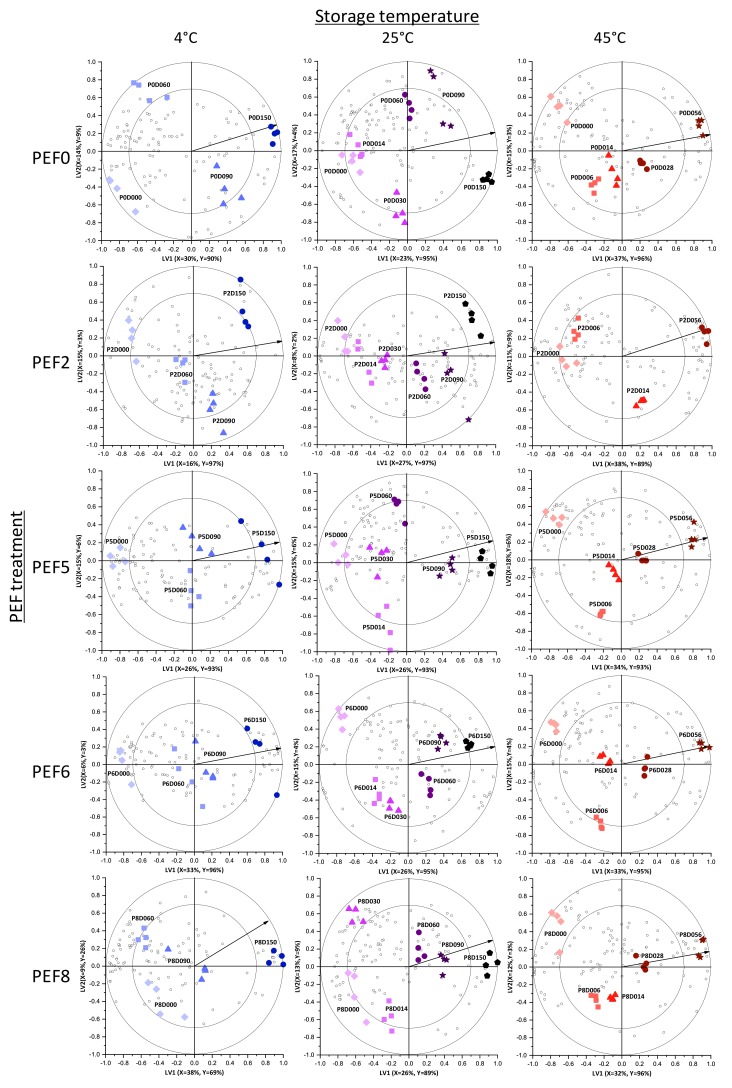
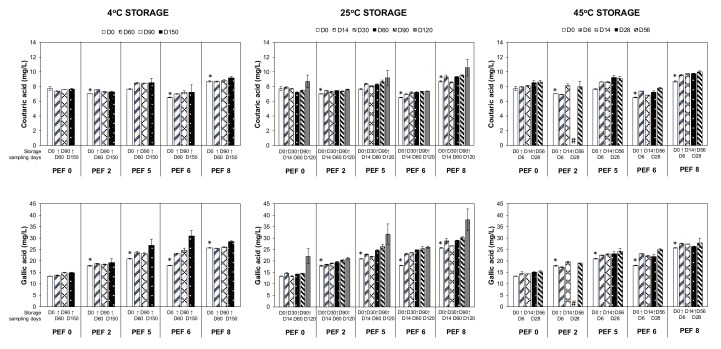
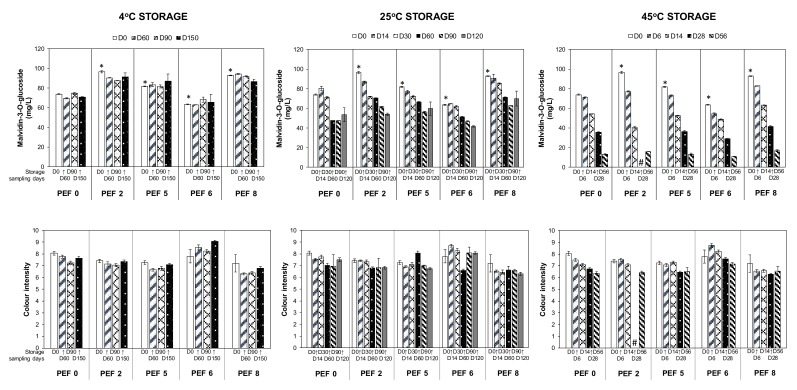
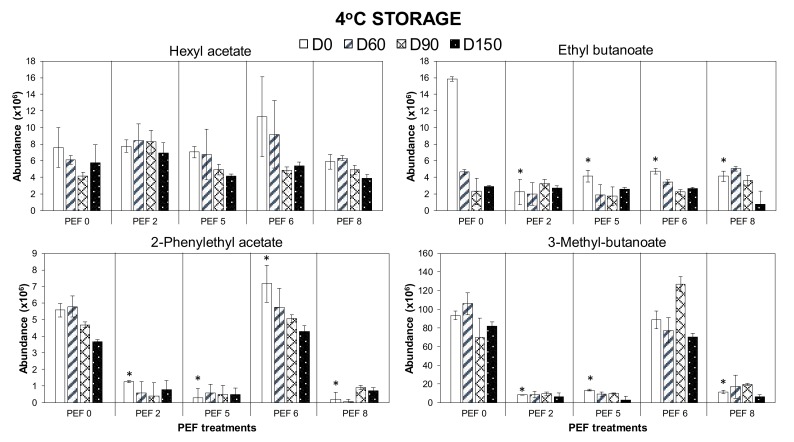
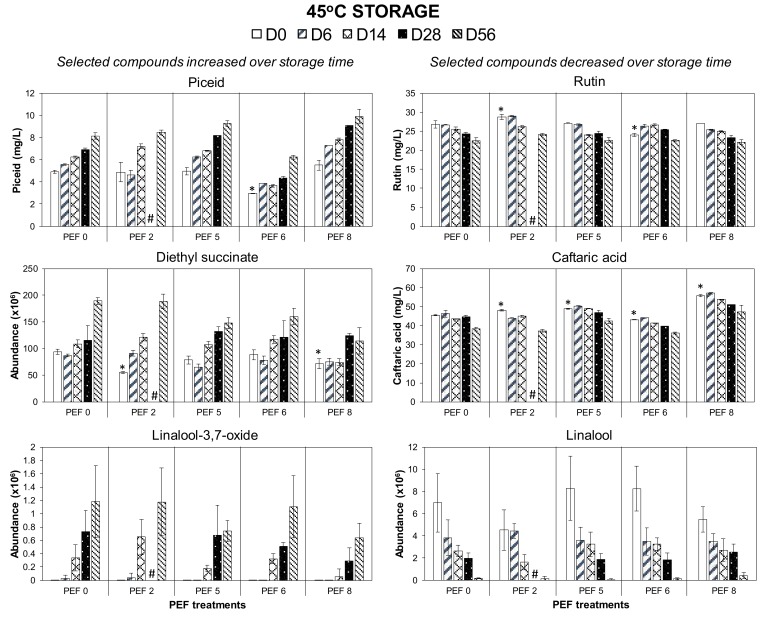
This study aimed to elucidate changes in volatile, phenolic, and oenological profiles of wines vinified from Pulsed Electric Fields (PEF)-treated and untreated Merlot grapes during bottle storage of up to 150, 90, and 56 days at 4 °C, 25 °C, and 45 °C, respectively, through chemometrics technique. Wines produced from untreated grapes and those PEF-treated at four different processing conditions (electric field strength 33.1 and 41.5 kV/cm and energy inputs between 16.5 and 49.4 kJ/kg) were used for the bottle storage study. Results showed that hydroxycinnamic and hydroxybenzoic acids in all stored wines, regardless vinified from untreated and PEF-treated grapes, increased as a function of time and temperature, while anthocyanins and selected esters (e.g., ethyl butanoate) decreased. Extreme storage temperature, at 45 °C particularly, resulted in a higher amount of linalool-3, 7-oxide in all stored wines. After prolonged storage, all wines produced from grapes PEF-treated with four different processing conditions were shown to favor high retention of phenolics after storage but induced faster reduction of anthocyanins when compared to wines produced from untreated grapes. Moreover, some volatiles in wines vinified using PEF-treated grapes, such as citronellol and 2-phenylethyl acetate, were found to be less susceptible towards degradation during prolonged storage. Production of furans was generally lower in most stored wines, particularly those produced from PEF-treated grapes at higher energy inputs (>47 kJ/kg). Overall, PEF pre-treatment on grapes may improve storage and temperature stability of the obtained wines.
Keywords: merlot; multivariate data analysis; phenolics profiling; pulsed electric fields; storage; volatile fingerprinting; wine.
Conflict of interest statement
The authors declare no conflict of interest. The funders had no role in the design of the study; in the collection, analyses, or interpretation of data; in the writing of the manuscript, or in the decision to publish the results.
Figures
References
-
- Leong S.Y., Treadwell M., Liu T., Hochberg M., Sack M., Mueller G., Sigler J., Silcock P., Oey I. Influence of Pulsed Electric Fields processing at high-intensity electric field strength on the relationship between anthocyanins composition and colour intensity of Merlot (Vitis vinifera L.) musts during cold maceration. Innov. Food Sci. Emerg. Technol. 2020;59:102243. doi: 10.1016/j.ifset.2019.102243. - DOI
-
- Puértolas E., López N., Condón S., Álvarez I., Raso J. Potential applications of PEF to improve red wine quality. Trends Food Sci. Technol. 2010;21:247–255. doi: 10.1016/j.tifs.2010.02.002. - DOI
-
- Arapitsas P., Speri G., Angeli A., Perenzoni D., Mattivi F. The influence of storage on the “chemical age” of red wines. Metabolomics. 2014;10:816–832. doi: 10.1007/s11306-014-0638-x. - DOI
-
- Mattivi F., Arapitsas P., Perenzoni D., Guella G. Influence of storage conditions on the composition of red wines. In: Ebeler S.B., Sacks G., Vidal S., Winterhalter P., editors. Advances in Wine Research. Volume 1203. American Chemical Society; Washington, DC, USA: 2015. pp. 29–49.
Grants and funding
LinkOut - more resources
Full Text Sources
