. 2020 Apr 6;9(4):165.
doi: 10.3390/antibiotics9040165.

Advanced Resistance Studies Identify Two Discrete Mechanisms in Staphylococcus aureus to Overcome Antibacterial Compounds that Target Biotin Protein Ligase

Affiliations

Advanced Resistance Studies Identify Two Discrete Mechanisms in Staphylococcus aureus to Overcome Antibacterial Compounds that Target Biotin Protein Ligase

Andrew J Hayes et al. Antibiotics (Basel). .

Abstract

Biotin protein ligase (BPL) inhibitors are a novel class of antibacterial that target clinically important methicillin-resistant Staphylococcus aureus (S. aureus). In S. aureus, BPL is a bifunctional protein responsible for enzymatic biotinylation of two biotin-dependent enzymes, as well as serving as a transcriptional repressor that controls biotin synthesis and import. In this report, we investigate the mechanisms of action and resistance for a potent anti-BPL, an antibacterial compound, biotinyl-acylsulfamide adenosine (BASA). We show that BASA acts by both inhibiting the enzymatic activity of BPL in vitro, as well as functioning as a transcription co-repressor. A low spontaneous resistance rate was measured for the compound (<10-9) and whole-genome sequencing of strains evolved during serial passaging in the presence of BASA identified two discrete resistance mechanisms. In the first, deletion of the biotin-dependent enzyme pyruvate carboxylase is proposed to prioritize the utilization of bioavailable biotin for the essential enzyme acetyl-CoA carboxylase. In the second, a D200E missense mutation in BPL reduced DNA binding in vitro and transcriptional repression in vivo. We propose that this second resistance mechanism promotes bioavailability of biotin by derepressing its synthesis and import, such that free biotin may outcompete the inhibitor for binding BPL. This study provides new insights into the molecular mechanisms governing antibacterial activity and resistance of BPL inhibitors in S. aureus.

Keywords: BirA; Gram-positive bacteria; Staphylococcus aureus; advanced resistance studies; antimicrobial resistance; biotin; biotin protein ligase; novel antibacterials.


Conflict of interest statement

The authors declare no competing financial interest.

Figures

Figure 1
Figure 1
Protein biotinylation catalyzed by biotin protein ligase (BPL). Biotin ligates with ATP to produce the reaction intermediate, biotinyl-5′-AMP. Biotinyl-5′-AMP is employed to covalently attach the biotinyl moiety onto a specific lysine residue present in the biotin-accepting protein substrate. The chemical structure of biotinyl-acylsulfamide adenosine (BASA), a chemical analog of the reaction intermediate, is shown.
Figure 2
Figure 2
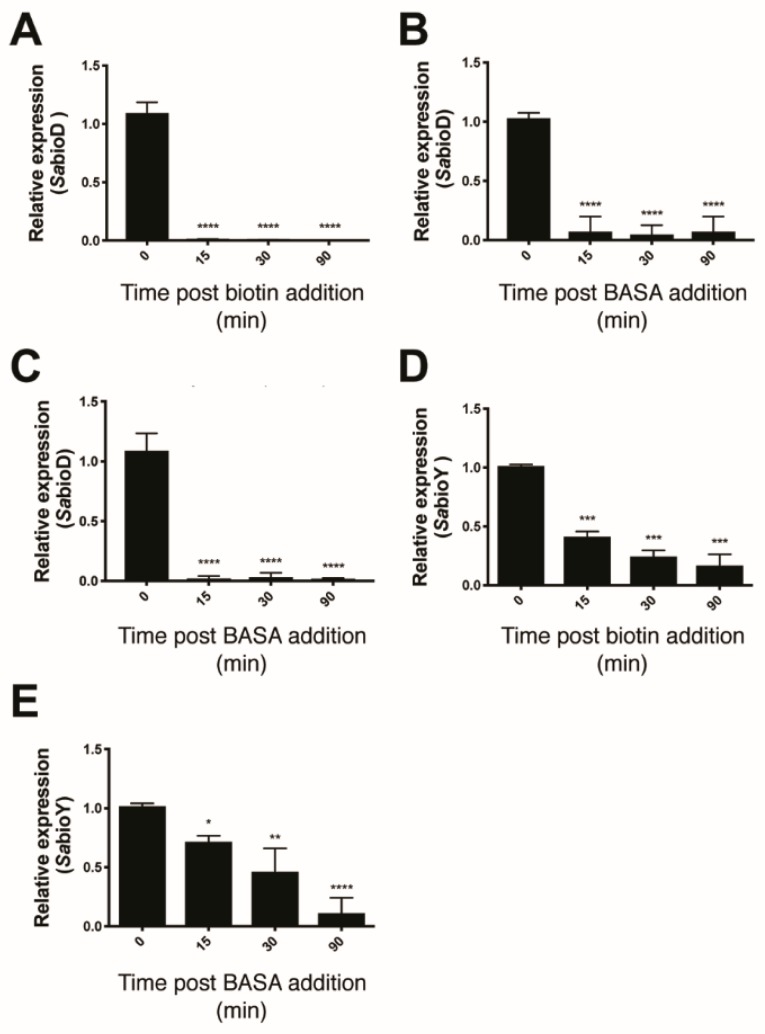
BASA represses expression of bioD and bioY. Quantitative RT–PCR was employed to measure the repression of bioD following treatment with (A) 10 nM biotin, (B) 10 nM of BASA (0.01× minimal inhibitory concentration (MIC)) and (C) 3.9 μM (4× MIC) of BASA, and the repression of bioY in response to (D) 10 nM biotin and (E) 10 nM of BASA. Transcript levels were normalized against an internal control (16s rRNA) and calculated relative to time = 0. Error bars represent SEM from 3 independent biological replicates (n = 3), *p < 0.05, **p < 0.01, ***p > 0.001, ****p < 0.0001.
Figure 3
Figure 3
Native native nano-electrospray ionization–mass spectrometry (nESI–MS) reveals S. aureus BPL (SaBPL) D200E is monomeric in the presence and absence of ligands. The oligomeric states of 10 μM of (A) wildtype apo SaBPL and (B) holo SaBPL were compared with 90 μM of (C) apo SaBPL-D200E and (D) holo SaBPLD200E. Monomeric protein is diagrammatically represented by a single grey sphere, homodimer by conjoined spheres and the presence of biotinyl-5′-AMP by a black triangle. Spectra showing SaBPL D200E at varying protein concentrations between 1.4 and 90 μM are presented in Figure S12 and masses extracted from the spectra are in Table S3.
Figure 4
Figure 4
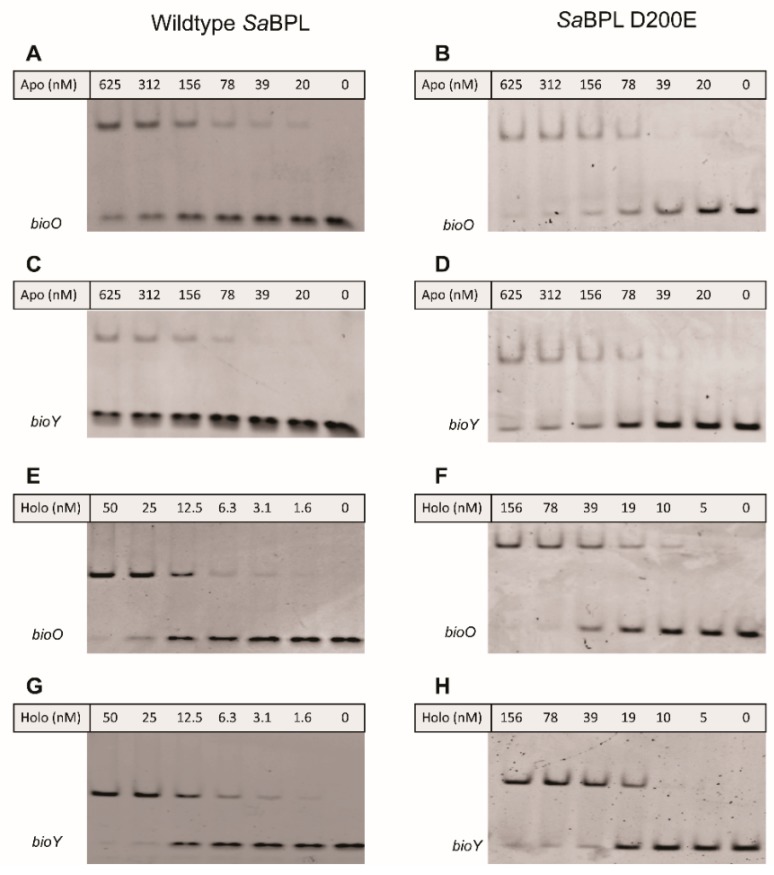
SaBPL D200E has reduced DNA binding activity compared to wildtype SaBPL. Electrophoretic mobility shift assays (EMSA) analysis was performed to measure the binding of (A) apo SaBPL wildtype binding to bioO, (B) apo SaBPL D200E binding to bioO, (C) apo SaBPL wildtype binding to bioY and (D) apo SaBPL D200E binding to bioY, (E) holo SaBPL wildtype binding to bioO, (F) holo SaBPL D200E binding to bioO, (G) holo SaBPL wildtype binding to bioY and (H) holo SaBPL D200E binding to bioY.
Figure 5
Figure 5
Biotin-regulated repressor activity of SaBPL and mutants. (A) In vivo expression assays were performed in an E. coli reporter strain containing chromosomally integrated repressor and promoter constructs [23]. LacZ units were calculated by subtracting the value generated by the control strain containing no integrated promoter construct (LacZ unit ≤10). Expression of the β-galactosidse reporter gene, under the control of promoters (B) bioO or (C) bioY, was measured in media containing varying concentrations of biotin. Transcription factors SaBPL (orange), SaBPL D200E (green) and SaBPL F123G (black) were analyzed alongside a control strain that harbored no repressor protein (blue). Error bars represent SEM from independent biological replicates (n = 6). The amount of biotin to reach half-maximum repression (KR biotin) was calculated from the curves using GraphPad Prism. The KR biotin for wildtype SaBPL repressing bioO and bioY was 4.3 ± 1.9 nM and 8.2 ± 0.7 nM, respectively. The KR biotin for SaBPL-D200E repressing bioO and bioY was 13.9 ± 3.4 nM and >500 nM, respectively. The KR biotin for SaBPL-F123G repressing bioO and bioY was 15.3 ± 3.5 nM and >500 nM.

References

    1. Cooper M.A., Shlaes D. Fix the antibiotics pipeline. Nature. 2011;472:32. doi: 10.1038/472032a. - DOI - PubMed
    1. Butler M.S., Blaskovich M.A.T., Cooper M.A. Antibiotics in the clinical pipeline at the end of 2015. J. Antibiot. 2016;70:3–24. doi: 10.1038/ja.2016.72. - DOI - PubMed
    1. Rushton J., Stärk K.D.C., Ferreira J.P. Antimicrobial Resistance. Organisation for Economic Co-Operation and Development (OECD); Paris, France: 2014.
    1. World Health Organisation . Global Action Plan on Antimicrobial Resistance. WHO; Geneva, Switzerland: 2015.
    1. Feng J., Paparella A., Booker G.W., Polyak S.W., Abell A.D. Biotin Protein Ligase Is a Target for New Antibacterials. Antibiotics. 2016;5:26. doi: 10.3390/antibiotics5030026. - DOI - PMC - PubMed

LinkOut - more resources