. 2020 Apr 8;19(1):141.
doi: 10.1186/s12936-020-03208-6.

Health systems and global progress towards malaria elimination, 2000-2016

Affiliations

Health systems and global progress towards malaria elimination, 2000-2016

Maitreyi Sahu et al. Malar J. .

Abstract

Background: As more countries progress towards malaria elimination, a better understanding of the most critical health system features for enabling and supporting malaria control and elimination is needed.

Methods: All available health systems data relevant for malaria control were collated from 23 online data repositories. Principal component analysis was used to create domain specific health system performance measures. Multiple regression model selection approaches were used to identify key health systems predictors of progress in malaria control in the 2000-2016 period among 105 countries. Additional analysis was performed within malaria burden groups.

Results: There was large heterogeneity in progress in malaria control in the 2000-2016 period. In univariate analysis, several health systems factors displayed a strong positive correlation with reductions in malaria burden between 2000 and 2016. In multivariable models, delivery of routine services and hospital capacity were strongly predictive of reductions in malaria cases, especially in high burden countries. In low-burden countries approaching elimination, primary health center density appeared negatively associated with progress while hospital capacity was positively correlated with eliminating malaria.

Conclusions: The findings presented in this manuscript suggest that strengthening health systems can be an effective strategy for reducing malaria cases, especially in countries with high malaria burden. Potential returns appear particularly high in the area of service delivery.

Keywords: Elimination; Health systems; Malaria.


Conflict of interest statement

The authors declare that they have no competing interests.

Figures
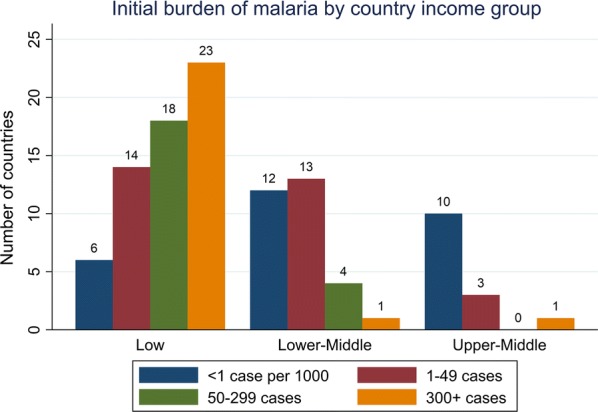
Fig. 1
Fig. 1
Initial burden of malaria by country income group. This figure shows the initial distribution of the 105 sample countries with respect to World Bank Income Category and initial malaria burden
Fig. 2
Fig. 2
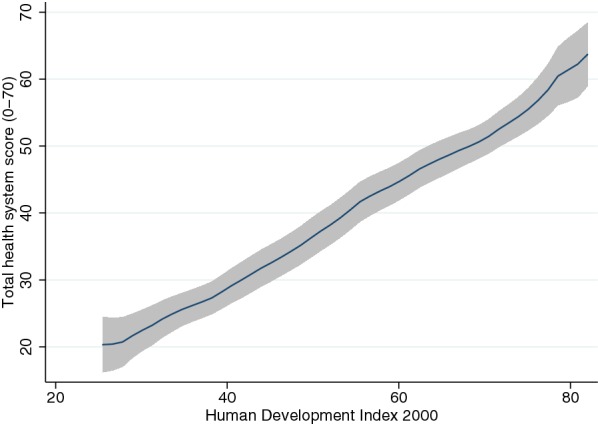
Health systems score and initial level of development in 2000. This figure shows kernel-weighted local polynomial smoothed relationship between the Human Development Index and total health systems scores
Fig. 3
Fig. 3
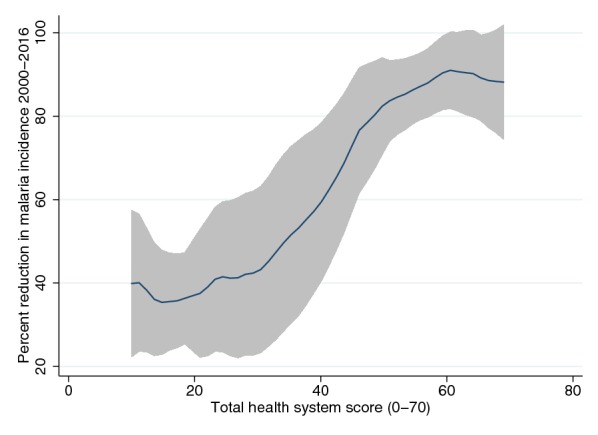
Health systems score and percent reduction in malaria incidence, 2000–2016. This figure shows kernel-weighted local polynomial smoothed relationship between reduction in malaria cases, 2000–2016 and total health systems scores
Fig. 4
Fig. 4
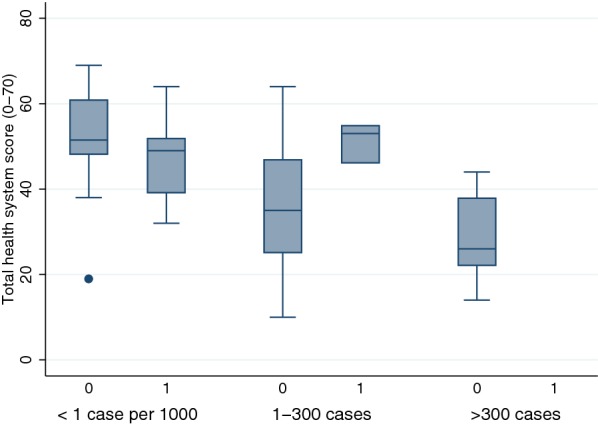
Health systems score for countries which eliminated malaria versus those that did not, by burden category (‘Yes’ = reached 0 cases, ‘No’ = did not reach 0 cases). This figure shows distribution of health systems scores by baseline burden and the likelihood of reaching 0 cases by 2016. In the first group (< 1 case per 1000 initially), 14 countries (50% of countries in this group) reached 0 cases; in the second group (1–300 cases), the same was achieved by 3 countries (6%), and in the third group (> 300 cases) no countries reached 0 cases
Fig. 5
Fig. 5
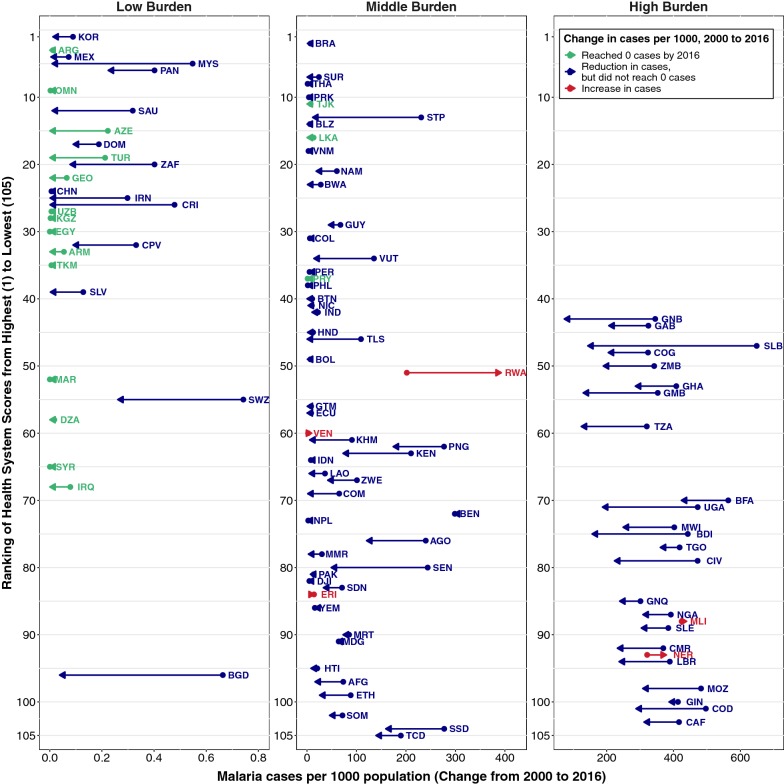
Ranking of health systems score and change in malaria incidence, 2000–2016. Low-burden countries (< 1 case per 1000 in 2000), middle-burden (1–300 cases in 2000), high-burden (> 300 cases per 1000 in 2000). Full country labels and rankings provided in Additional file 9
Fig. 6
Fig. 6
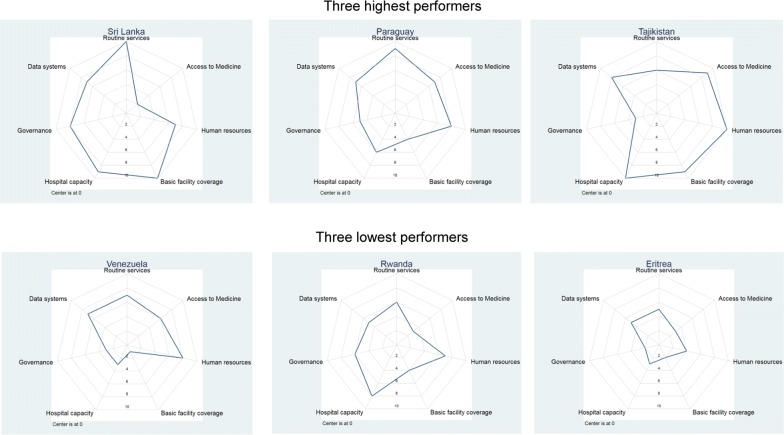
Health systems dimensions for highest and lowest performers for relative change in malaria cases, 2000–2016 among high burden countries (300+ cases per 1000 population)
Fig. 7
Fig. 7
Health systems dimensions for highest and lowest performers for relative change in malaria cases, 2000–2016 among middle-burden countries (1–300 cases per 1000 population)
Fig. 8
Fig. 8
Health systems dimensions for highest and lowest performers for relative change in malaria cases, 2000–2016 among low burden countries (< 1 case per 1000 population), excluding 14 countries which reached 0 cases

References

    1. Galactionova K, Tediosi F, de Savigny D, Smith T, Tanner M. Effective coverage and systems effectiveness for malaria case management in sub-Saharan African countries. PLoS ONE. 2015;10:e0127818. doi: 10.1371/journal.pone.0127818. - DOI - PMC - PubMed
    1. Webster J, Hill J, Lines J, Hanson K. Delivery systems for insecticide treated and untreated mosquito nets in Africa: categorization and outcomes achieved. Health Policy Plan. 2007;22:277–293. doi: 10.1093/heapol/czm021. - DOI - PubMed
    1. Rao VB, Schellenberg D, Ghani AC. Overcoming health systems barriers to successful malaria treatment. Trends Parasitol. 2013;29:164–180. doi: 10.1016/j.pt.2013.01.005. - DOI - PubMed
    1. Nájera JA, González-Silva M, Alonso PL. Some lessons for the future from the global malaria eradication programme (1955–1969) PLoS Med. 2011;8:e1000412. doi: 10.1371/journal.pmed.1000412. - DOI - PMC - PubMed
    1. Aylward RB, Acharya A, England S, Agocs M, Linkins J. Global health goals: lessons from the worldwide effort to eradicate poliomyelitis. Lancet. 2003;362:909–914. doi: 10.1016/S0140-6736(03)14337-1. - DOI - PMC - PubMed

MeSH terms