Bacterial cell division at a glance
- PMID: 32269092
- PMCID: PMC7157936
- DOI: 10.1242/jcs.237057
Bacterial cell division at a glance
Abstract
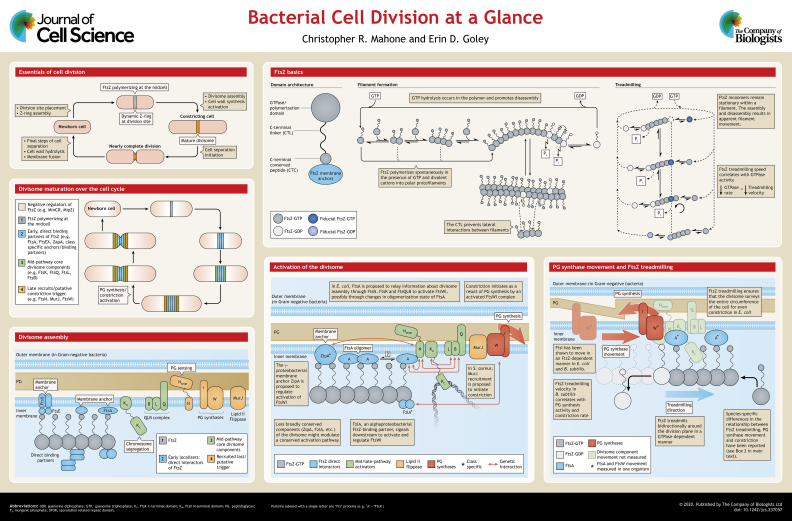
Bacterial cell division is initiated by the midcell assembly of polymers of the tubulin-like GTPase FtsZ. The FtsZ ring (Z-ring) is a discontinuous structure made of dynamic patches of FtsZ that undergo treadmilling motion. Roughly a dozen additional essential proteins are recruited to the division site by the dynamic Z-ring scaffold and subsequently activate cell wall synthesis to drive cell envelope constriction during division. In this Cell Science at a Glance article and the accompanying poster, we summarize our understanding of the assembly and activation of the bacterial cell division machinery. We introduce polymerization properties of FtsZ and discuss our current knowledge of divisome assembly and activation. We further highlight the intimate relationship between the structure and dynamics of FtsZ and the movement and activity of cell wall synthases at the division site, before concluding with a perspective on the most important open questions on bacterial cell division.
Keywords: Bacteria; Bacterial cell biology; Cell division; Cytokinesis; FtsZ; Peptidoglycan.
© 2020. Published by The Company of Biologists Ltd.
Conflict of interest statement
Competing interestsThe authors declare no competing or financial interests.
References
-
- Adam M., Fraipont C., Rhazi N., Nguyen-Distèche M., Lakaye B., Frère J. M., Devreese B., Van Beeumen J., van Heijenoort Y., Van Heijenoort J. et al. (1997). The bimodular G57-V577 polypeptide chain of the class B penicillin- binding protein 3 of Escherichia coli catalyzes peptide bond formation from thiolesters and does not catalyze glycan chain polymerization from the lipid II intermediate. J. Bacteriol. 179, 6005-6009. 10.1128/JB.179.19.6005-6009.1997 - DOI - PMC - PubMed
Publication types
MeSH terms
Substances
Grants and funding
LinkOut - more resources
Full Text Sources